
Executive Summary:
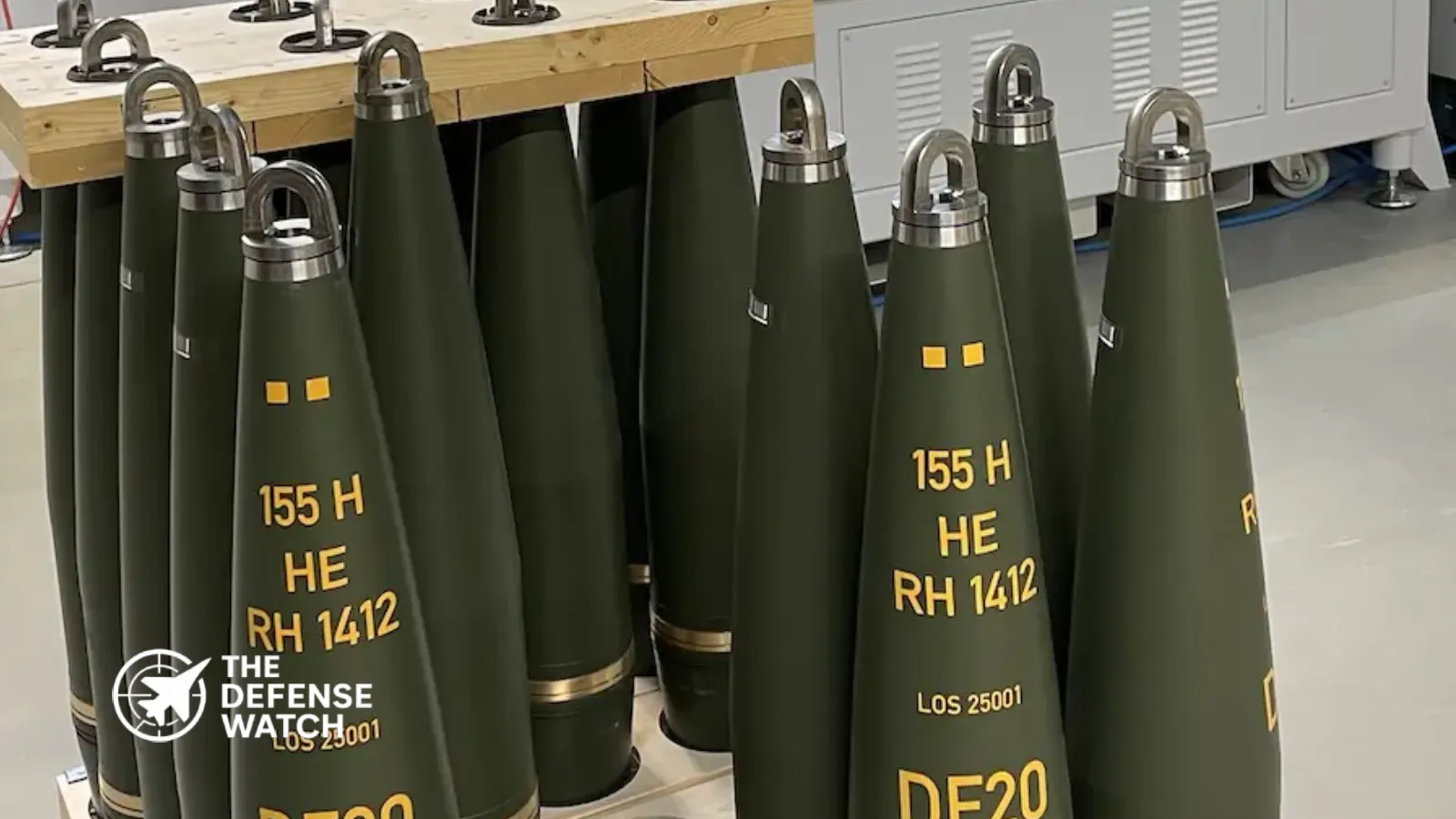
Rheinmetall has shipped the first batch of 155mm artillery ammunition produced at its new Werk Niedersachsen facility in Unterlüß, Lower Saxony, to Ukrainian forces. The delivery, consisting of a low five-figure number of RH1412 (or equivalent ER02A1 BB) projectiles and associated propellant charges, forms part of a larger order funded through European support mechanisms. More than half of the order has already been delivered from the company’s broader network, with remaining shipments expected by the end of 2026.
Rheinmetall Expands Direct Production Role in Supporting Ukraine
Rheinmetall’s delivery of 155mm ammunition directly from its Unterlüß site represents a significant milestone in the company’s integration into the sustained supply chain for Ukrainian artillery operations.
- Rheinmetall Expands Direct Production Role in Supporting Ukraine
- Technical and Operational Details of the Delivery
- Werk Niedersachsen: Scaling European Ammunition Manufacturing
- Strategic Context in the Russia-Ukraine Conflict
- Analysis: Implications for U.S. and Allied Defense Strategy
- Broader Rheinmetall Contributions and Future Outlook
The Düsseldorf-based defense contractor announced that the initial consignment from the Lower Saxony plant includes advanced RH1412 rounds, compatible with a wide array of NATO-standard 155mm systems such as the M777, CAESAR, and PzH 2000 howitzers. These projectiles are noted for their extended range and high effectiveness against fortified positions.
Technical and Operational Details of the Delivery
The projectiles in question are part of Rheinmetall’s latest artillery portfolio, offering improved ballistic performance through base-bleed or similar technologies that reduce drag and extend reach. Propellant charges, produced at other company facilities including Nitrochemie sites, complete the modular ammunition packages.
According to company statements, the order encompasses a low five-figure quantity of complete rounds. Production for this contract has drawn from multiple sites, but the Unterlüß contribution marks the operational debut of the new facility in the Ukraine support effort. Deliveries of the full order are slated for completion by the end of 2026.
Werk Niedersachsen: Scaling European Ammunition Manufacturing
The Unterlüß facility, officially known as Werk Niedersachsen, opened in 2025 following a rapid construction timeline supported by German government priorities. The plant is designed to ramp up to an annual capacity of up to 350,000 155mm artillery shells by 2027, positioning it as one of Europe’s largest dedicated munitions production sites.
Key Production Milestones at Werk Niedersachsen:
- Initial Output (2025): First 25,000 rounds targeted before year-end.
- 2026 Ramp-Up: Approximately 140,000 rounds scheduled.
- Full Capacity (2027): Up to 350,000 shells per year, plus explosives and rocket components.
This expansion is part of Rheinmetall’s broader strategy to address surging demand for 155mm ammunition, driven by high-intensity conflict requirements. The company aims for group-wide production of around 1.5 million 155mm projectiles annually by 2030.
Strategic Context in the Russia-Ukraine Conflict
Artillery remains the dominant consumable in the ongoing conflict, with both sides expending thousands of rounds daily. Ukraine’s Western partners have prioritized 155mm standardization to simplify logistics across donated systems from multiple nations.
Rheinmetall’s increased output directly supports this by diversifying and expanding the European supply base beyond traditional U.S. production. The company has previously delivered hundreds of thousands of rounds through various contracts, often funded by Germany or third-party NATO members.
Rheinmetall Group 155mm Production Goals (Approximate):
| Year/Target | Annual Capacity | Notes |
|---|---|---|
| Pre-2022 | ~100,000 | Baseline before major expansion |
| 2026-2027 | 700,000+ | Multiple sites including Spain and Germany |
| 2030 | 1.5 million | Group-wide objective |
Analysis: Implications for U.S. and Allied Defense Strategy
This development underscores the maturation of European defense industrial resilience. For the United States, which has shouldered a significant portion of Ukraine aid including vast quantities of 155mm ammunition, Rheinmetall’s ramp-up offers a complementary production source that eases pressure on American stockpiles and arsenals.
Operationally, consistent supply of quality 155mm rounds enhances Ukrainian counter-battery fire and deep strikes, critical for maintaining defensive lines and preparing potential offensive operations. Technically, the integration of new facilities like Unterlüß addresses previous bottlenecks in propellant and projectile manufacturing, though challenges remain in scaling explosives production and workforce training to full capacity without quality compromises.
From a geopolitical perspective, Germany’s investment in domestic munitions capacity signals a shift toward greater European strategic autonomy in conventional deterrence. This aligns with NATO’s broader emphasis on replenishing stockpiles depleted by Ukraine support while preparing for potential high-intensity scenarios elsewhere, such as the Indo-Pacific or Baltic regions.
The Unterlüß deliveries also highlight the importance of public-private partnerships and rapid permitting processes in wartime industrial mobilization—lessons applicable to U.S. efforts under initiatives like the Defense Production Act.
Broader Rheinmetall Contributions and Future Outlook
Beyond this specific order, Rheinmetall maintains multiple production lines across Europe, including its Spanish subsidiary Expal, which has contributed significantly to Ukraine-bound ammunition. The company continues to invest in automation, new explosive formulations, and modular charge systems to improve lethality and logistical efficiency.
As demand persists, further contracts and capacity expansions are anticipated, potentially including licensed production within Ukraine itself in the longer term.