• Home
  • About
  • Defense Systems
  • Manufacturer
  • Comparisons
  • Compare 
  • Tools
TheDefenseWatch.com
  • Aerospace & Aviation
  • Military & Ordnance
  • Naval & Maritime
  • Cyber & Space Defense
  • Policy & Strategy
  • Global News
  • Tools Library
    • Smart Calculator
    • Drone Flight Time Calculator
    • Drone Range Calculator
    • Counter-Drone Jammer Effective Range Calculator
    • Counter-Battery Radar Detection Calculator
    • Artillery Fire Correction Calculator
    • Thermal Camera Detection Range Calculator
    • Missile Range & Time-of-Flight Calculator
    • Radar Detection Range Calculator
    • FPV Strike Drone Payload vs Range Calculator
    • Loitering Munition Endurance Calculator
    • Sniper Ballistic Drop & Windage Calculator
    • Bullet Drop Calculator
    • U.S. Army Combat Fitness Test (ACFT) Calculator
    • Military Pension Calculator
    • Military Retirement Calculator
    • Military Pension Calculator
    • Large Number Calculator
Font ResizerAa

TheDefenseWatch.com

The Defense Watch | U.S. & Global Defense News, Analysis & Military Updates

Search
  • Home
  • About
  • Defense Systems
  • Manufacturer
  • Comparisons
  • Compare 
  • Tools

Stay Updated

Get the latest update

Subscribe

Explore

  • Drone
  • Fighter Jets & Military Aircraft
  • Hypersonic Weapons
  • Aircraft Carriers
  • Strategic History & Missions
  • Tools Library
Home » US Military Weighs MOAB for Potential Future Strikes on Iran, CNN Reports
Global News

US Military Weighs MOAB for Potential Future Strikes on Iran, CNN Reports

Samuel Drake | Defense Analyst
Last updated: October 15, 2026 5:07 am
Samuel Drake | Defense Analyst
Share
7 Min Read
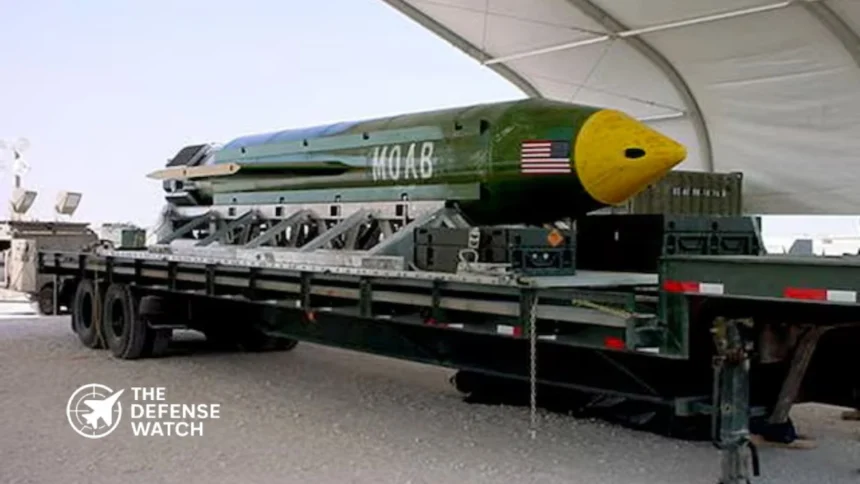
US MOAB bomb Iran strikes
The GBU-43/B Massive Ordnance Air Blast (MOAB) bomb is pictured in this undated handout photo
SHARE

The U.S. military has developed strike plans that could include the GBU-43/B Massive Ordnance Air Blast bomb, commonly known as the MOAB or Mother of All Bombs, against Iranian energy infrastructure and nuclear sites if President Donald Trump orders renewed combat operations, CNN reported on October 14.

Contents
  • What the reported strike plans involve
  • The MOAB’s intended role and limitations
  • Why the GBU-57 matters in the comparison
  • What a renewed strike campaign could mean
  • The unanswered questions

The following day that it could not independently verify CNN’s account. The Pentagon did not publicly confirm the reported plans in the available reporting, leaving the weapon’s potential role, target selection and operational timeline uncertain.

The reported planning points to a possible escalation in the U.S. campaign against Iran. However, the MOAB’s large explosive effect does not automatically make it suitable for every target associated with Iran’s nuclear program, particularly facilities protected by substantial layers of rock or reinforced underground construction.

What the reported strike plans involve

CNN cited multiple U.S. officials familiar with military planning discussions in reporting that the Pentagon had developed options involving the MOAB. The reported target categories include Iranian energy infrastructure and nuclear sites, with any operation dependent on a presidential decision to resume combat operations.

- Advertisement -

The report does not establish that an attack has been ordered, that the bomb has been deployed for an Iran mission, or that specific targets have been approved.

A Pentagon official, responding to CNN’s request for comment, referred to the department’s responsibility to plan for a range of operational scenarios and execute presidential and senior-level direction. That statement did not independently confirm the reported MOAB plans.

The distinction matters. Military planning routinely develops options that may never be used. A weapon appearing in a contingency plan does not establish that political leaders have selected it or that commanders consider it the best available choice.

The MOAB’s intended role and limitations

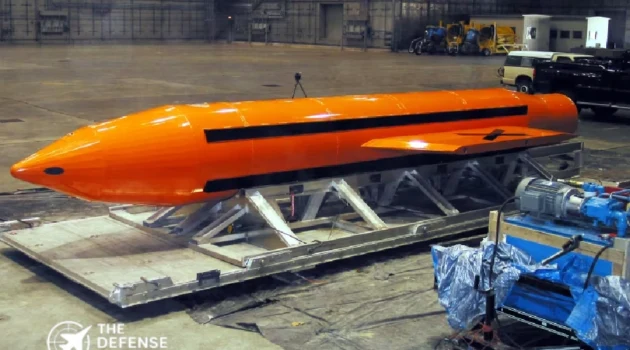
The GBU-43/B is a GPS-guided, air-delivered conventional munition weighing approximately 21,600 pounds. It produces a large blast and pressure effect over an area, making it different from weapons designed primarily to penetrate deeply buried structures.

  • GBU-43/B MOAB Bomb

    GBU-43/B MOAB Bomb

    • Warhead Type: Conventional high explosive
    • Delivery Platforms: Compatible MC-130 aircraft with specialized airdrop equipment
    • Guidance: GPS and inertial navigation system
    • Operational Role: Large-area blast effects against exposed targets and accessible cave or tunnel complexes
    • View Details →
    8.0

    The U.S. Air Force describes the MOAB as a weapon developed for large-area effects against personnel and obstacles. Its first combat use came on April 13, 2017, when U.S. forces dropped one against an Islamic State tunnel complex in Afghanistan’s Nangarhar province.

    That history provides a useful reference, but it does not demonstrate that the bomb would achieve the same results against Iran’s nuclear infrastructure. The geology, depth, reinforcement and layout of each facility would affect the outcome.

    A large surface blast can damage exposed infrastructure, entrances, access routes and nearby equipment. It does not necessarily destroy machinery or facilities located deep inside reinforced underground complexes.

    Why the GBU-57 matters in the comparison

    The distinction between the MOAB and the GBU-57 Massive Ordnance Penetrator is central to understanding the reported plans.

    The GBU-57 is specifically designed to attack hardened and deeply buried targets. The U.S. Air Force has described it as a precision-guided penetrator developed to reach facilities protected by substantial underground structures. The weapon is associated with the B-2 Spirit’s ability to deliver specialized conventional munitions against difficult targets.

    The two weapons therefore serve different purposes:

    • GBU-43/B MOAB: Emphasizes a large blast effect against area targets, obstacles and certain tunnel or cave complexes.
    • GBU-57 Massive Ordnance Penetrator: Designed to penetrate hardened structures and attack deeply buried facilities.

    This is not a simple comparison of explosive size. Target construction and depth, access to the target, delivery requirements and the intended military effect all influence weapon selection.

    The publicly available reporting does not establish which Iranian facilities, if any, would be assigned to the MOAB rather than other weapons. It also does not demonstrate that the MOAB could destroy a particular Iranian nuclear installation.

    What a renewed strike campaign could mean

    The reported plans emerge amid continuing U.S.-Iran tensions and uncertainty over whether Washington will resume combat operations. The inclusion of energy infrastructure alongside nuclear sites suggests that the reported planning covers more than one target category, although the available reporting does not disclose the intended sequence or objectives of any potential operation.

    Strikes against energy infrastructure could have consequences beyond the immediate military effects. Damage to power generation, fuel processing or other critical facilities could disrupt civilian services and economic activity. The actual consequences would depend on which facilities were targeted, the extent of damage and the availability of alternative supplies.

    Attacks on nuclear facilities raise a separate set of questions. Physical damage to a building does not necessarily establish that a nuclear program has been permanently disabled. Assessing the outcome would require reliable evidence about damage to equipment, underground structures and the facilities’ remaining operational capacity.

    There is also a distinction between destroying a target and achieving a strategic objective. Even successful attacks on selected facilities would not, by themselves, establish whether Iran’s nuclear activities had been permanently halted or whether renewed military action would change Tehran’s political decisions.

    The unanswered questions

    Several important details remain unavailable in the public record.

    First, neither the reported target list nor the operational plan has been independently established. Second, the reporting does not identify a confirmed launch date or establish that a presidential authorization has been issued. Third, no public evidence cited in the reports demonstrates that the MOAB has been selected as the preferred weapon for a specific Iranian nuclear facility.

    These uncertainties limit what can be concluded about the likely military impact.

    The Pentagon’s general statement about planning for different operational scenarios should not be treated as confirmation of a decision to use the weapon. Reuters explicitly said it could not independently verify CNN’s report.

    For now, the reported MOAB option is best understood as a possible element of contingency planning rather than evidence of an imminent strike. Its relevance will depend on whether U.S. leaders authorize renewed operations, which targets are selected and whether the weapon is considered suitable for the intended effects.
TAGGED:airstrikesIranMOABNuclear FacilitiesU.S. military
Share This Article
Facebook Copy Link Print
BySamuel Drake | Defense Analyst
Follow:
Samuel Drake is a defense analyst at TheDefenseWatch.com covering naval warfare, military ordnance, maritime technology, fleet modernization, and defense procurement. His reporting focuses on documented capabilities, procurement programs, and military technology.

Latest Defense Systems

  • GBU-43/B MOAB Bomb GBU-43/B MOAB Bomb
  • John F. Kennedy Aircraft Carrier John F. Kennedy Aircraft Carrier
  • Voyager Tanker Voyager Tanker
  • YU-20 Tanker YU-20 Tanker
  • China KJ-500 Aircraft China KJ-500 Aircraft
  • SPY-6 Radar SPY-6 Radar
  • Boeing VC-25B Presidential Aircraft Boeing VC-25B Presidential Aircraft
  • SM-3 Block IB Missile SM-3 Block IB Missile
  • USS Abraham Lincoln Aircraft Carrier USS Abraham Lincoln Aircraft Carrier

Recent Compares

  • Tejas vs Gripen: Key Differences and Capabilities Tejas vs Gripen: Key Differences and Capabilities View Comparison →
  • Tejas vs MiG-21 Bison: How India Replaced Its Iconic Supersonic Fighter Tejas vs MiG-21 Bison: How India Replaced Its Iconic Supersonic Fighter View Comparison →
  • F-35 vs F-16: Stealth, Sensors and Combat Roles F-35 vs F-16: Stealth, Sensors and Combat Roles View Comparison →
  • Tejas Fighter Jet vs F-16 Fighting Falcon: Capability Compared Tejas Fighter Jet vs F-16 Fighting Falcon: Capability Compared View Comparison →
  • Rafale Fighter Jet vs F-16 Fighting Falcon : Which Fighter Has the Edge? Rafale Fighter Jet vs F-16 Fighting Falcon : Which Fighter Has the Edge? View Comparison →
  • Su-57 Fighter Jet vs J-20 Fighter Jet: Stealth and Air Combat Compared Su-57 Fighter Jet vs J-20 Fighter Jet: Stealth and Air Combat Compared View Comparison →
  • Mirage 2000 vs Tejas Mk1A: Legacy Combat Power vs Indigenous Modernization Mirage 2000 vs Tejas Mk1A: Legacy Combat Power vs Indigenous Modernization View Comparison →
  • Rafale Fighter Jet vs F-22 Raptor: Which Air Dominance Fighter Has the Edge? Rafale Fighter Jet vs F-22 Raptor: Which Air Dominance Fighter Has the Edge? View Comparison →
  • Tejas Fighter Jet vs. Rafale Fighter Jet: India’s Indigenous Fighter Meets France’s Proven Multirole Combat Aircraft Tejas Fighter Jet vs. Rafale Fighter Jet: India’s Indigenous Fighter Meets France’s Proven Multirole Combat Aircraft View Comparison →
  • F-22 Raptor vs. F-35 Joint Strike Fighter: Which Fifth Generation Fighter Has the Edge? F-22 Raptor vs. F-35 Joint Strike Fighter: Which Fifth Generation Fighter Has the Edge? View Comparison →

Recent Posts

  • US Military Weighs MOAB for Potential Future Strikes on Iran, CNN Reports
  • Saab Wins $120 Million Order for New Gripen Flight Control Computer
  • L3Harris Delivers First VAMPIRE Counter-Drone Systems to U.S. Army
  • Lockheed Martin Invests $300 Million in Texas Munitions Expansion, Plans 6,000 U.S. Jobs
  • Lockheed Martin Taps Avio for ER GMLRS and PrSM Rocket Motor Production

You Might Also Like

UK Nightfall missile plan
Global News

Russia Rejects UK Nightfall Missile Plan for Ukraine, Warns Western Troops Are Targets

January 16, 2026
LGM-30G Minuteman III
Global News

U.S. to Launch LGM-30G Minuteman III Ballistic Missile in Scheduled Strategic Readiness Test

September 8, 2026
SM-6 missile production expansion
Global News

Raytheon Wins $29.2M SM-6 Contract Modification to Boost Missile Production Capacity

January 6, 2026
Iran US bases warning
Global News

Iran Warns Neighbors It Could Strike US Bases if Washington Intervenes in Protests

January 14, 2026

Logo

Copyright © 2026 TheDefenseWatch.com

Helpful Links

  • Home
  • About Us
  • Privacy Policy
  • Terms of Use / Disclaimer
  • U.S. Privacy Notice – CCPA Compliance

Defense Systems

  • Defense Systems
  • Comparisons 
  • Manufacturer
  • Tactical Calculators

Popuplar

Which 5 Air Forces Possess the Costliest Fighter Jet Fleets in the World
Evolving Strategic Value: Carrier Strike Groups in the Indo-Pacific’s Future Security Architecture
Autonomous Weapon Systems Spark U.S. Ethics Debate Amid Rapid Military AI Integration

We report on developments involving military forces, governments, defense companies, research organizations, and security institutions around the world. 

Welcome Back!

Sign in to your account

Username or Email Address
Password

Lost your password?