
- Home
- Defense Systems
- Bombers & Strategic Aircraft
- Voyager Tanker
Voyager Tanker
Defense Systems Full Specifications
1. General Information
| Name | Typically 2 flight crew, plus mission crew as required |
| Manufacturer | Airbus |
| Country of Origin | European multinational program |
| Introduction / In Service Since | RAF service began in 2012 |
| Status | Active |
| Category | Aerial refueling tanker and transport |
| Crew | 2 flight crew, additional mission crew as required |
| Unit Cost | Not publicly established as a single standard price |
2. Dimensions & Structure
| Length | 58.8 m (193 ft) |
| Wingspan | 60.3 m (198 ft) |
| Height | 17.4 m (57 ft) |
| Wing Area | 362 m² |
| Empty Weight | Exact RAF Voyager figure not confirmed here |
| Maximum Takeoff Weight (MTOW) | 233,000 kg |
3. Performance
| Maximum Speed | Mach 0.86 |
| Range | Up to 8,700 nautical miles, ferry configuration |
| Combat Radius | Not applicable as a standard published fighter-style rating |
| Service Ceiling | Approximately 41,500 ft |
| Rate of Climb | No verified standard figure available |
4. Powerplant
| Engine Type | Two turbofan engines |
| Thrust (per engine) | Approximately 71,000 to 72,000 lbf, depending on engine variant |
| Total Thrust | Approximately 142,000 to 144,000 lbf |
5. Payload & Armament
| Internal Payload Capacity | Up to 45,000 kg, family maximum payload |
| Weapons Bay | None |
| Compatible Weapons | No standard offensive weapons |
| Hardpoints | No conventional weapons hardpoints |
6. Avionics & Systems
| Radar System | Civil-derived weather radar and mission-specific systems |
| Navigation | Integrated flight management and navigation systems |
| Electronic Warfare (EW) | No publicly confirmed standard offensive EW suite |
| Stealth Features | None, conventional non-stealth airframe |
7. Operational History
| Primary Operator | Royal Air Force |
| Conflict Usage | Supports military deployments and air operations |
| Notable Missions | Long-range air refueling, personnel transport, strategic logistics, and medical evacuation support |
8. Additional Information
| Variants | RAF Voyager KC2 and KC3; wider family includes other A330 MRTT configurations |
| Successor / Future Replacement | No confirmed direct replacement identified here |
| Notable Features | Hose-and-drogue refueling, strategic transport, medical evacuation capability |
| Estimated Operational Life | No single verified retirement date established here |
PROS
- Long operational range: Supports long-distance deployments and overseas air operations.
- Large fuel capacity: Carries up to 111,000 kg of fuel in the A330 MRTT configuration.
- Multirole capability: Performs aerial refueling, passenger transport, cargo missions, and medical evacuation.
- Interoperability: Can refuel compatible allied aircraft using its hose-and-drogue system.
- Large transport capacity: The A330 MRTT family can carry up to 300 passengers, depending on configuration.
CONS
- Large operating footprint: Requires suitable runways and airport infrastructure.
- High operating costs: Fuel consumption and maintenance requirements are significant for a wide-body aircraft.
- Limited self-defense: The standard Voyager configuration lacks fighter-style weapons and defensive armament.
- Vulnerable in contested airspace: Requires protection when operating near advanced enemy air defenses.
- Specialized refueling compatibility: Receiver aircraft must support the available refueling interface.
Airbus A330 MRTT Voyager Tanker: Specifications and Capabilities
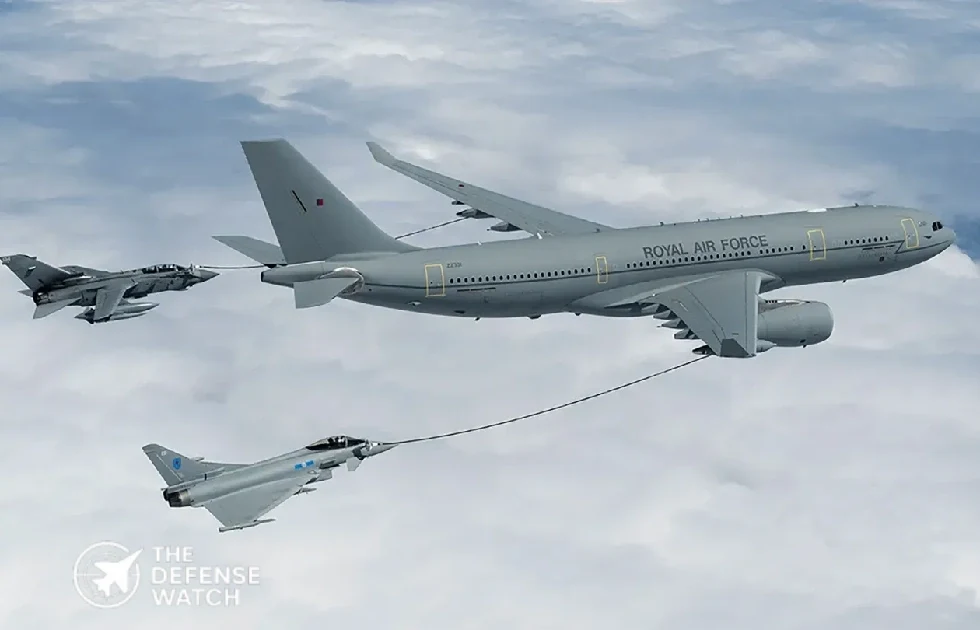
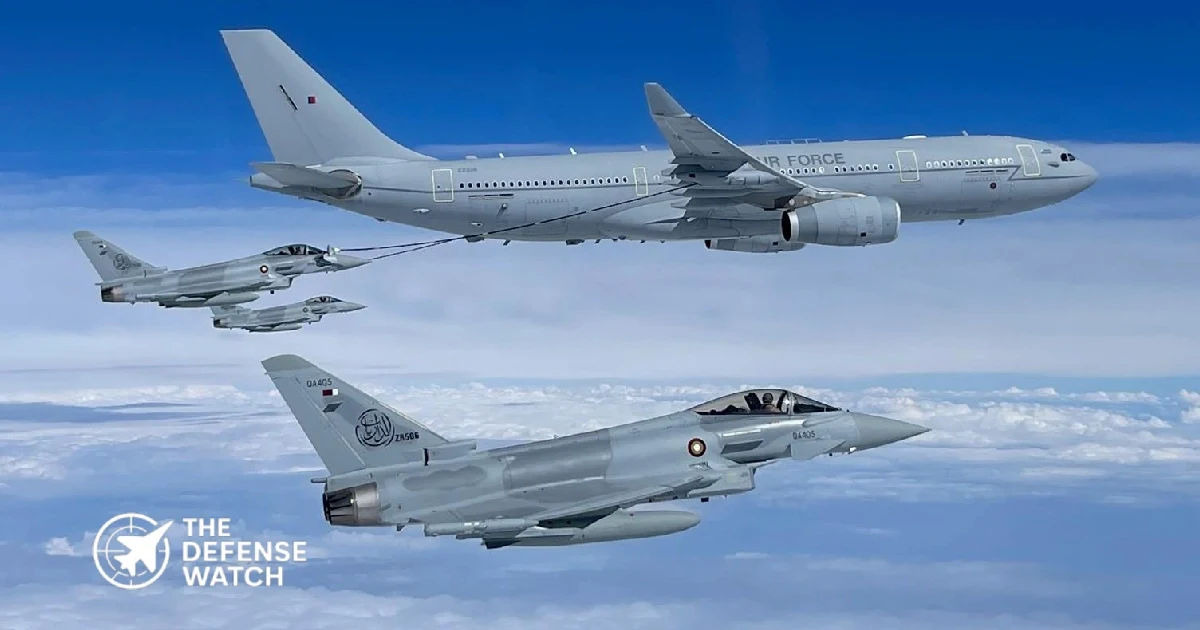
The Voyager tanker is the Royal Air Force’s (RAF) version of the Airbus A330 Multi Role Tanker Transport (MRTT), a multirole aircraft designed to refuel military aircraft in flight and transport personnel and cargo. Based on the commercial Airbus A330-200 airliner, the Voyager supports long-range air operations by extending the endurance of combat aircraft, transport planes, and other compatible receivers.
The aircraft can operate as an aerial refueling tanker or a transport platform, carrying passengers and freight on strategic missions. Unlike dedicated combat aircraft, the Voyager has no standard offensive armament. Its main military value comes from supporting air mobility, deployment, and sustained air operations.
Manufacturer
The Voyager is manufactured by Airbus, a European aerospace company headquartered in the Netherlands, with major operations across Europe. The RAF’s Voyager fleet was acquired through the UK Future Strategic Tanker Aircraft program and is operated by AirTanker Services. The aircraft entered RAF service in 2012.
Its refueling equipment includes a hose-and-drogue system, allowing compatible aircraft to receive fuel during flight. The wider A330 MRTT family also offers a boom-equipped configuration, but the RAF Voyager fleet uses hose-and-drogue refueling.
Speed and Range
The Voyager has a maximum operating speed of approximately Mach 0.86, depending on altitude and operating conditions. Its ferry range is generally cited at around 8,000 nautical miles, although actual range varies with fuel load, payload, and mission profile.
As a tanker, the aircraft can transfer fuel to receiver aircraft while carrying its own fuel reserves. Its long endurance and transport capacity make it useful for overseas deployments, air policing support, and long-distance military logistics.
Cost/Price
The Voyager does not have a single publicly applicable unit price because the UK program includes aircraft acquisition, conversion, availability, maintenance, and support arrangements. The cost of a new A330 MRTT also varies by configuration and contract. Any quoted price should therefore be treated as an estimate unless tied to a specific procurement agreement.
Disclaimer Note
The information provided on TheDefenseWatch.com is for general informational purposes only. While we strive to ensure the accuracy, completeness, and timeliness of our content regarding defense and aerospace products, technologies, and specifications, we cannot guarantee that all information is 100% accurate or up-to-date due to the evolving nature of military technology and classified data.TheDefenseWatch.com does not warrant the reliability, suitability, or availability of the information for any specific purpose. Users are advised to consult official sources, such as manufacturers, government publications, or defense agencies, for precise and verified data before making decisions based on our content.We are not affiliated with any defense manufacturers, governments, or military organizations mentioned. Opinions, reviews, and ratings reflect expert analysis but are subjective and should not be considered endorsements. TheDefenseWatch.com is not responsible for any errors, omissions, or consequences arising from the use of this website’s content.External links are provided for convenience and do not imply endorsement. TheDefenseWatch.com reserves the right to update or modify content without prior notice. By using this website, you agree to our Privacy & Cookies Policy.
More Defense Systems from General Dynamics European Land Systems
New Arrivals











Popular Comparisons
-
 Tejas vs Gripen: Key Differences and Capabilities
View Comparison →
Tejas vs Gripen: Key Differences and Capabilities
View Comparison → -
Tejas vs MiG-21 Bison: How India Replaced Its Iconic Supersonic Fighter
View Comparison →
-
F-35 vs F-16: Stealth, Sensors and Combat Roles
View Comparison →
-
Tejas Fighter Jet vs F-16 Fighting Falcon: Capability Compared
View Comparison →
-
Rafale Fighter Jet vs F-16 Fighting Falcon : Which Fighter Has the Edge?
View Comparison →
-
Su-57 Fighter Jet vs J-20 Fighter Jet: Stealth and Air Combat Compared
View Comparison →
-
Mirage 2000 vs Tejas Mk1A: Legacy Combat Power vs Indigenous Modernization
View Comparison →
-
Rafale Fighter Jet vs F-22 Raptor: Which Air Dominance Fighter Has the Edge?
View Comparison →
-
Tejas Fighter Jet vs. Rafale Fighter Jet: India’s Indigenous Fighter Meets France’s Proven Multirole Combat Aircraft
View Comparison →
-
F-22 Raptor vs. F-35 Joint Strike Fighter: Which Fifth Generation Fighter Has the Edge?
View Comparison →


- RAF Voyager Completes 14 Missions During Saudi Arabia Deployment

- L3Harris Wins $250 Million GMLRS Rocket Motor Contract
- L3Harris Wins $55 Million U.S. Army Contract for NOVA Night-Vision Goggles
- Lockheed Martin Outlines Layered Air Defense Plans, Debuts PAC-3 Edge
- China-Egypt Air Drills Highlight J-16, KJ-500 Teaming Against Rafale Fighters
- China’s Airshow China 2026 to Feature New PLA Aircraft and Naval Equipment
- Raytheon Tests Faster Coyote Interceptor With New Rocket Motor
- Raytheon to Develop Software Upgrades for U.S. Navy Radar Detection
- Kim Jong Un Opens North Korea Weapons Museum as Pyongyang Claims Missile Test Success
- Pentagon Certifies Bath Iron Works for Second Arleigh Burke Destroyer


Fighter Jets
-
 MIG-31 Fighter Jet
-
J-10CE Fighter Jet
-
Chengdu J-10 Fighter Jet
-
Chengdu J-10C Fighter Jet
-
Gripen E Fighter Jet
-
Tejas Mk1A Fighter Jet
-
Tejas Mk‑2 Fighter Jet
-
F-16V Viper Block 70 Fighter Jet
-
F-15EX Eagle II Fighter
-
Boeing F/A-XX Fighter
-
F-15E Strike Eagle Fighter
-
F/A-18E/F Super Hornet Fighter Jet
-
Saab Gripen F Fighter Jet
-
JAS 39E/F Gripen Fighter Jet
-
JAS 39 Gripen Fighter Jet
-
F-35A Lightning II Fighter Jet
-
F/A-18F Super Hornet
-
J-50 Fighter Jet
-
Spanish EF-18 Hornet Fighter
-
F-47 Fighter Jet
-
F-35i Adir Fighter Jet
-
F-16 Fighting Falcon
-
AIDC T-5 Brave Eagle
-
F-CK-1 Ching-Kuo Fighter








Recent Compares
-
Tejas vs Gripen: Key Differences and Capabilities
View Comparison →
-
Tejas vs MiG-21 Bison: How India Replaced Its Iconic Supersonic Fighter
View Comparison →
-
F-35 vs F-16: Stealth, Sensors and Combat Roles
View Comparison →
-
Tejas Fighter Jet vs F-16 Fighting Falcon: Capability Compared
View Comparison →
-
Rafale Fighter Jet vs F-16 Fighting Falcon : Which Fighter Has the Edge?
View Comparison →
Latest Defense Systems
10 Compares Defense Systems
-
Tejas vs Gripen: Key Differences and Capabilities
View Comparison →
-
Tejas vs MiG-21 Bison: How India Replaced Its Iconic Supersonic Fighter
View Comparison →
-
F-35 vs F-16: Stealth, Sensors and Combat Roles
View Comparison →
-
Tejas Fighter Jet vs F-16 Fighting Falcon: Capability Compared
View Comparison →
-
Rafale Fighter Jet vs F-16 Fighting Falcon : Which Fighter Has the Edge?
View Comparison →
-
Su-57 Fighter Jet vs J-20 Fighter Jet: Stealth and Air Combat Compared
View Comparison →
-
Mirage 2000 vs Tejas Mk1A: Legacy Combat Power vs Indigenous Modernization
View Comparison →
-
Rafale Fighter Jet vs F-22 Raptor: Which Air Dominance Fighter Has the Edge?
View Comparison →
-
Tejas Fighter Jet vs. Rafale Fighter Jet: India’s Indigenous Fighter Meets France’s Proven Multirole Combat Aircraft
View Comparison →
-
F-22 Raptor vs. F-35 Joint Strike Fighter: Which Fifth Generation Fighter Has the Edge?
View Comparison →
- RAF Voyager Completes 14 Missions During Saudi Arabia Deployment
- L3Harris Wins $250 Million GMLRS Rocket Motor Contract
- L3Harris Wins $55 Million U.S. Army Contract for NOVA Night-Vision Goggles
- Lockheed Martin Outlines Layered Air Defense Plans, Debuts PAC-3 Edge
- China-Egypt Air Drills Highlight J-16, KJ-500 Teaming Against Rafale Fighters