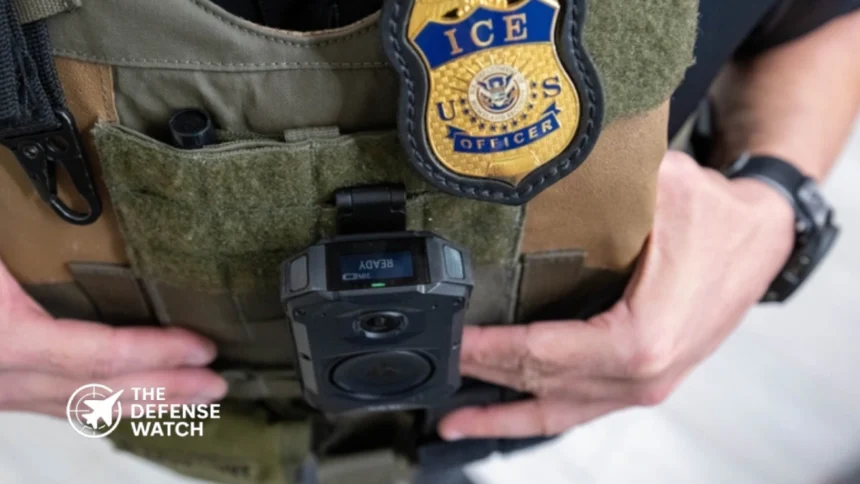
The U.S. Department of Homeland Security has rejected a recommendation to introduce automatic activation technology for body-worn cameras used by Immigration and Customs Enforcement (ICE), despite concerns from a congressional watchdog about inconsistent camera use and gaps in oversight.
The Government Accountability Office (GAO), an independent, nonpartisan agency that conducts oversight for Congress, published its findings on October 14, 2026. Its report recommended additional controls to ensure ICE officers record enforcement activities in accordance with agency policy. DHS accepted six of the report’s seven recommendations but rejected the proposal for automatic activation.
The decision leaves a key question unresolved: how can ICE ensure that officers record critical encounters consistently while protecting sensitive information and complying with privacy restrictions?
GAO identifies weaknesses in camera oversight
The GAO report, titled Federal Law Enforcement: CBP and ICE Should Improve Body-Worn Camera Program Management, examined camera deployment, program management and compliance with recording requirements at ICE and U.S. Customs and Border Protection (CBP).
Both agencies have established body-worn camera programs, but the watchdog found that their management plans had not kept pace with changes in deployment. CBP had not updated its original program plan since 2022, while ICE had not revised its plan since 2024.
The review also identified shortcomings in operational guidance. Most offices examined lacked specific instructions explaining when cameras should be used or when recording should be withheld under particular operational circumstances.
That gap matters because federal immigration officers conduct a range of activities, including arrests, searches, interviews, detention operations and investigations. Different assignments can involve different recording requirements, creating a need for clear instructions that officers and supervisors can apply consistently.
GAO also found that the agencies had not established results-oriented performance goals and measures to determine whether their camera programs were meeting objectives such as improving transparency, accountability and public trust.
The report recommended that ICE and CBP update their program plans, establish performance measures and develop more specific operational guidance. It also called for ICE to introduce additional controls to ensure officers activate cameras when required.
Why DHS rejected automatic activation
DHS argued that automatically activating cameras could create privacy and operational risks.
According to the department’s response described in the GAO report, automated systems could trigger recordings unintentionally during routine movements. They could also capture sensitive interactions with informants or victims, or record bystanders engaged in constitutionally protected activities in locations where camera use is restricted.
These concerns involve a genuine operational trade-off. Automatic activation can reduce dependence on an officer remembering to start a recording during a fast-moving incident. However, recording systems must also account for encounters in which filming could expose confidential information or interfere with legally protected activities.
The GAO’s recommendation was intended to improve compliance with existing ICE camera policy, rather than require unrestricted recording of every interaction. The watchdog maintained that additional controls would provide greater assurance that officers capture footage when policy requires it.
The disagreement is therefore not simply about whether cameras should be used. It concerns how agencies can reliably enforce recording requirements while retaining appropriate safeguards for sensitive encounters.
Camera deployment does not guarantee usable evidence
The scale of the programs shows why oversight is important.
According to GAO, CBP had deployed approximately 11,500 body-worn cameras as of June 2026, with nearly all issued to Border Patrol. ICE had deployed approximately 4,800 cameras as of April 2026, distributed almost evenly between Enforcement and Removal Operations and Homeland Security Investigations.
“`htmlFederal body-worn camera deployment
U.S. Customs and Border Protection
As of June 2026
Immigration and Customs Enforcement
As of April 2026
Figures are from different reporting dates and describe deployed cameras, not necessarily the number of officers recording every encounter.
The distinction between equipment availability and actual recording is important. A camera may be issued to an officer, but it does not automatically follow that the device is activated at the appropriate time, that the recording is stored correctly or that investigators can retrieve it when needed.
GAO noted that the agencies had some compliance measures, including supervisory controls and monthly reviews of footage to help ensure recordings were categorized properly. However, it concluded that further controls and clearer operational guidance were needed.
For investigators, footage can help establish the sequence of events during an arrest or use-of-force incident. It can also provide evidence for administrative reviews and help compare written reports with recorded interactions. These benefits depend on recordings being available, complete and handled under consistent procedures.
Automatic activation is an established technical option
Automatic activation does not require an entirely new category of camera. Body-worn camera systems can use external signals and sensors to begin recording when a defined event occurs.
The Department of Homeland Security’s own technology assessment material describes activation triggers such as an officer drawing a firearm, activating vehicle emergency lights or a siren, sudden vehicle movement, and proximity to another camera that has begun recording.
Such functions can reduce reliance on manual activation. They can also help preserve footage when an officer has limited time to operate equipment during a rapidly developing incident.
But automated triggers are not a complete solution. A camera activated by a weapon draw or vehicle siren may not capture an encounter that escalates without either event. Conversely, an automatic trigger could record an event that does not require recording under the applicable rules.
For that reason, activation technology works best as one part of a wider system involving written policies, officer training, supervisory review, secure storage and clear procedures for handling exceptions.
The available GAO findings do not establish that automatic activation alone would resolve the agencies’ compliance problems. Instead, they support a broader need for measurable program objectives and consistent implementation.
What happens after the rejection?
DHS’s rejection applies to the GAO recommendation for additional ICE controls such as automated activation. The department did not reject the other six recommendations in the report. GAO continues to identify the automatic activation recommendation as an outstanding issue.
A DHS spokesperson separately told Reuters that ICE had acquired body cameras for all officers and agents, while required training remained underway. That statement describes the department’s reported equipment procurement and training status, not independent confirmation that every officer was recording every qualifying encounter.
The next test will be whether ICE can demonstrate that its existing procedures reliably produce recordings when required. Clearer field instructions, meaningful compliance measurements and documented supervisory reviews could improve oversight even without automatic activation.
For Congress and external watchdogs, those measures would also make it easier to assess whether the camera program is achieving its stated goals. Without evidence about compliance and results, the number of cameras distributed offers only a limited picture of how effectively the system operates.
The dispute is ultimately about implementation and accountability. ICE has expanded camera availability, but the GAO report indicates that program management and consistent use remain separate challenges.