


















@2026 – All Right Reserved. TheDefenseWatch.com
- Home
- Defense Systems
- Missiles & Precision Weapons
- AGM-158C LRASM
AGM-158C LRASM
Defense Systems Full Specifications
1. General Information
| Name / Designation | AGM-158C LRASM |
| Type / Role | Long Range Anti-Ship Cruise Missile, Precision Maritime Strike |
| Country of Origin | United States |
| Manufacturer | Lockheed Martin |
| Service Entry / Year Introduced | 2018 |
| Operational Status | Active |
2. Performance & Range
| Range | >200 nmi (370 km) est.; up to ~500 nmi in extended variants |
| Speed | High-subsonic |
| Ceiling / Altitude Limit | Medium altitude cruise with low-altitude sea-skimming terminal |
| Accuracy (CEP) | High precision (meters class with terminal guidance) |
| Warhead Type | High Explosive blast-fragmentation penetrator |
3. Guidance & Targeting
| Guidance System | GPS/INS, IIR (EO), passive RF/ESM, AI target recognition |
| Targeting Mode | Semi-autonomous / Fire-and-forget with datalink updates |
| Launch Platform Compatibility | Fighter jets, bombers, potential surface/ship launch |
| Seeker Type | Multi-mode passive (IIR, RF) with automatic target matching |
4. Physical Characteristics
| Length | 14 ft (4.26 m) |
| Diameter | 25 in (635 mm) |
| Wingspan | 8 ft 10 in (2.7 m) |
| Launch Weight | ~2,760 lb (1,250 kg) |
| Propulsion | Williams F107-WR-105 turbofan |
5. Warhead & Payload
| Warhead Weight | 1,000 lb (453.6 kg) |
| Explosive Type | HE blast-fragmentation penetrator |
| Detonation Mechanism | FMU-156/B fuze (impact/proximity) |
| Payload Options | Conventional high-explosive |
6. Operational Use & Capabilities
| Operational Range Type | Long |
| Deployment Platform | Air (primary), surface |
| Target Types | Surface warships, high-value maritime assets |
| Combat Proven | Yes (limited operational use reported) |
| Users / Operators | United States (USAF, USN), Australia |
PROS
- Advanced autonomous targeting reduces reliance on external networks or GPS in contested areas.
- Stealth design and passive sensors improve survivability against advanced air defenses.
- Multi-mode guidance (GPS/INS, IIR, passive RF) enables precise target discrimination in ship groups.
- Heavy 1,000 lb penetrating warhead delivers significant lethality against capital ships.
- Long standoff range enhances platform safety and operational flexibility across services.
CONS
- High unit cost limits procurement quantities compared to legacy anti-ship missiles.
- Subsonic speed may increase vulnerability during certain phases if detected.
- Complex integration requirements for new aircraft platforms delay full fleet deployment.
- Dependence on advanced onboard processing could face challenges in extreme electronic warfare conditions.
- Larger size restricts internal carriage on some fighter aircraft without modifications.
AGM-158C LRASM: Long Range Anti-Ship Missile
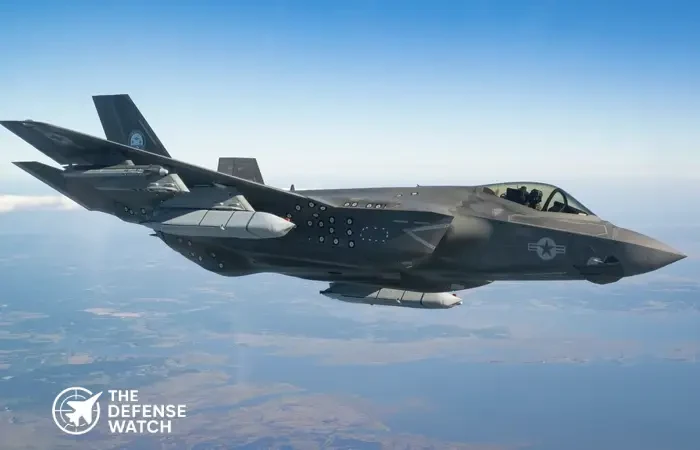
The AGM-158C LRASM (Long Range Anti-Ship Missile) represents a significant advancement in U.S. naval strike capabilities, designed to counter sophisticated integrated air defense systems and heavily defended surface fleets. Derived from the combat-proven AGM-158 JASSM-ER family, this stealthy cruise missile enables aircraft to engage high-value maritime targets from safe standoff distances in contested environments, such as those in the Indo-Pacific. It combines low-observability features with advanced autonomous navigation and targeting to penetrate defended airspace and deliver decisive effects against enemy warships.
Manufacturer
The LRASM was developed through a collaborative effort led by the Defense Advanced Research Projects Agency (DARPA) in partnership with the U.S. Navy and Air Force. Lockheed Martin serves as the primary manufacturer and integrator, building on its expertise with the JASSM program. Production supports both U.S. services and allies, including integration efforts for the Royal Australian Air Force.
Speed and Range
The AGM-158C achieves high-subsonic speeds, powered by a Williams F107-WR-105 turbofan engine. Its operational range is estimated at over 200 nautical miles (approximately 370 km), with some sources indicating capabilities approaching 500 nautical miles (926 km) in extended configurations, depending on mission profile and payload. This allows for sea-skimming terminal approaches that enhance survivability against shipboard defenses.
Cost/Price
The unit cost for the AGM-158C LRASM is approximately $3.24 million (FY24), reflecting advanced guidance, stealth, and sensor technologies. Multi-year procurement efforts aim to reduce per-unit costs through higher production volumes.
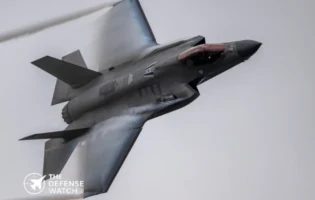
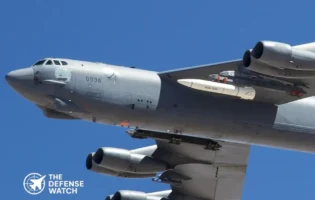
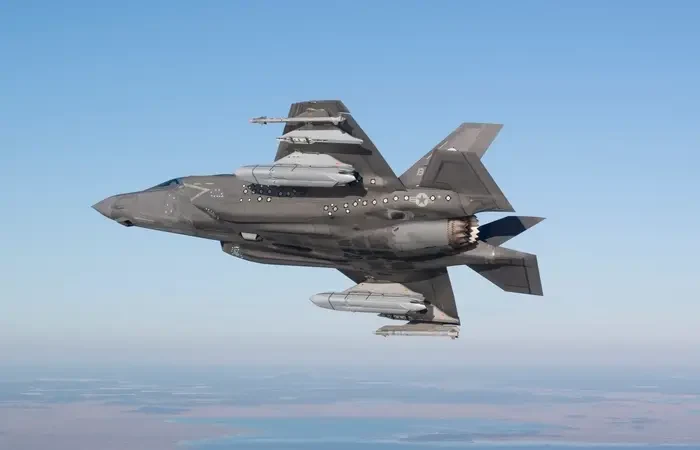
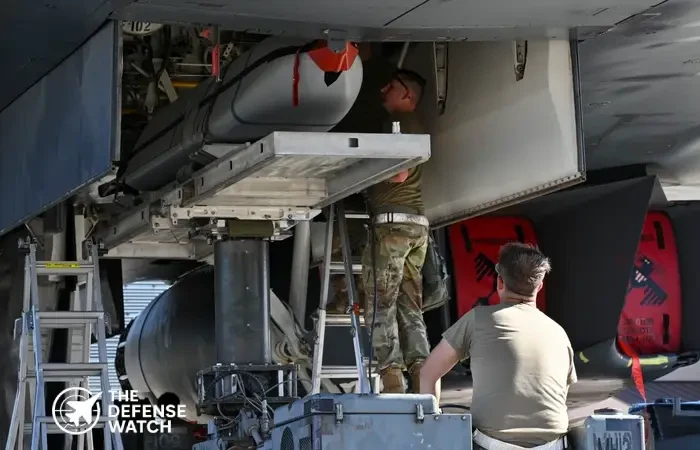
The missile features a low radar cross-section airframe for enhanced stealth, passive sensors to minimize emissions, and AI-assisted algorithms for target discrimination in cluttered maritime environments. It carries a 1,000 lb (453.6 kg) WDU-42/B high-explosive blast-fragmentation penetrator warhead, effective against large surface combatants. Launched primarily from platforms like the B-1B Lancer and F/A-18E/F Super Hornet, with ongoing integration for the F-35 and others, the LRASM provides flexible, precision maritime strike options. It supports both air-launched and surface-launched variants, with potential for broader platform compatibility.
Disclaimer Note
The information provided on TheDefenseWatch.com is for general informational purposes only. While we strive to ensure the accuracy, completeness, and timeliness of our content regarding defense and aerospace products, technologies, and specifications, we cannot guarantee that all information is 100% accurate or up-to-date due to the evolving nature of military technology and classified data.TheDefenseWatch.com does not warrant the reliability, suitability, or availability of the information for any specific purpose. Users are advised to consult official sources, such as manufacturers, government publications, or defense agencies, for precise and verified data before making decisions based on our content.We are not affiliated with any defense manufacturers, governments, or military organizations mentioned. Opinions, reviews, and ratings reflect expert analysis but are subjective and should not be considered endorsements. TheDefenseWatch.com is not responsible for any errors, omissions, or consequences arising from the use of this website’s content.External links are provided for convenience and do not imply endorsement. TheDefenseWatch.com reserves the right to update or modify content without prior notice. By using this website, you agree to our Privacy & Cookies Policy.
New Arrivals
Popular Comparisons
-
 Tejas vs Gripen: Key Differences and Capabilities
View Comparison →
Tejas vs Gripen: Key Differences and Capabilities
View Comparison → -
Tejas vs MiG-21 Bison: How India Replaced Its Iconic Supersonic Fighter
View Comparison →
-
F-35 vs F-16: Stealth, Sensors and Combat Roles
View Comparison →
-
Tejas Fighter Jet vs F-16 Fighting Falcon: Capability Compared
View Comparison →
-
Rafale Fighter Jet vs F-16 Fighting Falcon : Which Fighter Has the Edge?
View Comparison →
-
Su-57 Fighter Jet vs J-20 Fighter Jet: Stealth and Air Combat Compared
View Comparison →
-
Mirage 2000 vs Tejas Mk1A: Legacy Combat Power vs Indigenous Modernization
View Comparison →
-
Rafale Fighter Jet vs F-22 Raptor: Which Air Dominance Fighter Has the Edge?
View Comparison →
-
Tejas Fighter Jet vs. Rafale Fighter Jet: India’s Indigenous Fighter Meets France’s Proven Multirole Combat Aircraft
View Comparison →
-
F-22 Raptor vs. F-35 Joint Strike Fighter: Which Fifth Generation Fighter Has the Edge?
View Comparison →
- China Shows PLA Laser and Microwave Counter-Drone Weapons in Live-Fire Drill

- NASA’s SpaceX Crew-12 Nears Return After Extended ISS Science Mission
- F-15E Shot Down Over Iran: How the Dude 44 Crew Was Brought Home
- Operation Mount Hope III: How Two Night Stalker Chinooks Carried a Libyan Hind Out of Chad
- North Korea Fires Ballistic Missile From Wonsan Toward East Sea
- BAE Systems Wins $70.5 Million Trident II D5 Support Contract
- Saudi Arabia Weighs Yemen Offensive to Retake Bab el-Mandeb
- L3Harris Expands WESCAM Manufacturing Focus for Mission-Ready EO/IR Systems
- Northrop Grumman Unveils FORTITUDE RF Chip for Faster Defense Systems
- Northrop Grumman YFQ-48A Talon Blue Completes Autonomous Flight Test