














@2026 – All Right Reserved. TheDefenseWatch.com
- Home
- Defense Systems
- Bombers & Strategic Aircraft
- Avro Lancaster Heavy Bomber
Avro Lancaster Heavy Bomber
Defense Systems Full Specifications
1. General Information
| Name | Avro Lancaster |
| Manufacturer | A.V. Roe and Company |
| Country of Origin | United Kingdom |
| Introduction / In Service Since | 1941 |
| Status | Retired from military service |
| Category | Heavy bomber |
| Crew | 7 |
| Unit Cost | No reliable standardized figure |
2. Dimensions & Structure
| Length | 21.18 m |
| Wingspan | 31.09 m |
| Height | About 6.1 m |
| Wing Area | About 120.5 m² |
| Empty Weight | About 16,700 kg |
| Maximum Takeoff Weight (MTOW) | About 31,750 kg |
3. Performance
| Maximum Speed | 287 mph (462 km/h) |
| Range | Up to 2,530 miles (4,070 km), load dependent |
| Combat Radius | Not consistently published |
| Service Ceiling | About 24,500 ft (7,470 m) |
| Rate of Climb | Configuration dependent |
4. Powerplant
| Engine Type | 4 × Rolls-Royce Merlin V-12 piston engines |
| Thrust (per engine) | Not applicable, piston engine |
| Total Thrust | Not applicable |
5. Payload & Armament
| Internal Payload Capacity | Normally up to 14,000 lb |
| Weapons Bay | Large internal bomb bay |
| Compatible Weapons | Bombs, mines, Tallboy, Grand Slam, Upkeep |
| Hardpoints | No modern external hardpoint system |
6. Avionics & Systems
| Radar System | H2S radar on selected later aircraft |
| Navigation | Period-specific radio and navigation equipment |
| Electronic Warfare (EW) | Period defensive countermeasures |
| Stealth Features | None |
7. Operational History
| Primary Operator | Royal Air Force |
| Conflict Usage | World War II |
| Notable Missions | Dambusters raid, strategic bombing, Tirpitz attacks |
8. Additional Information
| Variants | Mk I, Mk II, Mk III, Mk VII, Mk X and others |
| Successor / Future Replacement | Avro Lincoln |
| Notable Features | Large bomb bay, four Merlin engines |
| Estimated Operational Life | 1941 through the postwar period, varying by operator and role |
PROS
- Large internal bomb bay
- Long range for its era
- Strong heavy bomber performance
- Flexible conventional weapon capacity
- Proven combat record
CONS
- No modern radar or electronic warfare suite
- Limited defensive protection by modern standards
- Relatively low speed
- Large and vulnerable airframe
- High crew requirements
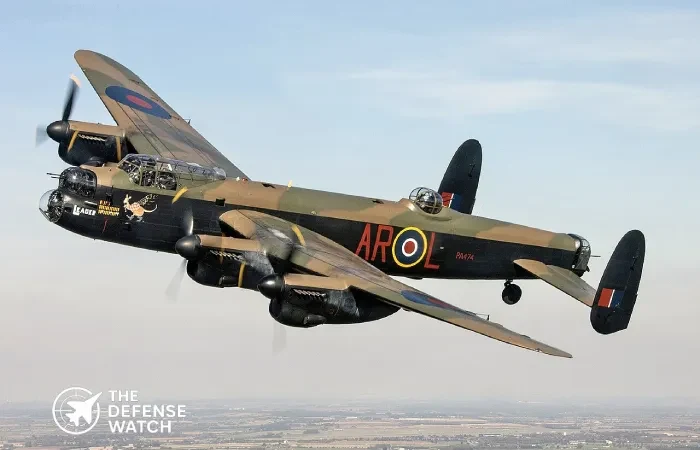
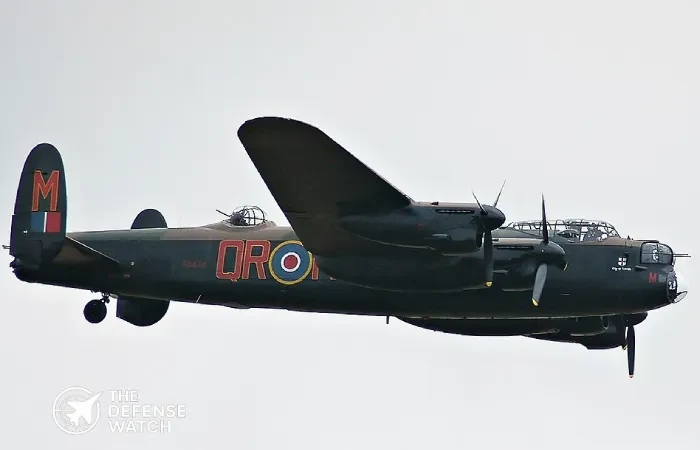
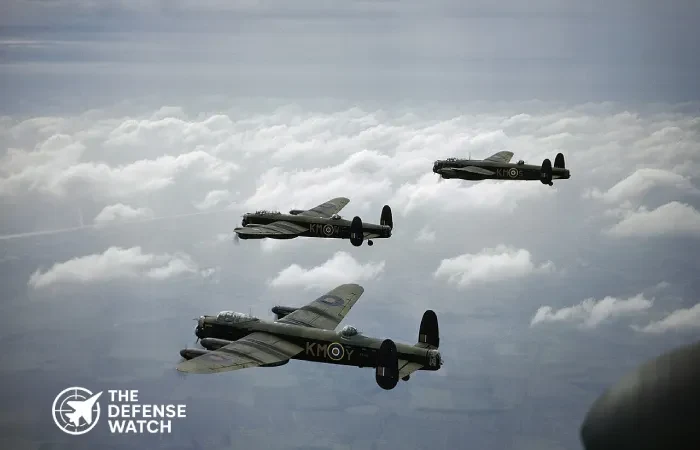
The Avro Lancaster was a four engine British heavy bomber developed for the Royal Air Force during World War II. Designed by Roy Chadwick and his team at A.V. Roe and Company, the Lancaster evolved from the unsuccessful twin engine Avro Manchester. Its first flight took place in January 1941, and it entered RAF service later that year.
The aircraft became the principal heavy bomber of RAF Bomber Command during the later years of the war. Its large, unobstructed bomb bay allowed it to carry substantial conventional weapons, including the 4,000 pound blockbuster and, in specially modified aircraft, the 12,000 pound Tallboy and 22,000 pound Grand Slam. The Lancaster also performed the famous 1943 Dambusters raid using the Barnes Wallis Upkeep weapon.
Manufacturer
The Lancaster was manufactured by A.V. Roe and Company, with production also undertaken by several other British and Canadian manufacturers. A total of 7,377 aircraft were produced.
Speed and Range
Typical Lancaster B.Mk I figures include a maximum speed of about 287 mph and a range of roughly 2,530 miles with a lighter bomb load. Range decreased significantly when carrying heavier weapons. Its service ceiling was approximately 24,500 feet.
Cost / Price
A reliable single unit price is difficult to establish because wartime production costs varied by manufacturer, configuration, and production period. The Lancaster is no longer produced, so there is no current procurement price.
Disclaimer Note
The information provided on TheDefenseWatch.com is for general informational purposes only. While we strive to ensure the accuracy, completeness, and timeliness of our content regarding defense and aerospace products, technologies, and specifications, we cannot guarantee that all information is 100% accurate or up-to-date due to the evolving nature of military technology and classified data.TheDefenseWatch.com does not warrant the reliability, suitability, or availability of the information for any specific purpose. Users are advised to consult official sources, such as manufacturers, government publications, or defense agencies, for precise and verified data before making decisions based on our content.We are not affiliated with any defense manufacturers, governments, or military organizations mentioned. Opinions, reviews, and ratings reflect expert analysis but are subjective and should not be considered endorsements. TheDefenseWatch.com is not responsible for any errors, omissions, or consequences arising from the use of this website’s content.External links are provided for convenience and do not imply endorsement. TheDefenseWatch.com reserves the right to update or modify content without prior notice. By using this website, you agree to our Privacy & Cookies Policy.
New Arrivals
-
 F-15EX Eagle II Fighter
-
UH-60M Black Hawk Helicopter
-
AN/SPY-6(V)1 Air and Missile Defense Radar
-
SR-71 Blackbird Aircraft
-
Boeing F/A-XX Fighter
-
F-15E Strike Eagle Fighter
-
F/A-18E/F Super Hornet Fighter Jet
-
Saab Gripen F Fighter Jet
-
JAS 39E/F Gripen Fighter Jet
-
JAS 39 Gripen Fighter Jet
-
F-35A Lightning II Fighter Jet
-
F/A-18F Super Hornet
Popular Comparisons
-
 F-35 vs F-16: Stealth, Sensors and Combat Roles
View Comparison →
F-35 vs F-16: Stealth, Sensors and Combat Roles
View Comparison → -
Tejas Fighter Jet vs F-16 Fighting Falcon: Capability Compared
View Comparison →
-
Rafale Fighter Jet vs F-16 Fighting Falcon : Which Fighter Has the Edge?
View Comparison →
-
Su-57 Fighter Jet vs J-20 Fighter Jet: Stealth and Air Combat Compared
View Comparison →
-
Mirage 2000 vs Tejas Mk1A: Legacy Combat Power vs Indigenous Modernization
View Comparison →
-
Rafale Fighter Jet vs F-22 Raptor: Which Air Dominance Fighter Has the Edge?
View Comparison →
-
Tejas Fighter Jet vs. Rafale Fighter Jet: India’s Indigenous Fighter Meets France’s Proven Multirole Combat Aircraft
View Comparison →
-
F-22 Raptor vs. F-35 Joint Strike Fighter: Which Fifth Generation Fighter Has the Edge?
View Comparison →
-
F-35A vs. F-22 Raptor: Which U.S. Stealth Fighter Dominates Modern Air Combat?
View Comparison →
-
AGM-114 Hellfire vs. AGM-179 JAGM: Which U.S. Precision Missile Is Better?
View Comparison →
- Finland Begins F-35 Fighter Transition as Arctic and NATO Roles Expand

- Nokia and ICEYE Develop Sovereign LEO Satellite Communications for Defense
- SpaceX Launches Crew-13 to International Space Station
- U.S. Army Selects Five Companies for PrSM Increment 4 Prototypes
- Boeing Wins $2.38 Billion Contract for 22 F-15EX Eagle II Fighters
- Captain Smit Machchhar, Indian Pilot Stabbed Aboard Flydubai Flight, Helped Prevent Disaster
- Hegseth Orders Creation of Autonomous Warfare Command
- Russia Reportedly Uses KRSN Cutting Warhead on Jet-Powered Drone Against Ukraine
- U.S. Army Expands UH-60 Black Hawk Production Pipeline Beyond 100 Aircraft
- Northrop Grumman Uses Robotics and AI to Accelerate F-35 Avionics Production