Executive Summary:
Leonardo’s Seaspray 7500E V2 radar has been selected to support Australia’s airborne maritime surveillance and border security missions. The radar will be integrated into aircraft operated by Metrea under the Australian Government’s Aerial Surveillance Service program, enhancing intelligence, surveillance, and reconnaissance coverage across vast maritime areas.
Leonardo Seaspray Radar Selected For Australian Surveillance Missions
The Leonardo Seaspray radar has been chosen to provide airborne intelligence, surveillance, and reconnaissance (ISR) capabilities for Australia’s Department of Home Affairs and the Australian Border Force, marking another significant international deployment for the advanced AESA radar family.
According to Leonardo, the radar was selected by Metrea, a defense and security services provider that will deliver surveillance operations to the Australian Government under the country’s Aerial Surveillance Service program. Metrea is expected to operate a fleet of 11 fully crewed aircraft performing both short and long-range surveillance missions across Australia’s extensive maritime approaches.
The variant selected for the program is the Seaspray 7500E V2, one of Leonardo’s latest maritime surveillance radar systems.
Advanced AESA Radar For Maritime Domain Awareness
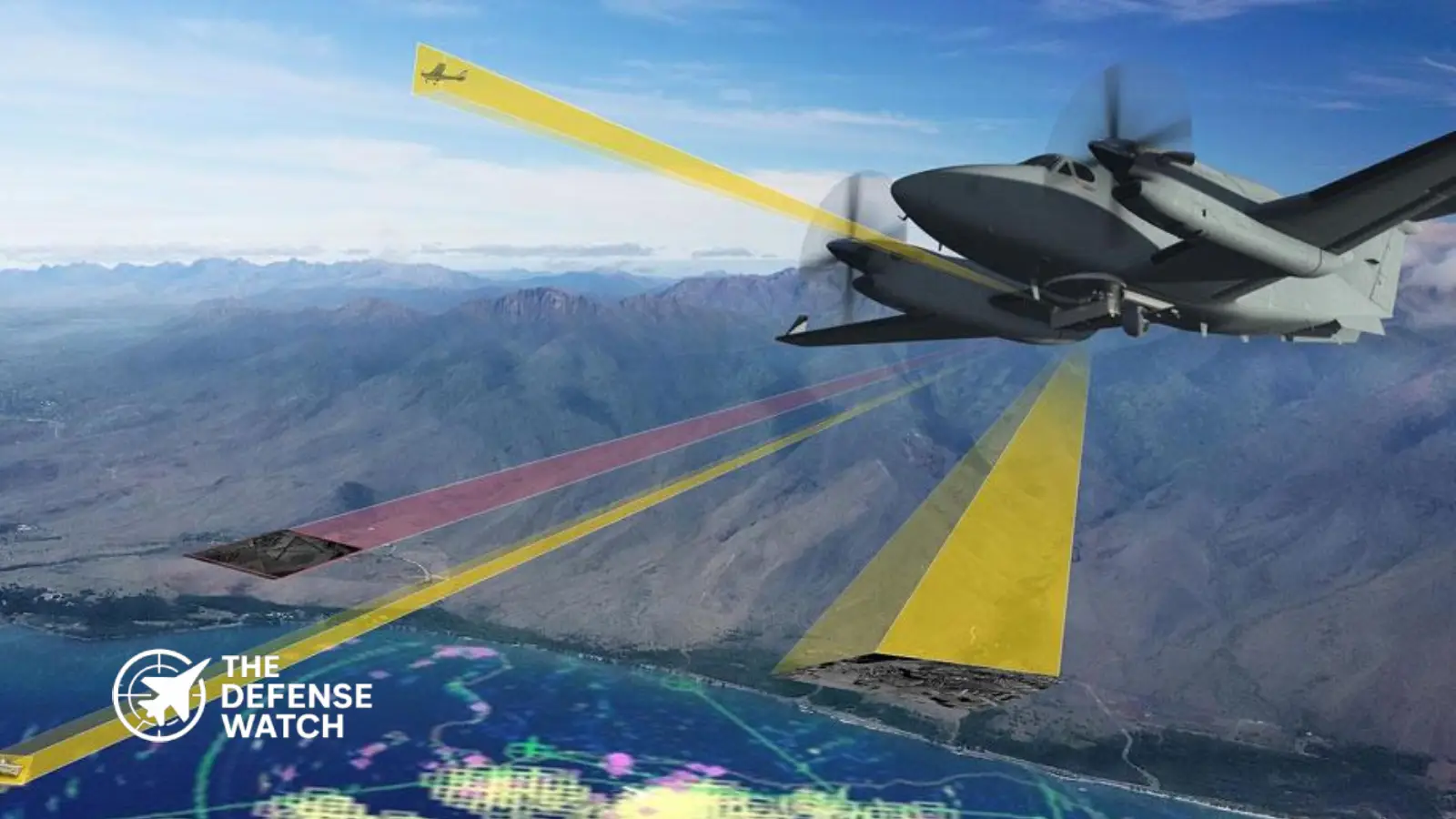
The Leonardo Seaspray radar belongs to a family of Active Electronically Scanned Array (AESA) radars designed for air, maritime, and land surveillance missions. Unlike mechanically scanned radars, AESA systems electronically steer radar beams, allowing rapid switching between multiple operating modes without moving antenna components.
This architecture provides several operational advantages:
- Long-range maritime search
- Simultaneous tracking of multiple targets
- Synthetic Aperture Radar (SAR) imaging
- Ground mapping capabilities
- Moving target detection
- High-speed mode switching during complex missions
Leonardo states that the radar can detect contacts at ranges extending hundreds of nautical miles while generating detailed imagery and tracking data for operators.
Small Target Detection Supports Border Security Missions
One of the most notable capabilities of the Seaspray 7500E V2 is its Small Target Mode, designed to detect low-signature objects in challenging maritime environments.
According to Leonardo, the system can identify small boats, individuals in the water, and other difficult-to-detect targets at significant ranges, even in rough sea conditions. This capability is particularly relevant for Australia’s maritime security requirements, which include border protection, search and rescue operations, fisheries monitoring, and monitoring of remote ocean regions.
Given Australia’s responsibility for one of the world’s largest maritime surveillance zones, the ability to detect small vessels over vast distances remains a critical operational requirement.
Why The Selection Matters
The selection highlights a growing trend among government agencies and security operators toward advanced airborne surveillance systems capable of covering large maritime areas without requiring dedicated military aircraft fleets.
Rather than purchasing and operating its own ISR aircraft, Australia is increasingly leveraging contractor-operated surveillance services. Under this model, companies such as Metrea provide aircraft, crews, and mission systems while delivering surveillance data directly to government agencies.
This approach can provide operational flexibility while accelerating the introduction of new sensor technologies.
For Leonardo, the award further strengthens its position in the global maritime surveillance market. The Seaspray radar family has already been integrated onto fixed-wing aircraft, helicopters, and uncrewed platforms. The radar has also been selected for integration on platforms such as the MQ-9B SeaGuardian, demonstrating its adaptability across multiple mission sets.
Leonardo’s Longstanding Presence In Australia
Leonardo maintains a significant presence in Australia across both defense and civil aviation sectors. The company has supplied aircraft, helicopters, surveillance technologies, and support services to Australian operators for decades. Its AW139 helicopter fleet is widely used throughout the country for search and rescue, law enforcement, offshore operations, and government missions.
The latest Seaspray radar selection further expands that footprint while reinforcing Australia’s investment in advanced maritime domain awareness capabilities.
Strategic Outlook
The Leonardo Seaspray radar award reflects the increasing importance of persistent airborne surveillance as governments seek greater visibility over maritime approaches, critical infrastructure, and border regions.
As maritime security challenges continue to evolve across the Indo-Pacific, sensors capable of detecting small targets, generating high-resolution imagery, and operating across multiple mission profiles are becoming essential tools for national security agencies.
For Australia, the addition of the Seaspray 7500E V2 provides another layer of surveillance capability aimed at improving situational awareness across one of the world’s largest and most strategically important maritime regions.