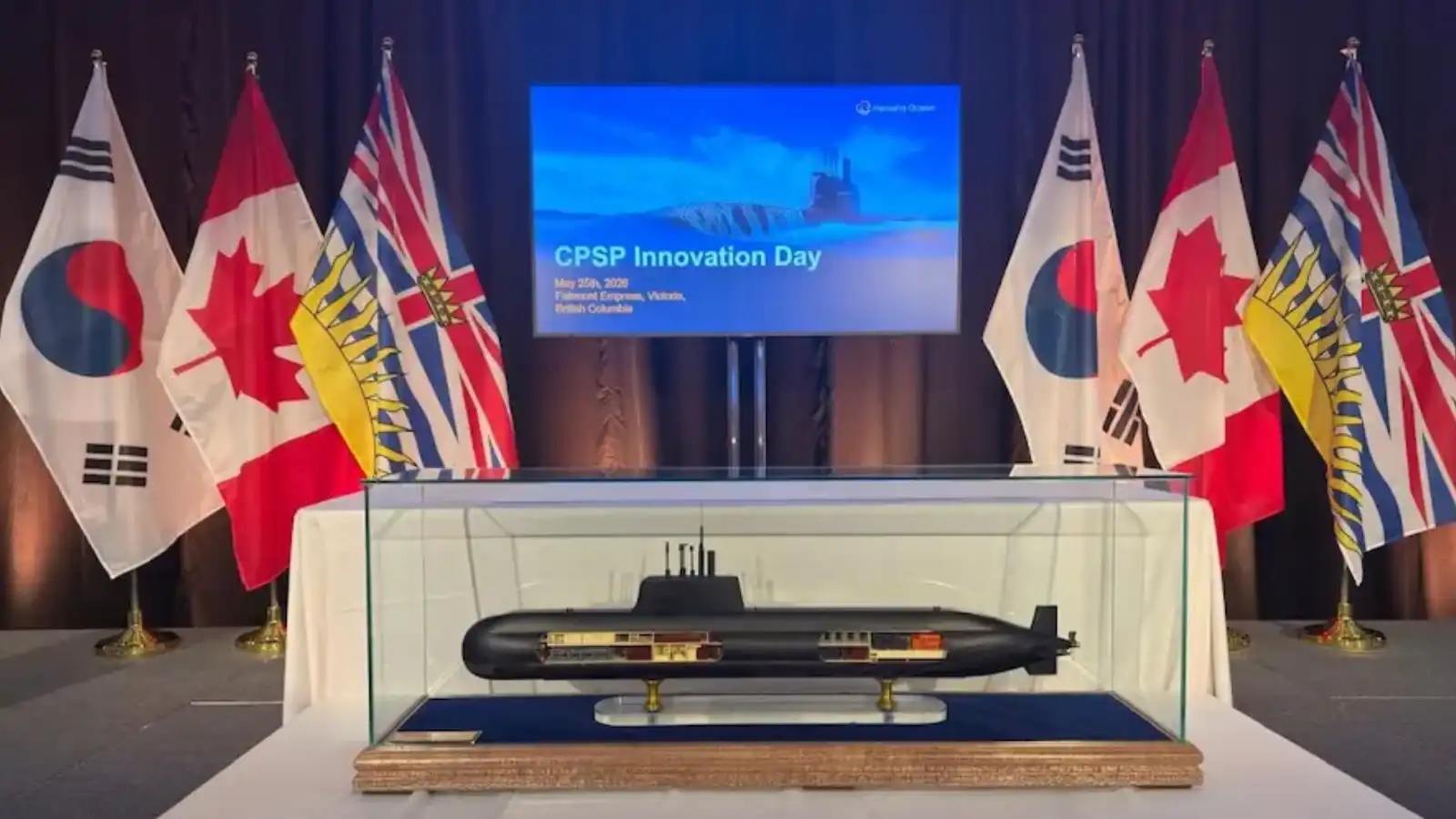
Canada’s search for a new submarine fleet is drawing increased competition as Hanwha Ocean positions the KSS-III as a fast-track option for Arctic and Indo-Pacific operations.
(adsbygoogle = window.adsbygoogle || []).push({});Executive Summary:
Hanwha Ocean is promoting its KSS-III submarine as a contender for Canada’s future patrol submarine program. The company says the design offers Arctic operational capability, rapid delivery potential, and industrial cooperation opportunities for Canadian industry.
Hanwha Ocean Highlights KSS-III For Canada’s Future Submarine Fleet
South Korean shipbuilder Hanwha Ocean is intensifying its campaign to position the KSS-III submarine for Canada’s future patrol submarine project, as Ottawa seeks to modernize its underwater warfare capability and expand Arctic operations.
The company presented the submarine’s operational capabilities and industrial benefits during the CANSEC defense exhibition in Ottawa, emphasizing the platform’s suitability for long-range patrol missions, under-ice operations, and Indo-Pacific deployments.
Canada is currently assessing options to replace its aging Victoria-class submarines, which have faced longstanding availability and maintenance challenges. Ottawa has increasingly stressed the need for persistent submarine operations in the Arctic amid growing strategic competition in the region.
Hanwha Ocean stated that the KSS-III submarine program could provide a relatively mature and lower-risk option compared with entirely new submarine development efforts.
KSS-III Designed For Long-Endurance Operations
The KSS-III is South Korea’s newest indigenous submarine design and represents one of the most advanced conventional submarines currently in production in Asia.
(adsbygoogle = window.adsbygoogle || []).push({});The diesel-electric submarine features air-independent propulsion (AIP), enabling longer submerged endurance compared with traditional diesel-electric boats. The platform was designed for extended patrol operations and multi-role missions, including anti-submarine warfare, anti-surface warfare, intelligence collection, and strategic strike operations.
Hanwha Ocean noted that the submarine’s size and endurance could support Canada’s requirement for operations across the Arctic, North Atlantic, and Pacific theaters.
The submarine displaces roughly 3,000 to 3,600 tons depending on configuration and is equipped with advanced combat systems, sonar suites, and vertical launch system capability. South Korea’s navy has already begun introducing the class into operational service.
The company also highlighted ongoing work on lithium-ion battery integration for later variants, which could further improve submerged endurance and operational flexibility.
Why Canada’s Submarine Competition Matters
Canada’s future submarine project has become increasingly important within NATO and Indo-Pacific security discussions.
The Royal Canadian Navy’s current Victoria-class fleet was originally acquired from the United Kingdom in the late 1990s. Aging systems, maintenance delays, and limited availability have repeatedly raised concerns over Canada’s ability to sustain continuous submarine patrols.
At the same time, strategic competition in the Arctic is accelerating. Russia continues to expand its Arctic military infrastructure and submarine activity, while China has increased interest in northern maritime routes and polar operations.
As a result, Canadian defense planners are seeking a platform capable of operating in harsh Arctic conditions while also supporting coalition operations alongside NATO and Indo-Pacific partners.
Hanwha Ocean’s proposal reflects a broader trend in global submarine procurement, where governments are prioritizing mature platforms with reduced development risk and faster production timelines.
Industrial Cooperation A Key Part Of The Offer
A major component of Hanwha Ocean’s campaign involves industrial cooperation with Canadian industry.
The company said the KSS-III proposal includes opportunities for technology transfer, local maintenance support, workforce development, and participation by Canadian shipbuilding and defense firms.
(adsbygoogle = window.adsbygoogle || []).push({});Industrial participation has become a central issue in Canadian defense procurement programs, particularly as Ottawa attempts to strengthen domestic defense manufacturing capacity.
Hanwha Ocean also stressed that South Korea’s shipbuilding sector maintains one of the world’s largest naval production capacities, which could support accelerated delivery schedules.
That point may carry weight as Canada faces growing pressure to modernize its naval capabilities amid evolving geopolitical tensions.
Increasing Competition In The Global Submarine Market
The Canadian competition is attracting growing international attention as submarine demand rises across NATO and Indo-Pacific nations.
South Korean defense firms have become increasingly active in export campaigns over the past decade, securing major contracts in Europe, the Middle East, and Southeast Asia.
The KSS-III campaign also reflects Seoul’s broader strategy to expand defense exports and strengthen strategic defense partnerships with Western allies.
Hanwha Ocean faces competition from several established submarine builders, including European shipyards with long-standing NATO relationships. However, South Korea’s ability to offer active production lines and potentially shorter delivery schedules could become a significant advantage.
For Canada, the decision will likely balance operational requirements, industrial benefits, long-term sustainment costs, and geopolitical considerations.
Strategic Implications For Arctic Security
The submarine competition comes as Arctic security gains greater prominence within NATO planning.
(adsbygoogle = window.adsbygoogle || []).push({});Submarines remain one of the most effective tools for surveillance, deterrence, and sea denial operations in contested maritime regions. For Canada, future submarines are expected to support sovereignty patrols, intelligence gathering, and alliance interoperability.
The KSS-III’s emphasis on endurance and multi-mission capability aligns with Canada’s expanding focus on Arctic domain awareness and maritime security.
The project could also deepen defense cooperation between Canada and South Korea at a time when Indo-Pacific partnerships are becoming increasingly connected to transatlantic security priorities.