Executive Summary:
Rohde & Schwarz Australia and BAE Systems Maritime Australia have completed the Preliminary Design Review for the Hunter Class frigate’s Integrated Communications System. The milestone confirms the maturity of the communications architecture and moves one of Australia’s largest naval modernization programs closer to detailed design and future fleet integration.
Hunter Class Frigate Communications System Advances Following Major Design Review
The Hunter Class frigate communications system has reached an important development milestone after Rohde & Schwarz Australia and BAE Systems Maritime Australia successfully completed the Preliminary Design Review (PDR) for the Integrated Communications System (ICS). The achievement, announced on July 6, marks another step forward for Australia’s Hunter Class Frigate Program, which is building the Royal Australian Navy’s future anti submarine warfare surface combatants.
The review confirms that the communications system architecture has matured sufficiently for the program to transition toward detailed engineering, integration, and eventual production. It also demonstrates continued collaboration between industry partners and the Australian Commonwealth as work progresses on the first three Hunter Class frigates.
Preliminary Design Review Confirms System Maturity
A Preliminary Design Review is one of the most important checkpoints in complex defense acquisition programs. Rather than validating final hardware, it demonstrates that operational requirements have been translated into an engineering architecture capable of supporting detailed design.
According to Rohde & Schwarz Australia, the completed review established:
| Key Outcome | Significance |
|---|---|
| System architecture validated | Defines internal and external interfaces |
| Requirements allocated | Confirms subsystem responsibilities |
| Integration planning completed | Supports future shipboard installation |
| Commonwealth review completed | Enables progression toward Critical Design Review |
Company officials stated that discussions with BAE Systems Maritime Australia and Australian government representatives confirmed the design direction for the next phase of development. The next major engineering milestone will be the Critical Design Review later in 2026.
NAVICS Will Form The Communications Backbone
The Integrated Communications System is centered on NAVICS, Rohde & Schwarz’s naval communications platform.
Unlike conventional shipboard radio suites, NAVICS combines internal and external communications into a unified digital architecture capable of handling multiple security classifications simultaneously.
The system is designed to provide:
- Internal voice communications
- External radio connectivity
- Multi level security networking
- Classified information processing
- Integrated command communications
- Future software driven capability upgrades
For modern naval operations, communications systems have become mission critical infrastructure rather than standalone radio equipment. They connect combat management systems, sensors, command teams, aviation assets, and coalition partners into a single operational network.
Supporting Australia’s Largest Surface Combatant Program
The Hunter Class Frigate Program represents Australia’s largest naval shipbuilding effort in decades.
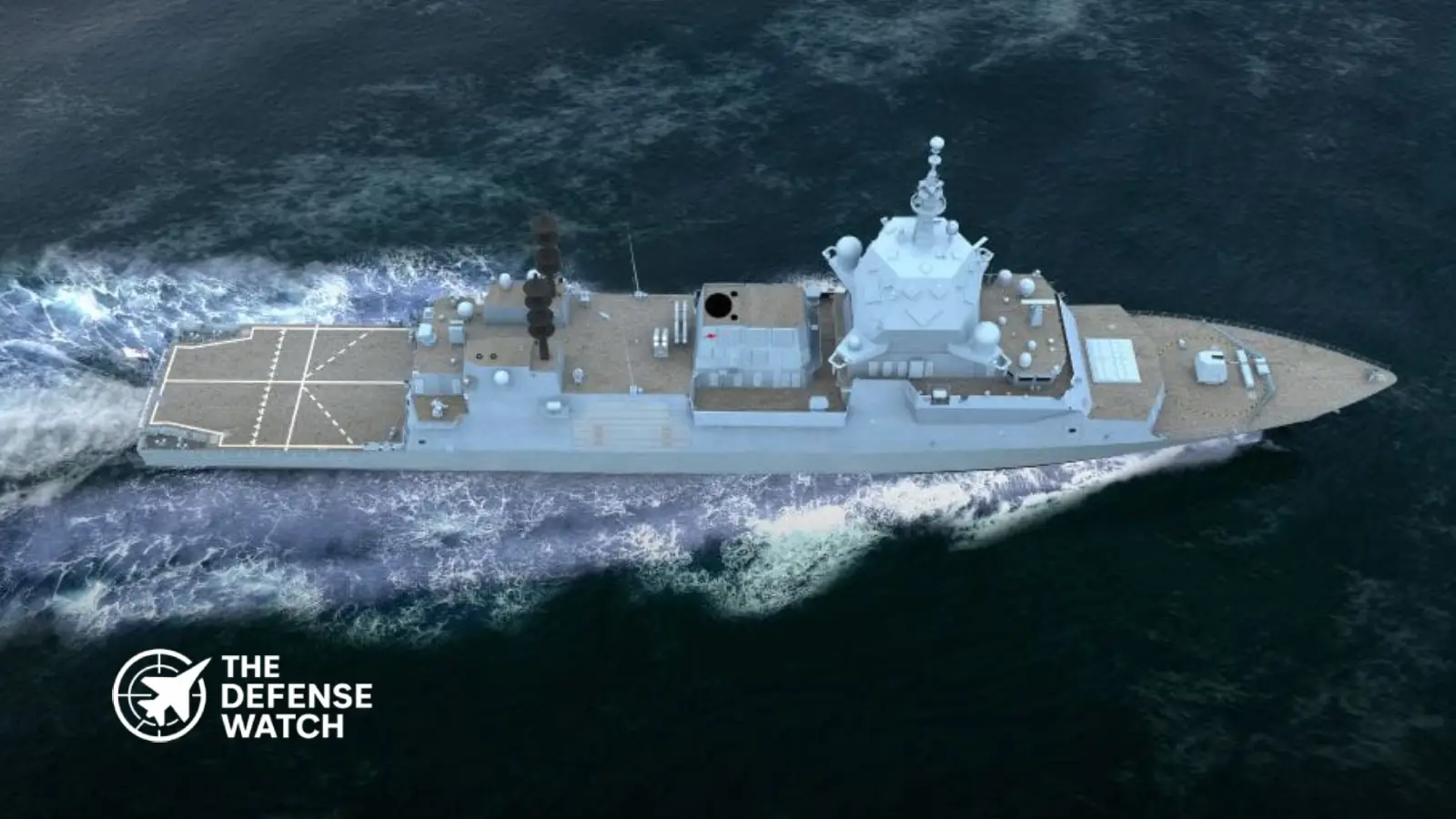
BAE Systems Maritime Australia is constructing the ships at Osborne Naval Shipyard in South Australia using an evolved version of the Royal Navy’s Type 26 frigate design.
The vessels are optimized primarily for anti submarine warfare while incorporating Australian specific capabilities including:
- Aegis Combat System integration
- CEAFAR2 phased array radar
- Advanced sonar systems
- MH 60R Seahawk helicopter operations
- Long range strike capability
- Network enabled combat systems
Construction has continued to advance during 2026, with significant portions of the lead ship already moving through fabrication while suppliers complete critical subsystem development.
Why Communications Systems Matter More Than Ever
While radar, missiles, and sonar often receive the most public attention, integrated communications systems increasingly determine how effectively a modern warship can fight.
Today’s naval operations require simultaneous connectivity across multiple domains, including:
- Fleet tactical data networks
- Air assets
- Submarine coordination
- Coalition operations
- Satellite communications
- Secure command networks
An integrated communications architecture reduces crew workload by consolidating multiple communication channels into a single managed environment. It also improves resilience by allowing operators to rapidly switch between communication paths if one network becomes unavailable.
For anti submarine warfare missions, secure and reliable communications are particularly important because submarines, helicopters, maritime patrol aircraft, and surface combatants often operate across large geographic areas while sharing sensitive targeting information.
Strengthening Australia’s Sovereign Defense Industry
Another significant aspect of the milestone is the continued expansion of Australia’s domestic defense industrial base.
Rohde & Schwarz Australia said its engineering workforce has already doubled to support development and manufacturing of the Integrated Communications System. Company leadership indicated additional workforce growth is expected as the Hunter Class program moves toward production.
BAE Systems Maritime Australia has consistently emphasized that the Hunter program is intended not only to deliver advanced warships but also to regenerate Australia’s sovereign naval shipbuilding capability through long term investment in domestic suppliers and skilled engineering jobs.
Analysis: A Quiet Milestone With Long Term Strategic Importance
Although the Preliminary Design Review does not generate the visibility associated with ship launches or weapons testing, it represents one of the most consequential engineering milestones in a complex naval acquisition program.
Communications systems are among the most integration intensive components aboard any modern combatant. They must interface with combat management software, navigation systems, sensors, encryption equipment, aviation assets, and coalition networks while maintaining cybersecurity and reliability under combat conditions.
Completing the review reduces technical uncertainty before detailed design and manufacturing begin. It also provides greater confidence that the communications architecture can support future software upgrades throughout the frigate’s operational life, an increasingly important consideration as naval platforms are expected to remain in service for several decades.
For Australia, successful maturation of these systems contributes directly to broader efforts to field a highly networked fleet capable of operating alongside the United States, the United Kingdom, and other Indo Pacific partners during multinational operations.
Outlook
With the Preliminary Design Review complete, the Hunter Class frigate communications system now moves toward Critical Design Review before production and shipboard integration accelerate.
As construction of the lead Hunter Class frigate continues at Osborne Naval Shipyard, progress across communications, navigation, combat systems, and platform engineering will collectively determine when the Royal Australian Navy begins receiving one of its most advanced surface combatants.