• Home
  • About
  • Defense Systems
  • Manufacturer
  • Comparisons
  • Compare 
  • Tools
TheDefenseWatch.com
  • Aerospace & Aviation
  • Military & Ordnance
  • Naval & Maritime
  • Cyber & Space Defense
  • Policy & Strategy
  • Global News
  • Tools Library
    • Smart Calculator
    • Drone Flight Time Calculator
    • Drone Range Calculator
    • Counter-Drone Jammer Effective Range Calculator
    • Counter-Battery Radar Detection Calculator
    • Artillery Fire Correction Calculator
    • Thermal Camera Detection Range Calculator
    • Missile Range & Time-of-Flight Calculator
    • Radar Detection Range Calculator
    • FPV Strike Drone Payload vs Range Calculator
    • Loitering Munition Endurance Calculator
    • Sniper Ballistic Drop & Windage Calculator
    • Bullet Drop Calculator
    • U.S. Army Combat Fitness Test (ACFT) Calculator
    • Military Pension Calculator
    • Military Retirement Calculator
    • Military Pension Calculator
    • Large Number Calculator
Font ResizerAa

TheDefenseWatch.com

The Defense Watch | U.S. & Global Defense News, Analysis & Military Updates

Search
  • Home
  • About
  • Defense Systems
  • Manufacturer
  • Comparisons
  • Compare 
  • Tools

Stay Updated

Get the latest update

Subscribe

Explore

  • Drone
  • Fighter Jets & Military Aircraft
  • Hypersonic Weapons
  • Aircraft Carriers
  • Strategic History & Missions
  • Tools Library
Home » Türkiye Moves To Expand Defense Industry Reach As Global Demand Surges
Global News

Türkiye Moves To Expand Defense Industry Reach As Global Demand Surges

Kaleem Sheikh | Regional Defense Correspondent
Last updated: April 13, 2026 2:19 am
Kaleem Sheikh | Regional Defense Correspondent
Share
2 Min Read
Türkiye defense industry expansion
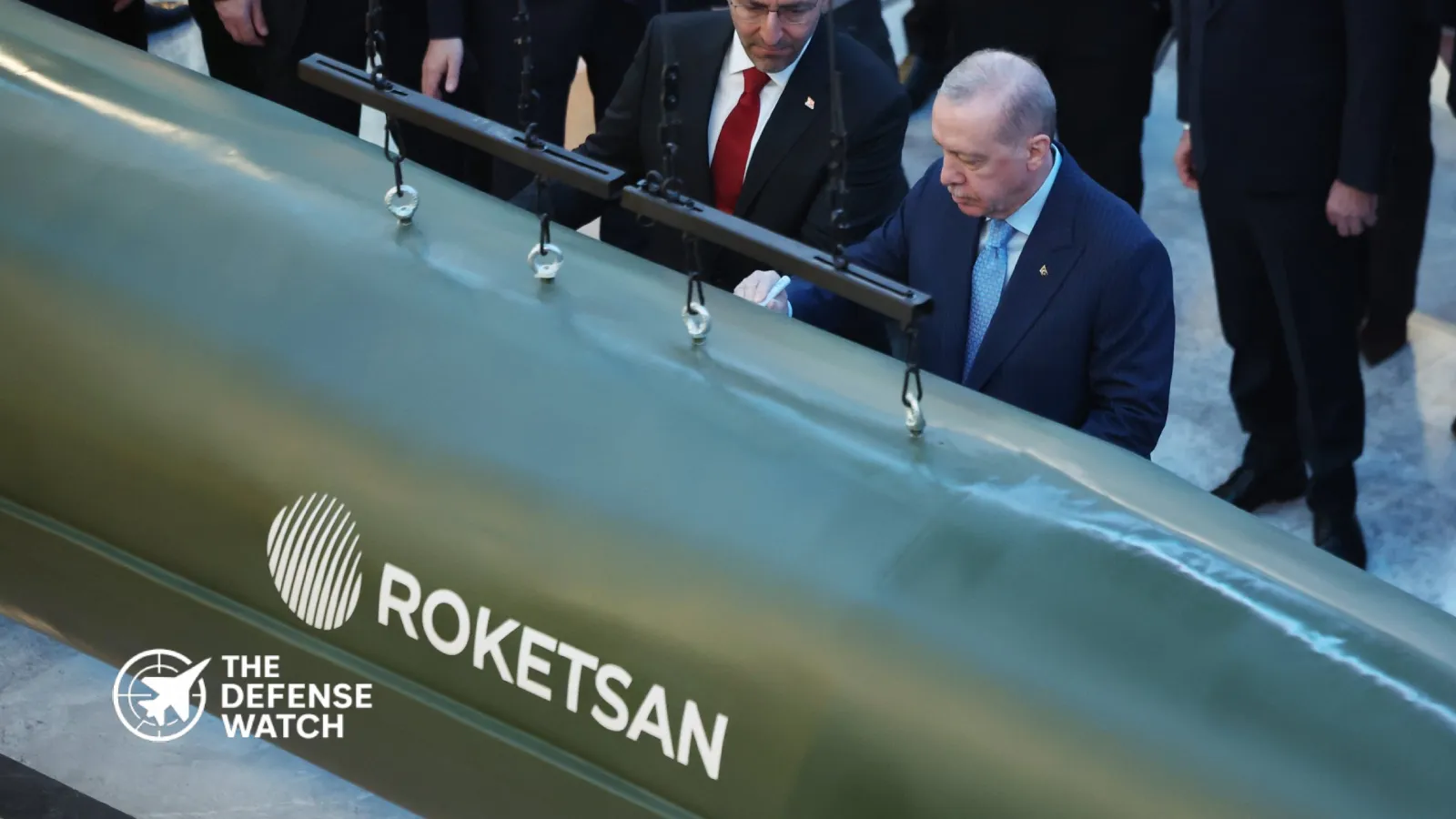
President Recep Tayyip Erdoğan signs off a Tayfun Blok-4 hypersonic missile developed by Turkish defense giant Roketsan, in a ceremony, Ankara, Türkiye, April 7, 2026. (AA Photo)
SHARE

Türkiye Defense Industry Expansion Gains Pace Amid Global Demand

The Türkiye defense industry expansion is entering a new phase as Türkiye rolls out a series of coordinated moves aimed at boosting exports, strengthening partnerships, and scaling production capacity.

Contents
Türkiye Defense Industry Expansion Gains Pace Amid Global DemandExport Growth Drives Strategic MomentumIndustrial Partnerships Expand Global ReachProduction Scaling Signals Long-Term AmbitionStrategic Context: Balancing Autonomy And Alliance CommitmentsMarket Position And Competitive Outlook

Ankara is pursuing three parallel efforts that signal a broader strategic shift. These include expanding international defense agreements, deepening industrial cooperation with foreign partners, and accelerating domestic manufacturing output across key sectors.

The developments come as global demand for cost-effective and combat-proven systems continues to rise, particularly in emerging markets.

¦ KEY FACTS AT A GLANCE
  • Türkiye announced three major moves to expand its defense industry’s global reach.
  • The initiatives include new export agreements, industrial partnerships, and increased production capacity.
  • Turkish defense firms continue to gain traction in Europe, Asia, and the Middle East.
  • The expansion aligns with Ankara’s goal of reducing foreign dependency in defense systems.
  • Officials highlight sustained demand for drones, armored vehicles, and naval platforms.

Export Growth Drives Strategic Momentum

At the core of the Türkiye defense industry expansion is a sustained push to increase exports. Turkish defense firms have gained visibility in recent years through platforms such as unmanned aerial vehicles, armored vehicles, and naval systems.

- Advertisement -

Officials have pointed to growing interest from countries in Europe, Asia, and the Middle East. This reflects a broader trend where buyers seek alternatives to traditional Western suppliers, often balancing cost, delivery timelines, and operational performance.

Analysis:
Türkiye’s export-driven model mirrors strategies used by established defense exporters but with a key difference. Turkish systems are often marketed as modular, adaptable, and competitively priced. This positioning has allowed Ankara to penetrate markets where budget constraints limit access to high-end Western platforms.

In practical terms, export growth is not just about revenue. It also strengthens political ties, expands logistical networks, and builds long-term maintenance relationships, all of which reinforce Türkiye’s strategic influence.

Industrial Partnerships Expand Global Reach

Another pillar of the Türkiye defense industry expansion is the emphasis on partnerships and joint production agreements. Turkish firms are increasingly entering co-production deals, technology-sharing arrangements, and localized manufacturing initiatives.

These partnerships serve two purposes. First, they help overcome export restrictions and regulatory barriers. Second, they align with partner nations’ goals of developing domestic defense capabilities.

Analysis:
This approach reflects a shift from traditional arms sales toward collaborative defense ecosystems. By offering co-production, Türkiye positions itself as a long-term partner rather than a transactional supplier. This model is especially attractive to countries seeking industrial development alongside military capability.

It also reduces political risk. Shared production creates mutual dependency, making defense relationships more resilient to diplomatic fluctuations.

Production Scaling Signals Long-Term Ambition

The third component of the Türkiye defense industry expansion involves scaling up production capacity across multiple sectors. Increased manufacturing output is essential to meet rising international demand and fulfill existing contracts.

- Advertisement -

Turkish defense companies are investing in infrastructure, workforce development, and supply chain resilience. This includes expanding facilities for UAV production, armored vehicle assembly, and naval shipbuilding.

Analysis:
Scaling production is a critical test for any emerging defense exporter. Rapid growth can strain supply chains and quality control systems. Türkiye’s ability to maintain delivery timelines while preserving performance standards will determine whether it can compete consistently with established players.

Moreover, production capacity is closely tied to strategic autonomy. By strengthening domestic manufacturing, Ankara reduces reliance on foreign components and mitigates the impact of export restrictions imposed by allied nations.

Strategic Context: Balancing Autonomy And Alliance Commitments

The Türkiye defense industry expansion is unfolding within a complex geopolitical environment. As a NATO member, Türkiye must balance alliance commitments with its ambition to build an independent defense industrial base.

Recent years have seen tensions over procurement decisions and technology transfers. In response, Ankara has doubled down on indigenous development and diversified its supplier network.

Analysis:
This dual-track strategy reflects a broader trend among middle powers seeking greater strategic autonomy. Türkiye is not abandoning its alliances but is clearly reducing vulnerabilities linked to external dependencies.

The result is a more flexible defense posture, one that allows Ankara to respond to regional threats while maintaining leverage in international negotiations.

Market Position And Competitive Outlook

Türkiye’s defense sector is increasingly positioned as a mid-tier alternative between high-cost Western systems and lower-cost competitors with limited technological depth.

Its success in UAV exports, in particular, has reshaped perceptions of Turkish defense capabilities. This momentum is now extending to other domains, including naval platforms and land systems.

Analysis:
Sustaining this trajectory will depend on innovation, reliability, and after-sales support. As more countries adopt Turkish systems, expectations around interoperability and lifecycle management will rise.

If Türkiye can meet these demands, it is likely to secure a lasting role in the global defense market.


TAGGED:Defense partnershipsglobal arms marketMilitary ExportsNATO ally industryTürkiye defense
Share This Article
Facebook Copy Link Print
ByKaleem Sheikh | Regional Defense Correspondent
Follow:
Kaleem Sheikh is a regional defense correspondent at TheDefenseWatch.com covering defense and security developments across Asia and the Middle East, including military operations, procurement, and regional security issues.
Leave a Comment

Leave a Reply Cancel reply

Your email address will not be published. Required fields are marked *

Search Defense Systems

Latest Defense Systems

  • TRML-4D Radar TRML-4D Radar
  • F-47A Fighter Jet F-47A Fighter Jet
  • China DF-61 Missile China DF-61 Missile
  • B61 Nuclear Bomb B61 Nuclear Bomb
  • Japan E-767 Airborne Japan E-767 Airborne
  • Remington 870 Shotgun Remington 870 Shotgun
  • RUTA B1 Cruise Missile RUTA B1 Cruise Missile
  • XQ-67A Drone XQ-67A Drone
  • B-25 Mitchell Bomber B-25 Mitchell Bomber

Recent Compares

  • J-10C vs JF-17 Thunder: Which Fighter Is More Capable? J-10C vs JF-17 Thunder: Which Fighter Is More Capable? View Comparison →
  • Tejas vs Gripen: Key Differences and Capabilities Tejas vs Gripen: Key Differences and Capabilities View Comparison →
  • Tejas vs MiG-21 Bison: How India Replaced Its Iconic Supersonic Fighter Tejas vs MiG-21 Bison: How India Replaced Its Iconic Supersonic Fighter View Comparison →
  • F-35 vs F-16: Stealth, Sensors and Combat Roles F-35 vs F-16: Stealth, Sensors and Combat Roles View Comparison →
  • Tejas Fighter Jet vs F-16 Fighting Falcon: Capability Compared Tejas Fighter Jet vs F-16 Fighting Falcon: Capability Compared View Comparison →
  • Rafale Fighter Jet vs F-16 Fighting Falcon : Which Fighter Has the Edge? Rafale Fighter Jet vs F-16 Fighting Falcon : Which Fighter Has the Edge? View Comparison →
  • Su-57 Fighter Jet vs J-20 Fighter Jet: Stealth and Air Combat Compared Su-57 Fighter Jet vs J-20 Fighter Jet: Stealth and Air Combat Compared View Comparison →
  • Mirage 2000 vs Tejas Mk1A: Legacy Combat Power vs Indigenous Modernization Mirage 2000 vs Tejas Mk1A: Legacy Combat Power vs Indigenous Modernization View Comparison →
  • Rafale Fighter Jet vs F-22 Raptor: Which Air Dominance Fighter Has the Edge? Rafale Fighter Jet vs F-22 Raptor: Which Air Dominance Fighter Has the Edge? View Comparison →
  • Tejas Fighter Jet vs. Rafale Fighter Jet: India’s Indigenous Fighter Meets France’s Proven Multirole Combat Aircraft Tejas Fighter Jet vs. Rafale Fighter Jet: India’s Indigenous Fighter Meets France’s Proven Multirole Combat Aircraft View Comparison →

Recent Posts

  • Raytheon Wins DARPA Contract to Develop All-Optical Signal Processing Technology
  • Lockheed Martin Delivers 100,000th GMLRS Rocket as Production Reaches 14,000 a Year
  • L3Harris CEO Sam Mehta Discusses Defense Spending and Missile Production on CNBC
  • L3Harris Demonstrates Multi-Domain Defense Network for Pacific Security
  • Saab Secures SEK 350 Million Danish Order for Combat Training Systems

You Might Also Like

Iranian drone Arabian Sea
Global News

US Navy F-35 Shoots Down Iranian Drone Near USS Abraham Lincoln in Arabian Sea

February 3, 2026
F-35 deliveries 2025
Global News

Which 5 Air Forces Possess the Costliest Fighter Jet Fleets in the World

September 8, 2026
LORA missile system
Global News

India Reportedly Eyes Israel’s LORA Missile System for Long-Range Precision Strikes

September 8, 2026
Iran peace talks US pilot
Global News

Iran Moves To Keep Peace Talks Open As Search For Missing US Pilot Intensifies

April 4, 2026

Logo

Copyright © 2026 TheDefenseWatch.com

Helpful Links

  • Home
  • About Us
  • Privacy Policy
  • Terms of Use / Disclaimer
  • U.S. Privacy Notice – CCPA Compliance

Defense Systems

  • Defense Systems
  • Comparisons 
  • Manufacturer
  • Tactical Calculators

Popuplar

Which 5 Air Forces Possess the Costliest Fighter Jet Fleets in the World
Evolving Strategic Value: Carrier Strike Groups in the Indo-Pacific’s Future Security Architecture
Autonomous Weapon Systems Spark U.S. Ethics Debate Amid Rapid Military AI Integration

We report on developments involving military forces, governments, defense companies, research organizations, and security institutions around the world. 

Welcome Back!

Sign in to your account

Username or Email Address
Password

Lost your password?