
- Home
- Defense Systems
- Aircraft Carriers
- INS Vikrant Aircraft Carrier
INS Vikrant Aircraft Carrier
Defense Systems Full Specifications
1. Physical Characteristics
| Ship Type | Aircraft Carrier |
| Class | Vikrant-class (IAC-1) |
| Length | ~262 m |
| Beam (Width) | ~62 m |
| Flight Deck Width | — (designed for STOBAR deck ~12,500 m²) |
| Draft | ~8.4 m |
| Displacement (Full Load) | ~45,000 tonnes |
2. Propulsion & Performance
| Propulsion Type | Conventional – Gas Turbine |
| Powerplant | 4 × GE LM2500+ Gas Turbines (88 MW total) |
| Shafts | 2 shafts |
| Maximum Speed | 28–30 knots |
| Range | ~7,500–8,600 nautical miles |
| Endurance | Several weeks to 45 days at sea |
3. Flight Operations
| Aircraft Launch System | STOBAR (Ski-jump takeoff, Arrested recovery) |
| Catapult Type | None |
| Recovery System | Arrestor wire system |
| Total Aircraft Capacity | 30–40 aircraft |
| Hangar Capacity | Full-length enclosed hangar |
| Aircraft Types Supported | MiG-29K fighters, MH-60R ASW helos, Ka-31 AEW, ALH Dhruv, future TEDBF |
4. Sensors & Electronics
| Primary Radar | EL/M-2248 MF-STAR AESA |
| Navigation Radar | Long-range naval navigation radars |
| Fire Control Radar | CMS-linked FCR for guns & CIWS |
| Electronic Warfare Suite | “Shakti” EW suite (ESM, ECM, jammers) |
| Communication Systems | SATCOM, secure data links (Indian equivalent) |
5. Weapons & Defense Systems
| CIWS | AK-630 30 mm CIWS (multiple mounts) |
| Short-Range SAMs | Barak-1 & Barak-8 SAM via VLS cells |
| Missile Launchers | VLS only for SAMs (no strike missiles) |
| Decoy Systems | Chaff, flare, electronic decoy launchers |
6. Command & Control
| Combat Management System | Integrated Indian Navy CMS |
| Combat Information Center (CIC) | Multi-deck CIC for ship & air ops |
| Air Operations Center | Full-scale AOC for flight deck control |
| Data Links | SATCOM + Tactical naval networks |
7. Crew & Capacity
| Ship Crew | ~1,600–1,700 personnel |
| Air Wing Personnel | ~500–600 (variable) |
| Total Complement | ~2,200–2,300+ personnel |
8. Construction & Cost
| Shipbuilder/Manufacturer | Cochin Shipyard Limited (India) |
| Construction Started | 2009 |
| Commissioned | September 2022 |
| Estimated Cost | ~$2.5–3 billion (approx.) |
PROS
- Strong indigenous build: over 75–76% domestic content, showcasing self-reliant shipbuilding.
- Flexible air wing: supports fighters, AEW helicopters, ASW helicopters, and future naval aircraft — ideal for varied missions.
- Modern sensors and defensive suite: AESA radar, VLS, CIWS and guns provide layered air/missile defense.
- Extended range and endurance: Gas-turbine propulsion gives strategic reach and sustained deployments.
- Full-featured shipboard living and support facilities: accommodation, medical complex, automation, enabling sustained operations.
CONS
- STOBAR limits: Without catapult launch, payload and sortie rates are lower than CATOBAR carriers (e.g. US-class carriers).
- Moderate air wing capacity vs super-carriers: ~30–40 aircraft, less than large nuclear carriers with 60+ assets.
- Gas-turbine conventional propulsion: requires frequent refueling compared to nuclear-powered carriers.
- Limited strike payload: deck limitations may restrict heavier future aircraft or full load-out.
- Regional focus: Though powerful, Vikrant lacks global reach and sustained continuous high-ops tempo compared to larger US/UK/French carriers.
INS Vikrant – India’s First Indigenous Carrier
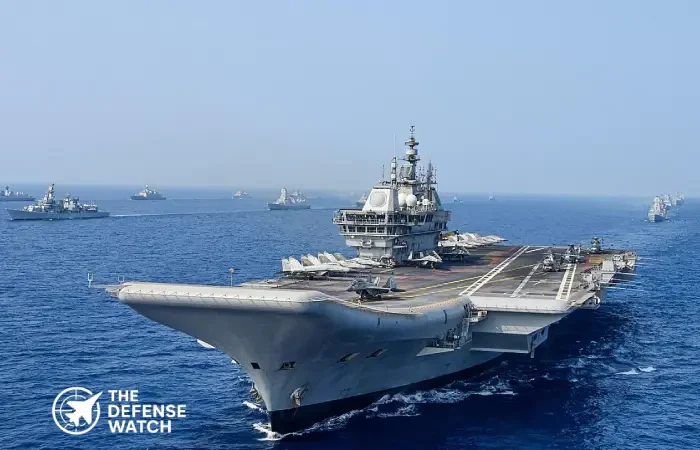
The INS Vikrant represents a major milestone in modern naval shipbuilding — India’s first fully indigenous aircraft carrier and a symbol of growing maritime ambition. Built for the Indian Navy by Cochin Shipyard Limited, Vikrant was laid down under the design supervision of the navy’s Warship Design Bureau and commissioned in September 2022.
INS Vikrant is designed to project blue-water capabilities across the Indian Ocean and beyond. At 262 meters in length and roughly 62 meters beam, it displaces around 45,000 tonnes at full load — placing it among mid-sized modern carriers rather than super-carriers.
Powered by four gas turbines (General Electric LM2500+) driving twin shafts, the carrier delivers roughly 88 MW (≈110,000 hp), enabling a top speed of about 28–30 knots and a range/ endurance sufficient for extended deployments (est. 7,500–8,600 nautical miles).
Vikrant uses a STOBAR (Short Take-Off But Arrested Recovery) launch system with a ski-jump for fixed-wing aircraft and arrestor wires for recovery. This flight deck supports a mixed air wing of roughly 30–40 aircraft: carrier-capable fighters (such as Mikoyan MiG-29K), helicopters for airborne early warning (e.g. Kamov Ka-31), anti-submarine/multi-role helicopters such as MH-60R Seahawk, and indigenous rotary or future fixed-wing platforms.
On the electronics and defense front, Vikrant is equipped with advanced radar and sensor suites — including the EL/M-2248 MF-STAR AESA radar and Selex RAN-40L 3D surveillance radar — plus a modern Combat Management System developed domestically. For layered defense, the ship carries close-in weapon systems like the AK-630 CIWS, dual-purpose naval guns (e.g. Otobreda 76 mm naval gun), and vertical-launch surface-to-air missiles (e.g. Barak 8 missile / Barak-1 via VLS).
Thanks to its combination of flight deck, air wing flexibility, modern sensors, and defensive suite, INS Vikrant offers credible power-projection, maritime air support, fleet defense, and anti-submarine warfare capability — expanding India’s sea-based deterrence and regional reach.
Disclaimer Note
The information provided on TheDefenseWatch.com is for general informational purposes only. While we strive to ensure the accuracy, completeness, and timeliness of our content regarding defense and aerospace products, technologies, and specifications, we cannot guarantee that all information is 100% accurate or up-to-date due to the evolving nature of military technology and classified data.TheDefenseWatch.com does not warrant the reliability, suitability, or availability of the information for any specific purpose. Users are advised to consult official sources, such as manufacturers, government publications, or defense agencies, for precise and verified data before making decisions based on our content.We are not affiliated with any defense manufacturers, governments, or military organizations mentioned. Opinions, reviews, and ratings reflect expert analysis but are subjective and should not be considered endorsements. TheDefenseWatch.com is not responsible for any errors, omissions, or consequences arising from the use of this website’s content.External links are provided for convenience and do not imply endorsement. TheDefenseWatch.com reserves the right to update or modify content without prior notice. By using this website, you agree to our Privacy & Cookies Policy.
New Arrivals











Popular Comparisons
-
 J-10C vs JF-17 Thunder: Which Fighter Is More Capable?
View Comparison →
-
Tejas vs Gripen: Key Differences and Capabilities
View Comparison →
-
Tejas vs MiG-21 Bison: How India Replaced Its Iconic Supersonic Fighter
View Comparison →
-
F-35 vs F-16: Stealth, Sensors and Combat Roles
View Comparison →
-
Tejas Fighter Jet vs F-16 Fighting Falcon: Capability Compared
View Comparison →
-
Rafale Fighter Jet vs F-16 Fighting Falcon : Which Fighter Has the Edge?
View Comparison →
-
Su-57 Fighter Jet vs J-20 Fighter Jet: Stealth and Air Combat Compared
View Comparison →
-
Mirage 2000 vs Tejas Mk1A: Legacy Combat Power vs Indigenous Modernization
View Comparison →
-
Rafale Fighter Jet vs F-22 Raptor: Which Air Dominance Fighter Has the Edge?
View Comparison →
-
Tejas Fighter Jet vs. Rafale Fighter Jet: India’s Indigenous Fighter Meets France’s Proven Multirole Combat Aircraft
View Comparison →


- P-800 Oniks Missile: Range, Speed and BrahMos Comparison

- Ukrainian Drone Unit Caused 70% of Simulated U.S. Brigade Casualties in Germany Exercise
- OCCAR Marks 25 Years of European Defense Cooperation With 28 Programs
- Saab Q3 2026 Results Show 30.6% Organic Sales Growth as Orders Surge
- How Much Does a Tomahawk Missile Cost? Price, Range and Blocks
- Faster Than Sound, Unstoppable at Sea: Inside China’s YJ-20 and YJ-17 Hypersonic Missiles
- U.S., Australia and UK Test Maritime Autonomy Under AUKUS
- TAI Anka-3: Turkey’s Stealth Flying-Wing Drone and Specifications
- Lockheed Martin’s Third-Quarter Innovations Span Missile Defense, Aviation and Space
- RTX Plans to Increase Missile Production Up to Fourfold Under Pentagon Contracts




Fighter Jets
-
 SU-57 Felon Stealth Fighter
-
Boeing F/A-XX Fighter
-
JF-17 Thunder Fighter Jet
-
F-47 Fighter Jet
-
MIG-31 Fighter Jet
-
J-10CE Fighter Jet
-
Chengdu J-10 Fighter Jet
-
Chengdu J-10C Fighter Jet
-
Gripen E Fighter Jet
-
Tejas Mk1A Fighter Jet
-
Tejas Mk‑2 Fighter Jet
-
F-16V Viper Block 70 Fighter Jet
-
F-15EX Eagle II Fighter
-
F-15E Strike Eagle Fighter
-
F/A-18E/F Super Hornet Fighter Jet
-
Saab Gripen F Fighter Jet
-
JAS 39E/F Gripen Fighter Jet
-
JAS 39 Gripen Fighter Jet
-
F-35A Lightning II Fighter Jet
-
F/A-18F Super Hornet
-
J-50 Fighter Jet
-
Spanish EF-18 Hornet Fighter
-
F-35i Adir Fighter Jet
-
F-16 Fighting Falcon






Recent Compares
-
J-10C vs JF-17 Thunder: Which Fighter Is More Capable?
View Comparison →
-
Tejas vs Gripen: Key Differences and Capabilities
View Comparison →
-
Tejas vs MiG-21 Bison: How India Replaced Its Iconic Supersonic Fighter
View Comparison →
-
F-35 vs F-16: Stealth, Sensors and Combat Roles
View Comparison →
-
Tejas Fighter Jet vs F-16 Fighting Falcon: Capability Compared
View Comparison →
Latest Defense Systems
10 Compares Defense Systems
-
J-10C vs JF-17 Thunder: Which Fighter Is More Capable?
View Comparison →
-
Tejas vs Gripen: Key Differences and Capabilities
View Comparison →
-
Tejas vs MiG-21 Bison: How India Replaced Its Iconic Supersonic Fighter
View Comparison →
-
F-35 vs F-16: Stealth, Sensors and Combat Roles
View Comparison →
-
Tejas Fighter Jet vs F-16 Fighting Falcon: Capability Compared
View Comparison →
-
Rafale Fighter Jet vs F-16 Fighting Falcon : Which Fighter Has the Edge?
View Comparison →
-
Su-57 Fighter Jet vs J-20 Fighter Jet: Stealth and Air Combat Compared
View Comparison →
-
Mirage 2000 vs Tejas Mk1A: Legacy Combat Power vs Indigenous Modernization
View Comparison →
-
Rafale Fighter Jet vs F-22 Raptor: Which Air Dominance Fighter Has the Edge?
View Comparison →
-
Tejas Fighter Jet vs. Rafale Fighter Jet: India’s Indigenous Fighter Meets France’s Proven Multirole Combat Aircraft
View Comparison →
- P-800 Oniks Missile: Range, Speed and BrahMos Comparison
- Ukrainian Drone Unit Caused 70% of Simulated U.S. Brigade Casualties in Germany Exercise
- OCCAR Marks 25 Years of European Defense Cooperation With 28 Programs
- Saab Q3 2026 Results Show 30.6% Organic Sales Growth as Orders Surge
- How Much Does a Tomahawk Missile Cost? Price, Range and Blocks