Takeaways
Saab’s A3-001 concept points toward a future Swedish combat air architecture built around crewed and uncrewed aircraft working together.
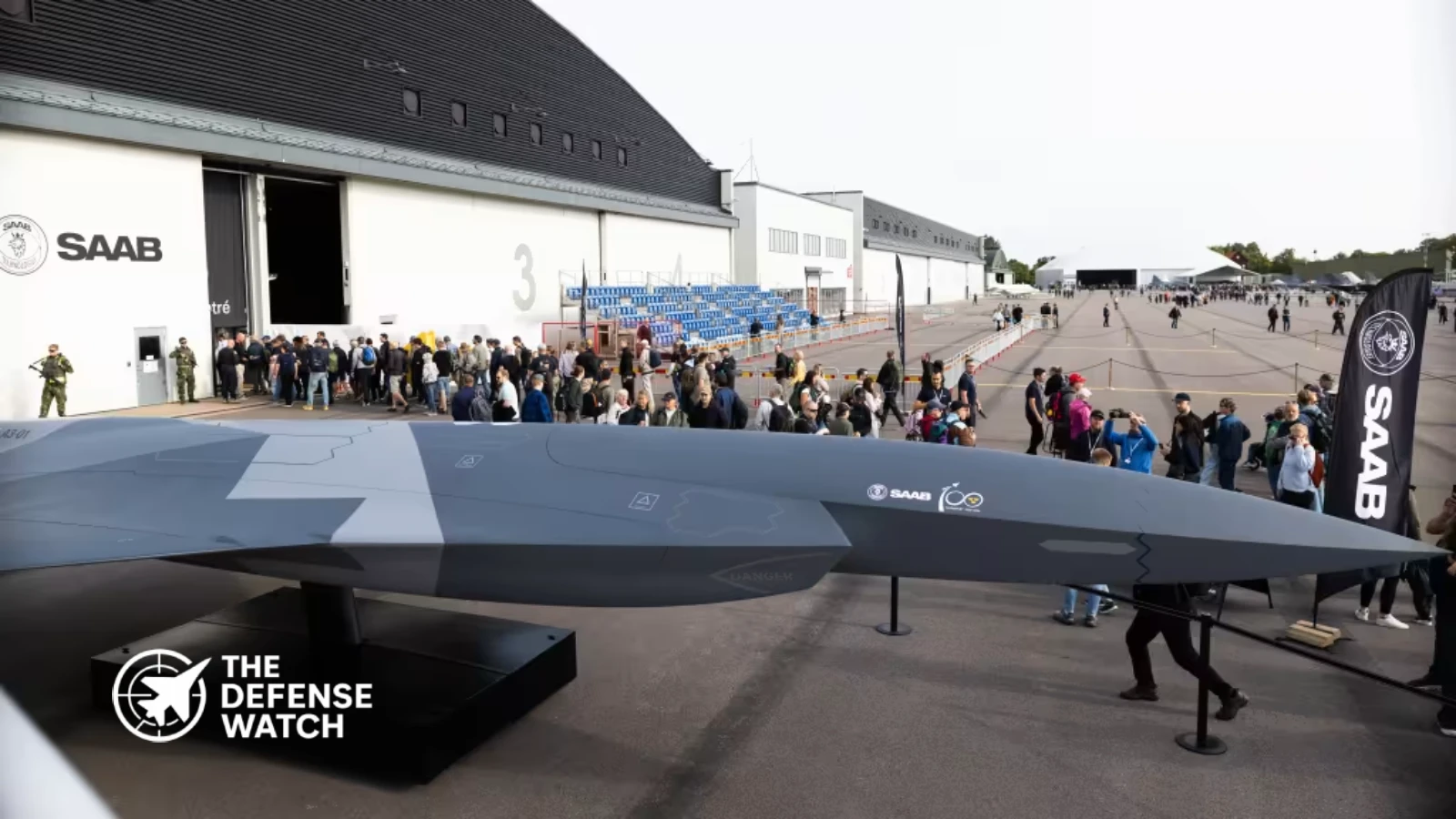
Saab A3-001 Uncrewed Combat Aircraft Concept
Saab has unveiled the full-scale A3-001 uncrewed combat aircraft concept at the Swedish Armed Forces Jubilee Air Show at Malmen Air Base in Linköping, presenting a possible future combat air system in which crewed and uncrewed aircraft operate together. Saab says the concept is intended to illustrate how Sweden could evolve its combat air capability beyond today’s crewed platforms.
The Swedish aerospace company describes A3-001 as a potential uncrewed component of a broader system-of-systems architecture. Rather than replacing fighter aircraft, the concept is intended to complement Gripen and future crewed combat aircraft in missions where sending an uncrewed platform could reduce risk to pilots.
Saab’s announcement does not provide a finalized specification, production configuration, engine selection, weapons load, range or unit cost for A3-001. The aircraft on display is a concept model, so its configuration should not be treated as representative of a production aircraft.
Designed for High-Risk Missions
Saab identifies three broad mission areas for the concept: electronic warfare, suppression of enemy air defenses, and precision strike in highly contested environments. These missions share a common requirement for aircraft to operate where hostile sensors, air defenses and other threats can make conventional crewed operations more difficult.
The concept incorporates Saab’s stated goals of low observability, a high degree of autonomy and the ability to operate across multiple domains. Saab has not released quantitative radar cross-section, speed, endurance, payload or weapons data for A3-001.
That distinction is important because the displayed aircraft represents an early-stage design concept rather than a fielded weapons system. The principal significance of the announcement is therefore the direction of Saab’s combat-air development rather than a new operational capability entering service.
A3-001 Fits a Broader System-of-Systems Approach
The A3-001 concept reflects a shift in how advanced air forces are approaching future combat aviation. Instead of relying exclusively on individual fighters, future formations can be designed around networks of crewed aircraft, uncrewed platforms, sensors, electronic warfare assets and command-and-control systems.
For Sweden, this approach could allow different aircraft to perform different functions within the same mission package. A crewed fighter could remain responsible for tasks requiring human judgment while an uncrewed aircraft conducts missions in areas where the threat level is particularly high.
This architecture also places greater importance on communications, data links, autonomy and mission management. The effectiveness of an uncrewed combat aircraft would depend not only on its airframe, but also on its ability to receive information, share sensor data and continue operating when communications are disrupted.
Those requirements make interoperability a central technical issue. A future Swedish combat air system would need to connect uncrewed aircraft with Gripen, airborne sensors, ground-based command systems and other military networks without creating additional vulnerabilities.
Saab Plans Fighter-Like Uncrewed Demonstrators Before 2030
Peter Nilsson, head of Saab’s Advanced Programs business unit, said the company is working with Sweden on technologies intended to support the next generation of combat air systems.
According to Saab, the company intends to fly uncrewed demonstrators with fighter-like characteristics before 2030. The work is intended to help Sweden assess future options for combat aviation.
Saab separately describes A3-001 as its own concept for what could follow this work in the mid-2030s if Sweden decides to build on the technologies being developed.
This creates a clear distinction between the near-term demonstrator activity and the A3-001 concept. The former is part of current technology development, while the latter illustrates a possible future operational system.
| Area | Saab’s current disclosure |
|---|---|
| Concept | A3-001 |
| Configuration | Full-scale concept model |
| Primary role | Future uncrewed combat air system |
| Crewed integration | Intended to complement Gripen and future crewed aircraft |
| Potential missions | Electronic warfare, SEAD, precision strike |
| Key design goals | Low observability, autonomy, multi-domain operation |
| Demonstrator timeline | Fighter-like uncrewed demonstrators before 2030 |
| Possible A3 timeframe | Mid-2030s, subject to Swedish decisions |
| Production status | No production program announced |
Why the Concept Matters for Swedish Air Power
Sweden’s approach to combat aviation has historically placed significant emphasis on operating capable aircraft from a relatively compact national defense structure. The future integration of uncrewed aircraft could give that force additional ways to distribute risk and mission functions.
A3-001 also comes as Sweden marks the 100th anniversary of its Air Force. The Jubilee Air Show at Malmen Air Base on August 22 and 23 formed the centerpiece of the Swedish Air Force’s centennial celebrations.
The timing provides a visible demonstration of where Saab sees combat aviation heading. The company is moving beyond the traditional model of a fighter as a standalone aircraft and toward a networked force in which different platforms contribute specialized capabilities.
For Sweden, this could eventually support a more flexible force structure. Uncrewed aircraft could potentially be designed around specific missions instead of requiring every platform to perform every task.
Connection to Saab’s Wider Air Warfare Portfolio
A3-001 is also consistent with Saab’s broader development of networked air and surveillance capabilities.
In July 2026, Saab announced an order for two GlobalEye airborne early warning and control aircraft worth SEK 10.1 billion, with deliveries scheduled for 2030. GlobalEye combines airborne sensors with command-and-control functions across air, maritime and land domains.
Earlier in May, Saab and General Atomics Aeronautical Systems reported the first flight of Saab’s LoyalEye airborne early warning sensor integrated onto an MQ-9B aircraft. The companies are developing an unmanned airborne early warning capability intended to provide long-range detection and tracking while complementing manned assets.
These programs illustrate a broader direction in which Saab is applying advanced sensors and mission systems to both crewed and uncrewed platforms. A3-001 would extend that approach into the combat aircraft mission set.
NATO and the Wider Combat Air Context
The development also has relevance beyond Sweden because the country is now a NATO member and Saab’s aircraft and sensor systems are increasingly integrated into multinational defense planning.
NATO announced in July that it would begin formal negotiations with Saab concerning the potential acquisition of up to 10 GlobalEye aircraft. NATO said the requirement is linked to modernization of the alliance’s airborne early warning and control capability.
An uncrewed combat aircraft designed to work with crewed fighters could eventually contribute to the same broader networked approach to air operations. However, Saab has not announced that A3-001 is a NATO program or that any NATO procurement decision has been made concerning the concept.
For the United States and other NATO members, the development is relevant because future coalition air operations increasingly depend on common data, distributed sensing and interoperable command systems. The value of an uncrewed combat aircraft would therefore extend beyond the aircraft itself to the networks and mission systems connecting it with allied forces.
Technical Challenges Remain Before an Operational System
Moving from a full-scale concept to an operational uncrewed combat aircraft would require substantial development.
One of the most difficult areas is autonomous operation in contested airspace. A platform expected to perform electronic warfare, air-defense suppression or precision strike missions would need to make rapid decisions while dealing with uncertain sensor information, changing threats and potentially degraded communications.
Another challenge is survivability. Low observability can reduce the probability of detection, but it does not eliminate the threat posed by modern sensors and integrated air defenses. An operational aircraft would therefore need a combination of signature management, electronic warfare, situational awareness and mission planning.
Weapons integration would create another development path. Saab has not disclosed a weapons configuration for A3-001, so claims about specific missiles or strike payloads would be premature.
The aircraft would also need to operate within strict rules governing autonomous systems and human control. The more complex the mission, the greater the importance of reliable command authority, identification of targets and safeguards against unintended engagement.
Saab’s Concept Points Toward the Mid-2030s
Saab’s A3-001 display does not represent a production aircraft or an immediate replacement for Gripen. Instead, it provides a visible indication of the company’s direction for future uncrewed combat aviation.
The immediate development milestone is the planned flight testing of fighter-like uncrewed demonstrators before 2030. A3-001 represents a separate Saab concept for a possible capability that could emerge in the mid-2030s if Sweden decides to proceed with the technology and associated combat air architecture.
The most important feature of the concept is therefore not a disclosed performance figure, but the operating model behind it. Saab is examining how uncrewed aircraft could become integrated members of a combat formation, working alongside pilots, sensors and command systems rather than operating as conventional standalone drones.
That approach places A3-001 within a wider transformation of military aviation toward distributed, networked and increasingly autonomous combat systems. For Sweden and its NATO partners, the success of such a model will ultimately depend on whether the technology can deliver useful combat effects while maintaining interoperability, survivability and meaningful human control.
Get real time update about this post category directly on your device, subscribe now.