Takeaways
The U.S. Navy has disclosed the AIM-424 Malice, a new long-range air-to-air missile designed to extend the engagement range of current and future naval fighters.
U.S. Navy Reveals AIM-424 Malice Long-Range Air-to-Air Missile
The AIM-424 Malice is the U.S. Navy’s newly disclosed long-range air-to-air missile, with an officially stated range of more than 250 nautical miles, or 463 kilometers. The Navy identified the weapon as the Long Range Air-to-Air Missile, or LRAAM, and lists Raytheon as its contractor.
The Navy publicly disclosed the program at the Tailhook Symposium in Reno, Nevada, on August 22, 2026, before adding the AIM-424 to its official Fact Files. The service says the missile is intended to strengthen fleet defense and provide greater reach, survivability and tactical flexibility against advanced air threats.
The disclosure is significant because the AIM-424 is being designed across multiple generations of naval aircraft. The Navy identifies fourth-, fifth- and sixth-generation platforms as potential users, including the F/A-18, F-35 and future F/A-XX.
AIM-424 Malice Specifications
The Navy has released a limited but important set of technical specifications.
| Specification | AIM-424 Malice |
|---|---|
| Primary function | Air-to-air missile |
| Contractor | Raytheon |
| Propulsion | Solid-propellant rocket motor |
| Length | 13.5 feet, 4.11 meters |
| Diameter | 13.5 inches, 0.34 meters |
| Wingspan | 26.2 inches, 0.67 meters |
| Weight | 1,500 pounds, 680.4 kg |
| Stated range | More than 250 nautical miles, 463 km |
| Warhead | Blast fragmentation |
| Intended aircraft | F/A-18, F-35, F/A-XX |
| Generation compatibility | Fourth, fifth and sixth generation |
These figures come directly from the Navy’s AIM-424 fact sheet. The service has not released a public operational timeline or a complete description of the missile’s guidance and seeker systems.
A Much Larger Weapon Than the AIM-120
The physical dimensions of the AIM-424 show the engineering tradeoff behind its long-range mission.
At 13.5 feet in length and 1,500 pounds, Malice is considerably larger than the AIM-120 AMRAAM used by U.S. and allied fighters. The additional size provides considerably more volume for propulsion, control systems and other components needed for long-range flight, but it also creates integration challenges for aircraft that must carry the weapon internally or on external stations.
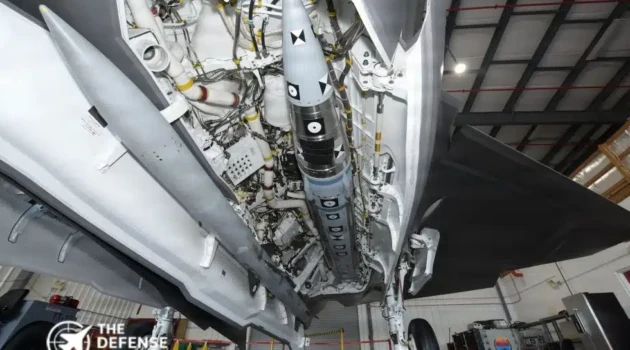
The Navy’s own imagery shows the AIM-424 associated with both the F/A-18E Super Hornet and F-35C. A Navy image released in August shows the missile installed in the F-35C’s internal weapons bay, demonstrating that internal carriage is part of the program’s aircraft integration effort.
That point matters for the F-35C. Internal carriage preserves the aircraft’s low-observable configuration, allowing a long-range weapon to be carried without relying exclusively on external pylons that can increase radar signature.
The F/A-18E/F, meanwhile, offers greater external carriage flexibility. Recent Navy imagery has shown test aircraft carrying multiple AIM-424 training or test missiles, indicating that flight testing has already progressed beyond a purely conceptual stage.
What the 250-Nautical-Mile Range Means
The Navy’s stated range of more than 250 nautical miles places the AIM-424 in a different class from conventional medium-range air-to-air weapons.
Range alone, however, does not determine the effective combat envelope of a missile. Actual engagement performance depends on launch conditions, altitude, speed, target maneuvering, seeker performance, guidance updates, electronic warfare conditions and the amount of energy remaining when the missile reaches the target area.
For that reason, the Navy’s 250-plus nautical mile figure should be treated as a published maximum range indicator rather than a guarantee that every target can be engaged at that distance.
The operational value is instead the ability to give naval aviators more options before entering the threat envelope of opposing aircraft or air-defense systems. A longer-range weapon can potentially allow a fighter to remain farther from an adversary while still contributing to an engagement.
That becomes particularly relevant to carrier aviation, where aircraft must operate from mobile platforms that can be exposed to increasingly long-range surveillance and strike systems.
Built for the F/A-18, F-35C and F/A-XX
The Navy explicitly identifies the AIM-424 as a weapon for fourth-, fifth- and sixth-generation platforms. That makes it more than a replacement weapon for a single fighter type.
The F/A-18E/F remains a major component of carrier aviation. The Navy’s 2025 year-in-review publication said the Super Hornet fleet is expected to continue operating into the 2040s, while the Navy’s sixth-generation strike fighter will eventually augment and replace the Super Hornet and EA-18G Growler.
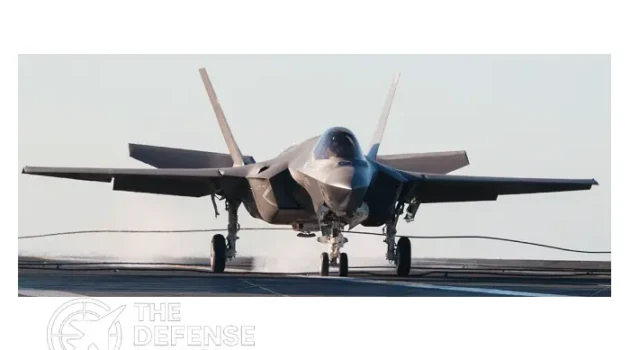
The F-35C adds another important dimension. Its stealth characteristics and sensor architecture provide a different method of employing long-range weapons, particularly when the aircraft can detect, track or receive targeting information without exposing itself unnecessarily.
The future F/A-XX is expected to become another major carrier-based platform for the weapon. Navy aviation planning describes F/A-XX as a sixth-generation fighter intended to bring greater range, speed and sensor capability to the carrier air wing while operating alongside unmanned systems.
A common long-range missile across these aircraft could therefore provide continuity as the carrier air wing transitions between generations.
AIM-424 and the U.S. Long-Range Air Combat Requirement
The AIM-424 is emerging alongside other U.S. efforts to extend air-to-air engagement ranges.
The Navy has already introduced the AIM-174B Gunslinger, an air-launched adaptation of the SM-6 family, while the Navy and Air Force are also pursuing the AIM-260 Joint Advanced Tactical Missile. The emergence of Malice indicates that the U.S. is pursuing multiple long-range air-to-air options rather than relying on a single weapon architecture.
The distinction between these weapons is important. The AIM-424 is specifically described by the Navy as an LRAAM intended for fourth-, fifth- and sixth-generation aircraft, while the AIM-174B is derived from a larger surface-to-air missile family and provides a different combination of range and platform integration.
The AIM-260, meanwhile, is intended to provide a next-generation tactical air-to-air capability for U.S. fighters. The continued development of all three reflects the importance the U.S. military places on long-range air combat.
Why the Missile Matters for Carrier Aviation
The central issue for the Navy is not simply missile range. It is the changing geometry of combat in the Indo-Pacific.
Potential adversaries are developing aircraft, sensors and weapons that can threaten carrier air wings at increasingly long distances. A carrier-based fighter therefore needs to detect, identify, target and engage threats without necessarily approaching the range at which the opposing force can effectively attack the carrier or supporting aircraft.
A weapon such as Malice can contribute to that requirement by extending the reach of the fighter itself.
The Navy describes the program in terms of maintaining a first-look, first-shot and first-kill advantage. In practical terms, that concept depends on more than the missile. It requires a complete chain involving sensors, data links, airborne networking, electronic warfare, targeting information and reliable weapon guidance.
This makes aircraft integration particularly important. A very long-range missile has limited value if the launching aircraft cannot obtain a sufficiently accurate track, maintain the required data exchange or defeat electronic countermeasures during the engagement.
Internal Carriage Creates an Important F-35C Challenge
The F-35C presents a particularly demanding integration problem because the aircraft’s internal weapons capacity is constrained by bay dimensions and aerodynamic requirements.
The Navy’s released imagery indicates that the AIM-424 has been fitted into an F-35C weapons bay. That is an important development because the missile’s 13.5-foot length and 13.5-inch diameter make it a large weapon for internal carriage.
The integration effort will have to balance missile size against the aircraft’s internal weapon capacity, separation safety, flight characteristics and mission configuration.
If the AIM-424 can be carried internally without major restrictions, it could allow the F-35C to combine low-observable operations with substantially longer-range air-to-air effects. The Navy has not yet published enough information to determine the final operational loadout or restrictions.
What Remains Classified
The Navy has provided the missile’s basic dimensions, weight, propulsion type, warhead and range, but many of the characteristics that determine actual combat performance remain undisclosed.
Those include the specific seeker technology, guidance architecture, datalink capabilities, terminal engagement characteristics, maximum speed, no-escape-zone performance and resistance to electronic countermeasures.
The Navy has also not announced an operational deployment date. Defence Industry Europe reported that further details on specific capabilities and deployment timelines remain classified for operational security reasons.
That makes it premature to describe Malice as an operational replacement for an existing missile. The available information establishes that the Navy is developing the system and has conducted aircraft integration activity, but it does not establish an initial operational capability date.
A Decade-Long Development Path
The AIM-424 appears to have roots in earlier U.S. work on very-long-range air-to-air weapons.
Aviation Week reporting cited by Defence Industry Europe connects the program with a Long Range Engagement Weapon concept disclosed in 2017. Earlier budget documentation described a two-year technology demonstration before the technology was transferred to the military services.
That history helps explain why the Navy is now able to disclose an apparently mature weapon rather than a purely conceptual design.
Recent reporting has also identified flight-test activity involving F/A-18E aircraft and integration work with the F-35C. A Navy photograph shows the weapon associated with an F/A-18E test aircraft, while another image shows an AIM-424 in an F-35C weapons bay.
The public evidence therefore points to a program that has moved into aircraft integration and testing, although the Navy has not disclosed the complete test schedule or milestones.
Strategic Implications for U.S. Airpower
The most important feature of Malice is its combination of range and platform flexibility.
A missile designed for Super Hornets, F-35Cs and the future F/A-XX can potentially provide a common long-range air-to-air effect across several stages of the Navy’s fighter modernization plan.
For carrier aviation, that could reduce the gap between today’s force and the future air wing. The Super Hornet can provide near-term capacity, the F-35C brings stealth and advanced sensing, and F/A-XX is being developed for the next generation of carrier air combat.
The AIM-424 does not solve the broader challenge of long-range air warfare by itself. Its effectiveness will depend on the aircraft carrying it, the quality of the targeting network and the ability of the entire force to operate inside heavily contested electromagnetic and air-defense environments.
What the disclosure does show is that the Navy is placing substantial emphasis on increasing the reach of its carrier-based air-to-air weapons.
AIM-424 Malice: What Is Confirmed
Based on the Navy’s official fact sheet and publicly released imagery, the following points are confirmed:
- The weapon is designated AIM-424 LRAAM.
- Its official name is Malice.
- Raytheon is the contractor.
- The Navy lists its range as more than 250 nautical miles, or 463 kilometers.
- It uses a solid-propellant rocket motor.
- It has a blast-fragmentation warhead.
- It is 13.5 feet long.
- Its diameter is 13.5 inches.
- Its wingspan is 26.2 inches.
- Its listed weight is 1,500 pounds.
- It is intended for fourth-, fifth- and sixth-generation aircraft.
- The Navy identifies the F/A-18, F-35 and future F/A-XX as intended platforms.
- The Navy has not announced an operational deployment timeline.
Conclusion
The U.S. Navy’s disclosure of the AIM-424 Malice marks a significant addition to its long-range air-to-air weapon portfolio.
With an officially stated range beyond 250 nautical miles and planned compatibility with F/A-18E/F, F-35C and F/A-XX aircraft, the missile is designed to extend the reach of naval aviation as the carrier air wing moves toward a more distributed and networked combat model.
The weapon is still under development, and key information about its seeker, guidance system, speed, engagement envelope and deployment schedule remains unavailable. Those details will ultimately determine how the AIM-424 fits alongside the AIM-120, AIM-174B and AIM-260.
For now, the Navy’s disclosure establishes the core fact: the United States is developing a large, long-range air-to-air missile specifically intended to give naval fighters substantially greater reach against advanced air threats.
Get real time update about this post category directly on your device, subscribe now.