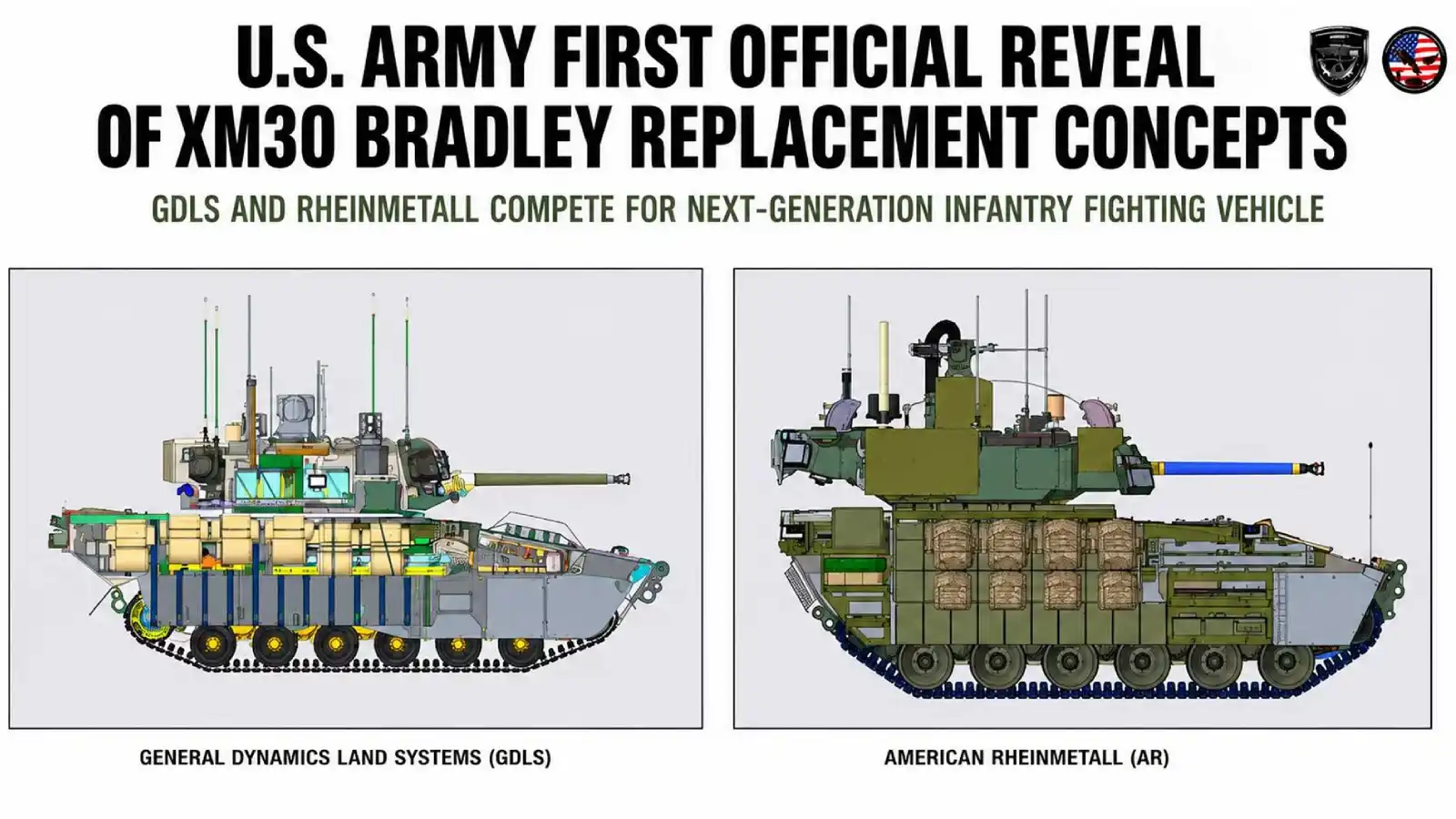
The U.S. Army has released the first official designs of its XM30 mechanized infantry combat vehicle contenders, marking a major step in replacing the aging Bradley fleet.
(adsbygoogle = window.adsbygoogle || []).push({});Executive Summary:
The U.S. Army has unveiled the first official designs of two XM30 infantry fighting vehicle candidates competing to replace the M2 Bradley. The program focuses on AI integration, survivability, and future battlefield networking as the Army accelerates armored modernization efforts.
U.S. Army Reveals First XM30 Infantry Fighting Vehicle Designs
The U.S. Army’s XM30 infantry fighting vehicle program has entered a new phase after officials revealed the first designs of two competing armored vehicle concepts intended to replace the long serving M2 Bradley infantry fighting vehicle.
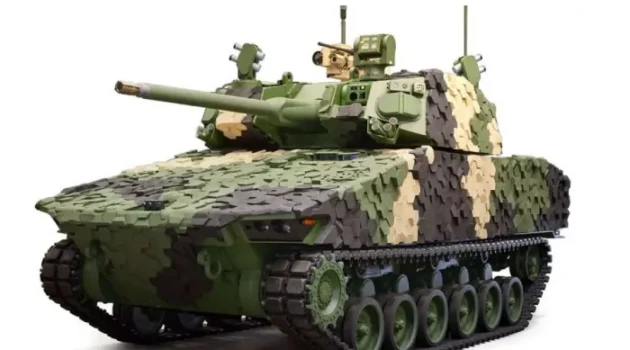
The two competing teams are led by General Dynamics Land Systems and American Rheinmetall Vehicles. Both companies are developing advanced mechanized infantry platforms designed for future multidomain combat operations.
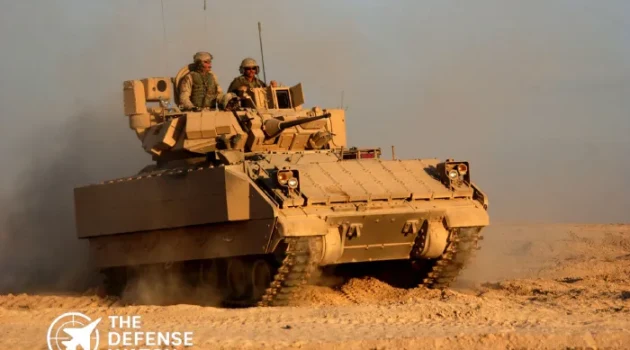
The XM30 program, previously known as the Optionally Manned Fighting Vehicle initiative, represents one of the Army’s most important armored modernization projects. The new vehicle is intended to replace thousands of Bradley fighting vehicles that have served since the early 1980s.
Focus On AI Integration And Battlefield Networking
A defining feature of the XM30 infantry fighting vehicle program is its emphasis on artificial intelligence enabled battlefield capabilities.
The Army is seeking a platform capable of integrating autonomous systems, advanced targeting technologies, predictive maintenance tools, and sensor fusion networks. The goal is to reduce crew workload while improving battlefield awareness and operational survivability.
The two XM30 concepts feature modular architectures that could support future software upgrades and autonomous operations. Army planners have repeatedly stressed that future armored combat vehicles must operate within highly connected combat environments where electronic warfare, drone threats, and rapid sensor sharing play critical roles.
This marks a broader doctrinal shift in U.S. armored warfare. Instead of relying solely on heavier armor protection, future infantry fighting vehicles are increasingly expected to survive through networked awareness, active protection systems, mobility, and AI assisted decision making.
Competing Designs Reflect Different Operational Approaches
The two competing XM30 infantry fighting vehicle concepts appear to reflect different engineering priorities.
The General Dynamics Land Systems proposal reportedly emphasizes survivability and integrated digital architecture. Meanwhile, the American Rheinmetall Vehicles design appears influenced by modern European infantry fighting vehicle trends, including unmanned turret concepts and advanced mission systems.
Both vehicles are expected to include hybrid propulsion technologies aimed at reducing fuel consumption while increasing onboard electrical power generation for future systems.
The Army has also prioritized reduced logistical burden. That includes easier maintenance access, improved operational readiness rates, and greater adaptability across combat scenarios.
The XM30 infantry fighting vehicle will likely serve as a central component of future U.S. Army mechanized formations for decades, making the program strategically significant beyond simple fleet replacement.
Lessons From Ukraine Continue To Shape Requirements
Combat operations in Ukraine continue to influence global armored vehicle development, including U.S. Army modernization priorities.
Recent battlefield experience has demonstrated the growing vulnerability of armored vehicles to loitering munitions, armed drones, top attack missiles, and long range precision fires. As a result, survivability requirements for next generation infantry fighting vehicles have expanded beyond traditional armor thickness.
The XM30 infantry fighting vehicle program reflects those evolving realities. Future vehicles are expected to operate in highly contested electromagnetic environments while maintaining communications resilience and situational awareness.
The Army’s emphasis on optional manning capability also highlights increasing interest in reducing soldier exposure during high risk operations. While the XM30 is expected to remain crewed in most operational scenarios, future autonomous capabilities could support remote operations in contested areas.
Industrial Competition And Strategic Importance
The competition between major defense manufacturers underscores the long term industrial importance of the XM30 program.
Replacing the Bradley fleet represents a multibillion dollar opportunity likely to shape the future of the U.S. armored vehicle industrial base. The eventual production winner could secure decades of manufacturing work, sustainment contracts, and export opportunities.
The program also demonstrates continued Pentagon investment in conventional land warfare modernization despite growing focus on Indo Pacific competition and emerging technologies.
Army modernization officials have repeatedly stated that armored maneuver forces remain essential for deterrence and large scale combat operations. The XM30 infantry fighting vehicle is therefore expected to play a key role in future combined arms doctrine alongside the M1 Abrams and future robotic combat systems.
Program Timeline And Next Steps
The U.S. Army is expected to continue detailed design evaluations before selecting prototypes for further testing phases.
Future testing will likely examine mobility, survivability, digital integration, operational reliability, and interoperability with existing Army combat systems.
If development remains on schedule, the XM30 infantry fighting vehicle could begin gradually replacing Bradley vehicles during the next decade.
The modernization effort reflects the Army’s broader push to prepare for future high intensity conflicts where speed, data integration, autonomous support systems, and survivability will define battlefield effectiveness.