Executive Summary:
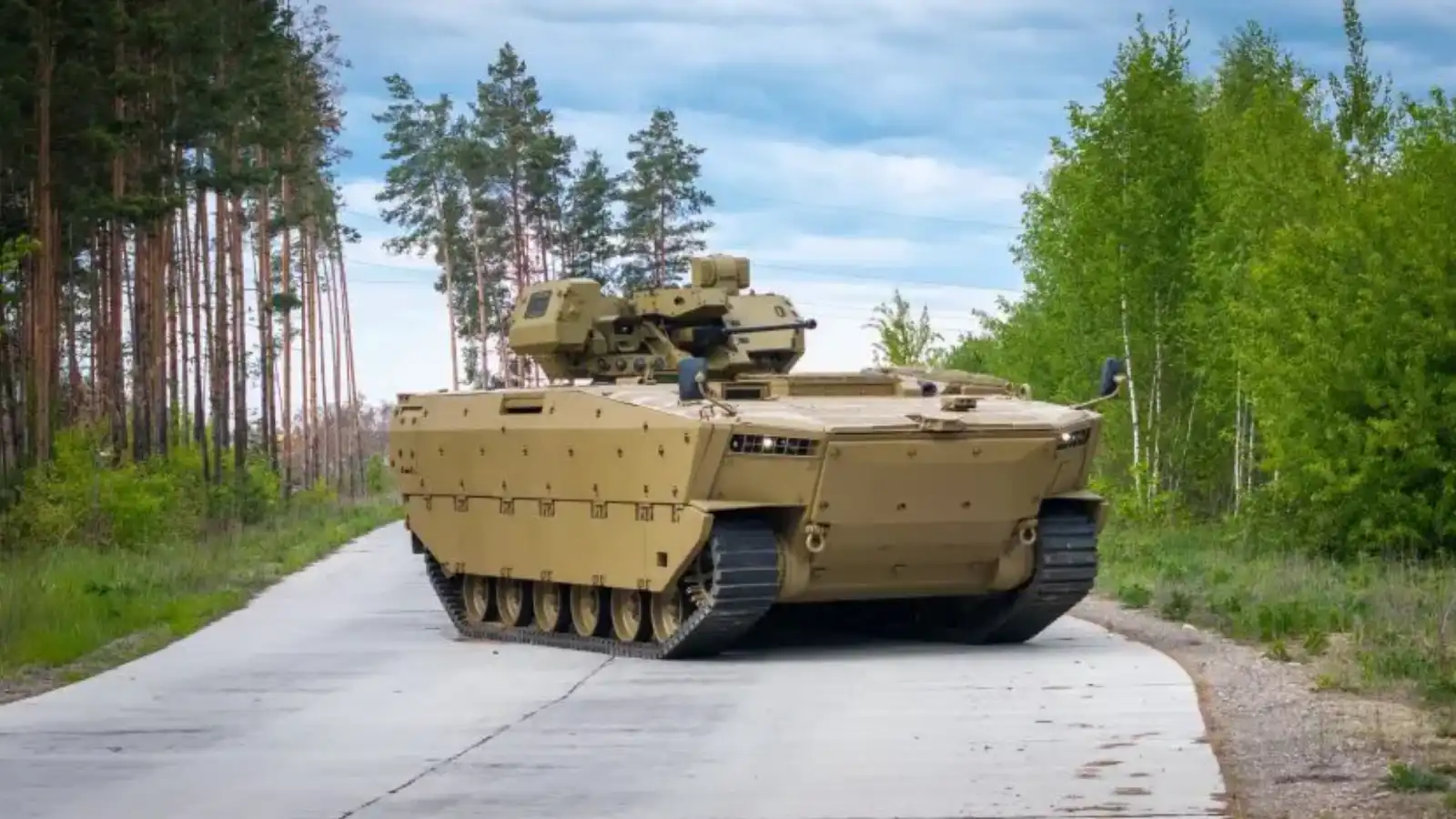
Poland’s PGZ unveiled an export version of the Borsuk infantry fighting vehicle equipped with the Turra 30 turret during IDEB 2026 in Bratislava.
The move highlights Warsaw’s push to expand defense exports while offering NATO-aligned armies a modern amphibious tracked combat vehicle with modular weapon options.
PGZ Export Borsuk IFV Debuts At IDEB 2026
The export Borsuk infantry fighting vehicle was officially presented by Polska Grupa Zbrojeniowa during the IDEB 2026 defense exhibition, marking a significant step in Poland’s effort to position its next generation armored platforms in international markets.
The vehicle displayed at the exhibition combined the Polish-developed Borsuk chassis with the Slovak-made Turra 30 remote-controlled turret. The configuration is aimed at export customers seeking a modern tracked infantry fighting vehicle with NATO-standard systems, amphibious capability, and modular combat options.
The new variant was showcased as part of broader regional defense cooperation between Polish and Slovak defense manufacturers.
A NATO-Focused Export Strategy
The Borsuk program has become one of Poland’s most important land modernization projects. Developed by HSW S.A. under the PGZ group, the platform is intended to replace the Soviet-era BWP-1 vehicles still used by the Polish Armed Forces.
The unveiling of an export-configured version signals that PGZ is now moving beyond domestic procurement and actively targeting allied nations looking to modernize aging armored fleets.
That strategy comes as several European states increase defense spending following continued security concerns across Eastern Europe and renewed emphasis on NATO readiness. Amphibious infantry fighting vehicles remain relatively limited within NATO inventories, giving the Borsuk a potentially important niche in mobility-focused operations.
Unlike many heavier Western IFVs, the Borsuk was designed to maintain amphibious capability without extensive preparation. That operational flexibility may appeal to militaries operating in river-heavy terrain or requiring rapid maneuver operations.
Turra 30 Integration Expands International Appeal
A key feature of the export Borsuk infantry fighting vehicle is the integration of the Turra 30 turret, developed by Slovak defense firm EVPU.
The remotely operated turret is armed with a 30mm automatic cannon and can be configured with anti-tank guided missiles and advanced fire control systems. The system is already known within Central European defense markets, which may simplify logistics and interoperability for regional operators.
By pairing the Borsuk platform with a non-Polish turret option, PGZ appears to be adopting a more flexible export approach. That could allow future buyers to integrate national subsystems, communications equipment, or weapon packages according to operational requirements.
The approach reflects a broader trend across the European defense sector, where modularity and industrial cooperation are increasingly important in multinational procurement programs.
Export Borsuk IFV Targets Growing European Demand
Demand for tracked infantry fighting vehicles has increased sharply across Europe since 2022, with multiple NATO members launching recapitalization programs for mechanized ground forces.
Countries in Central and Eastern Europe are especially focused on replacing legacy Soviet-designed armored systems with NATO-compatible platforms featuring stronger protection, digital battle management systems, and improved mobility.
The export Borsuk infantry fighting vehicle enters a highly competitive market that includes vehicles such as the CV90, Lynx KF41, and ASCOD.
However, the Borsuk offers a distinct balance between mobility, amphibious operations, and modern combat systems. That combination may prove attractive for nations prioritizing operational flexibility over heavier armor configurations.
Poland’s rapidly expanding defense industrial base could also strengthen the platform’s export prospects. Warsaw has significantly increased military production capacity in recent years while investing heavily in armored vehicle manufacturing and artillery systems.
Regional Defense Cooperation Gains Momentum
The IDEB 2026 presentation also underscored expanding defense cooperation between Poland and Slovakia. Joint industrial initiatives are becoming more common across Central Europe as regional governments seek to strengthen local defense production and reduce dependence on non-European suppliers.
The integration of the Turra 30 turret onto the Borsuk platform demonstrates how regional defense firms are increasingly pursuing collaborative export solutions rather than competing independently.
For PGZ, the export Borsuk infantry fighting vehicle represents more than a new armored platform. It also reflects Poland’s ambition to emerge as a major European defense exporter capable of delivering advanced land systems to NATO and partner nations.
Whether the vehicle secures international contracts will likely depend on pricing, production timelines, interoperability, and how effectively PGZ can compete against established Western European manufacturers.
Why The Borsuk Matters
The unveiling of the export Borsuk infantry fighting vehicle comes at a time when European armies are reassessing force mobility, survivability, and industrial resilience.
Poland’s defense sector has gained visibility through accelerated modernization programs and growing regional influence. If the Borsuk succeeds internationally, it could strengthen Poland’s position within Europe’s armored vehicle market and expand defense industrial cooperation across NATO’s eastern flank.
The addition of the Turra 30 turret also signals a practical export philosophy centered on adaptability and multinational integration rather than a single fixed configuration.