(adsbygoogle = window.adsbygoogle || []).push({});Executive Summary:
The AGM-114 Hellfire began in 1971 as a Cold War contingency weapon — a laser-guided tank killer designed to stop Soviet armor from rolling through the Fulda Gap. Over five decades, it evolved into the primary precision munition of the drone age, carried by MQ-9 Reapers, AH-64 Apaches, and a dozen allied platforms across the globe. Its most classified variant, the R9X, carries no explosive at all — just kinetic mass and six deployable steel blades, making it arguably the most surgically precise lethal weapon in any nation’s inventory.
Between 1998 and 2018 alone, the U.S. Department of Defense procured over 71,500 AGM-114 Hellfire missiles at a total cost of $7.2 billion. That volume tells only part of the story. The Hellfire is not merely a munition — it is a doctrine written in aluminum and laser light, one that has fundamentally reordered how the United States, and by extension NATO, thinks about air-to-ground precision strike.
- The Origin: Soviet Tanks and a 1971 Army Requirement
- Technical Architecture and the Multi-Variant Family
- Data Block: AGM-114 Hellfire Variant Comparison
- The UAV Pivot — How the Reaper Redefined the Hellfire’s Mission
- The Strategic Irony — A $150,000 Round Replacing a $150 Million Ground Raid
- The Competitive Intelligence Angle — How Hellfire Logic Maps to Tactical Decision-Making
- Conclusion: The Weapon That Defined an Era — and What Comes Next
No other single weapons system has undergone as dramatic a strategic reinvention. It was born to kill tanks. Today, one of its variants kills individual human beings from 30,000 feet, leaving behind a car with a surgically punctured roof and no blast crater.
The Origin: Soviet Tanks and a 1971 Army Requirement
The development program began in 1971 under a brutally literal name: Heliborne Laser, Fire and Forget Missile — an acronym that collapsed naturally into “Hellfire.” The U.S. Army needed a tank-busting weapon for its AH-64 Apache attack helicopters, purpose-built to counter the Warsaw Pact’s armored columns in a potential European land war.
Rockwell International received the first development contract in October 1976. Martin Marietta entered as an equal partner after offering a cheaper guidance seeker. By late 1978, prototype YAGM-114A test firings had begun. Operational testing completed in 1981; the missile entered service with the Army in 1984.
The Cold War threat it was designed to answer never materialized. Instead, the Hellfire went to war in the Persian Gulf.
Technical Architecture and the Multi-Variant Family
The Core Airframe
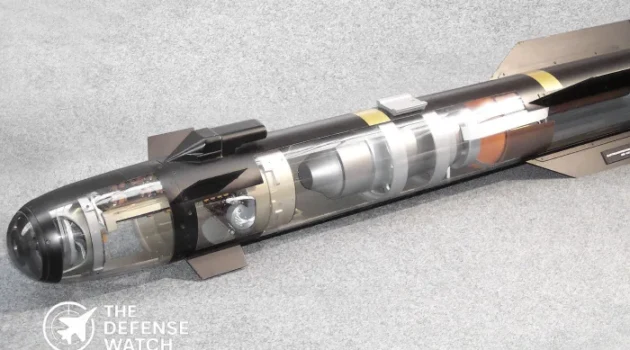
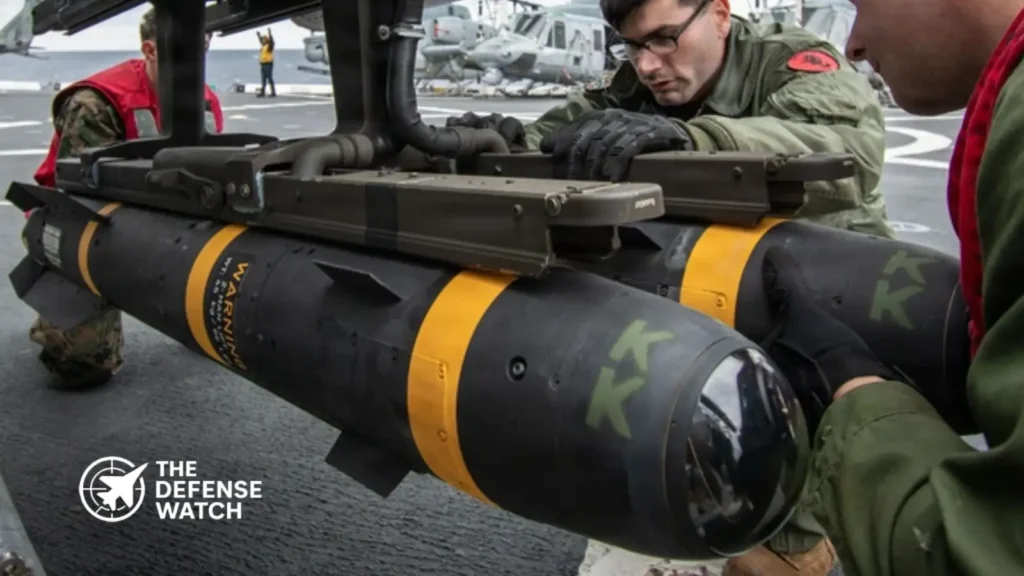
The AGM-114’s base specifications have remained remarkably consistent across its family tree. The missile is 163 cm long, 17.8 cm in diameter, and weighs approximately 49 kg depending on warhead configuration. Its solid-fuel rocket motor propels it to speeds exceeding Mach 1.3, with a maximum operational range of roughly 8–11 km from rotary-wing platforms and potentially further from high-altitude UAV launch profiles.
Guidance, however, is where the variants diverge dramatically.
(adsbygoogle = window.adsbygoogle || []).push({});The Variant Spectrum
The early AGM-114A/B/C series used semi-active laser (SAL) homing — a laser designator paints the target, the seeker rides the reflected beam. Effective, but it tethers the launching platform to the target until impact. Not ideal when the platform is a helicopter at low altitude over a contested battlespace.

The AGM-114K “Hellfire II”, entering service in 1996, refined the SAL seeker with a digital autopilot and anti-jamming improvements. The AGM-114L “Longbow Hellfire” broke the mold entirely: a millimeter-wave (MMW) active radar seeker enables true fire-and-forget engagement. Launch, maneuver, hide — the missile finds the tank on its own.
The AGM-114R “Romeo”, introduced in 2010, was the unification variant. It merged the capabilities of every preceding model — blast fragmentation, anti-armor HEAT, and enclosed-space engagement — into a single multipurpose warhead. One missile, previously four. A logistical and operational simplification with significant cost implications.
Then came the variant the Pentagon refused to confirm existed for years.
The R9X: Kinetic Assassination Without Explosives
The AGM-114R9X — colloquially the “Ninja Bomb” or “Flying Ginsu” — does not carry an explosive warhead. In its place: approximately 45 kg of dense kinetic mass and six razor-sharp steel blades that deploy from the missile body seconds before impact, extending roughly 1–2 meters outward.
-
(adsbygoogle = window.adsbygoogle || []).push({});
The operational logic is precise and ruthless. Against a target in a vehicle or an exposed position, the R9X punches through the roof or canopy with kinetic force, and the blades shred whatever is in the immediate strike zone. The explosive blast radius — which can kill or injure civilians 30–50 meters away in a standard warhead detonation — drops to near zero.
The Wall Street Journal first reported the weapon’s existence in 2019. The U.S. first used it operationally in 2017. Its confirmed high-profile uses include:
- 2019: Killing of Abu al-Khayr al-Masri, al-Qaeda’s deputy leader, in Idlib, Syria
- 2022: The elimination of Ayman al-Zawahiri in Kabul, Afghanistan — struck on a balcony while his family remained unharmed inside the building
- March 2025: Elimination of Muhammed Yusuf Ziya Talay, a senior Hurras al-Din commander, confirmed by CENTCOM video showing a pickup truck with only the driver’s side roof perforated
That last point deserves emphasis: a weapon that can kill one person in the front seat of a car without injuring the passenger beside them represents a categorical leap in targeted lethality.
Data Block: AGM-114 Hellfire Variant Comparison
Variant Guidance Type Primary Role Warhead Type Approx. Unit Cost Key Platform AGM-114A/B/C Semi-Active Laser Anti-Armor (Cold War) HEAT (shaped charge) ~$40,000–$60,000 AH-64 Apache (early) AGM-114K (Hellfire II) Semi-Active Laser (digital) Anti-Armor / Multi-Target HEAT w/ anti-jamming ~$60,000–$120,000 AH-64, AH-1, MQ-1 Predator AGM-114L (Longbow) MMW Active Radar Fire-and-Forget Armor HEAT ~$100,000–$150,000 AH-64D/E Apache Longbow AGM-114M Semi-Active Laser Soft/Urban Targets Blast-Fragmentation ~$70,000–$120,000 AH-1Z, AH-64, MQ-9 AGM-114N Semi-Active Laser Enclosed Structures Metal Augmented Charge ~$80,000–$130,000 Multi-platform AGM-114R (Romeo) Semi-Active Laser Multi-Mission Universal Multi-Purpose ~$150,000–$200,000 MQ-9 Reaper, AH-64E AGM-114R9X Semi-Active Laser HVT Surgical Strike Kinetic/Blade (No Explosive) Classified (~$200,000+) MQ-9 Reaper Cost figures reflect open-source contract reporting and DoD procurement data. R9X costs remain officially classified.
(adsbygoogle = window.adsbygoogle || []).push({});The UAV Pivot — How the Reaper Redefined the Hellfire’s Mission
The Predator/Hellfire marriage in 2001 was not planned doctrine — it was improvised urgency.
The Air Force had operated the MQ-1 Predator as a pure surveillance asset. After the USS Cole bombing and the escalating al-Qaeda threat, CIA and USAF planners began evaluating whether the Predator could carry a weapon. The Predator first flight-tested a Hellfire in January 2001 and fired one in combat in October 2001 — weeks after the September 11 attacks, over Afghanistan.
That improvisation became the template for the next two decades of U.S. counterterrorism operations.
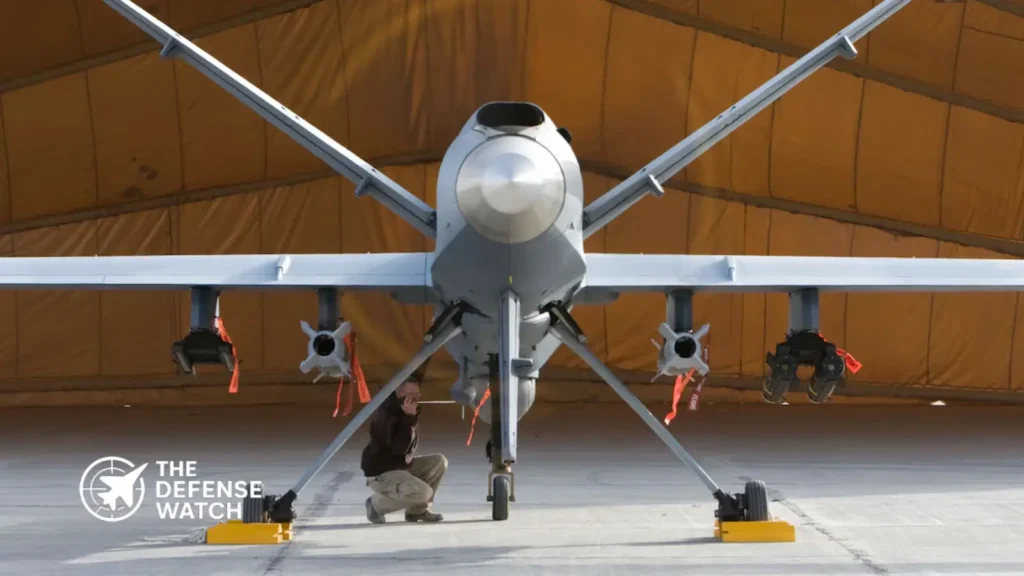
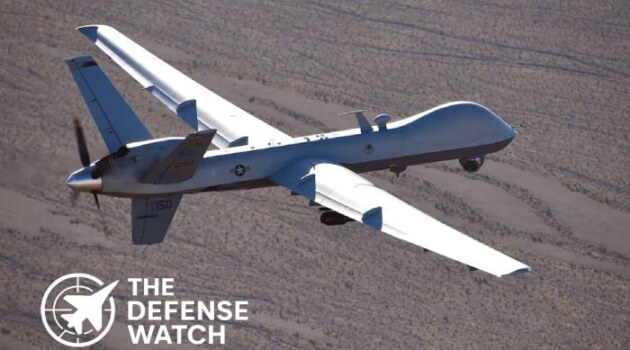
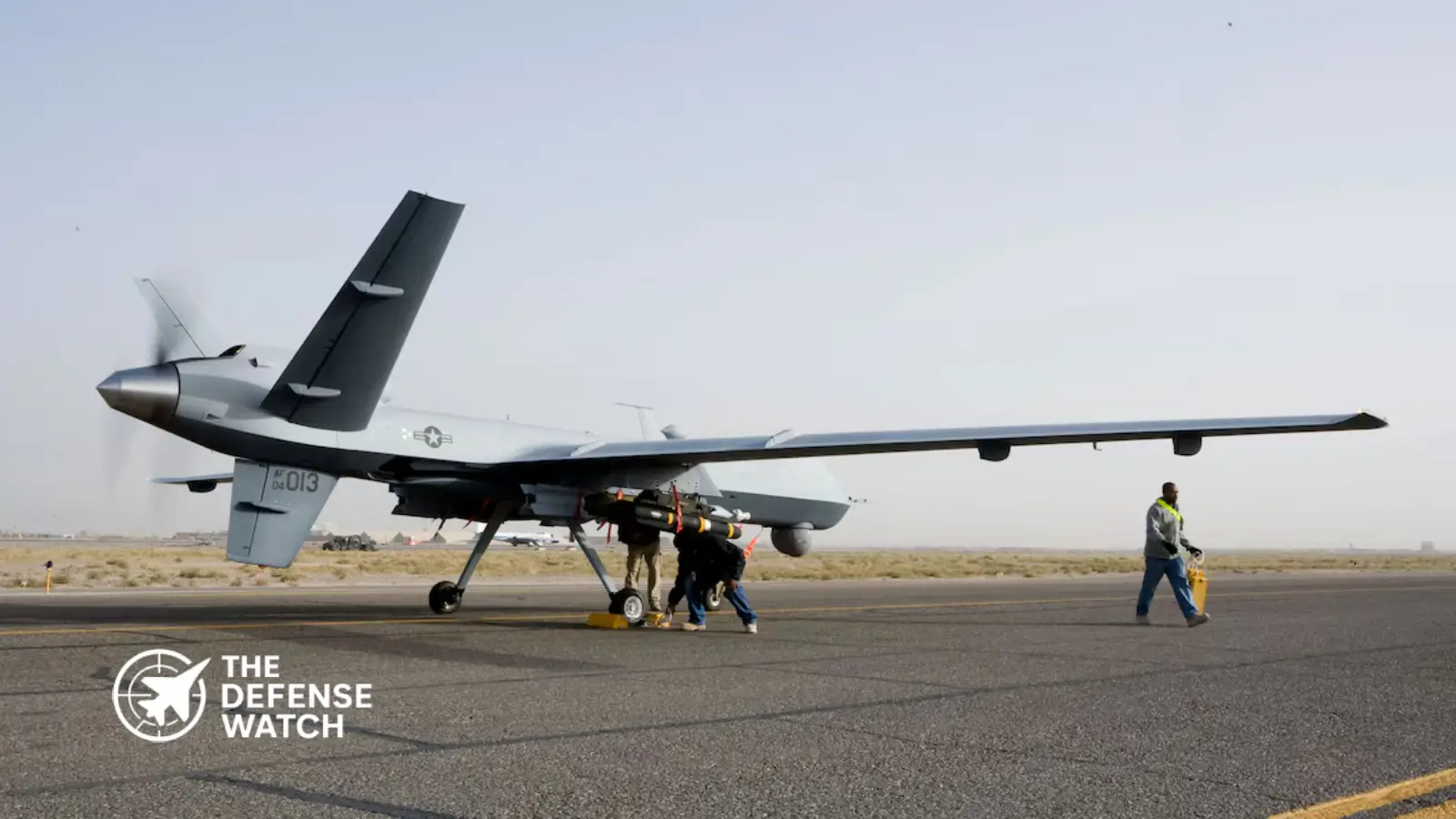
The MQ-9 Reaper, entering service in 2007, was built from the ground up to do what the Predator could only partially accomplish. With over 27 hours of endurance, a payload capacity approaching 1,700 kg, and a ceiling of 50,000 feet, the Reaper could loiter over a target for a full day, confirm identification, establish pattern-of-life intelligence, and strike — all without a pilot risking exposure. It carries up to four AGM-114 Hellfires per sortie, with mixed loadouts common (Romeos for armored targets, R9X rounds for individual HVTs).
The doctrine shift this enabled was profound. The Hellfire was no longer a weapon of maneuver warfare. It became an instrument of deliberate, intelligence-driven targeted killing — a strategic tool dressed in tactical hardware.
(adsbygoogle = window.adsbygoogle || []).push({});“We’ve moved from using UAVs primarily in intelligence, surveillance, and reconnaissance roles before, to a true hunter-killer role with the Reaper.” — General T. Michael Moseley, Chief of Staff, United States Air Force, 2006
This transition fundamentally altered the calculus of counterterrorism. A ground raid requires insertion, extraction, rules of engagement compliance under fire, and risk to personnel. A Reaper orbit requires a sensor operator in Nevada and a weapons release authority in a command center. The Hellfire — specifically its later variants — made the logic of drone warfare economically and operationally irresistible.
The Strategic Irony — A $150,000 Round Replacing a $150 Million Ground Raid
The cost arithmetic of Hellfire employment is rarely discussed with full transparency. A single AGM-114R Romeo costs approximately $150,000–$200,000 per unit. A full MQ-9 sortie with fuel, personnel, satellite bandwidth, and infrastructure is estimated in the range of $5,000–$10,000 per flight hour. Against the cost of a special operations ground raid — aircraft, personnel risk, diplomatic exposure, potential hostage scenarios — the drone-and-Hellfire combination is not just cheaper. It’s structurally safer for the state deploying it.
This is the embedded logic behind over 100,000 Hellfire deliveries by Lockheed Martin by 2020. The weapon’s proliferation is not simply about military effectiveness. It’s about political economy: the Hellfire enabled the United States to conduct lethal operations at industrial scale, across multiple theaters simultaneously, with reduced political liability.
That scale has attracted serious scrutiny. Documented civilian casualty incidents across Syria, Yemen, Afghanistan, and Pakistan have generated sustained criticism from human rights organizations and allied governments. The R9X exists, in part, as an engineering response to that scrutiny — a weapon whose design acknowledges that explosive blast radius is itself a liability.
The Competitive Intelligence Angle — How Hellfire Logic Maps to Tactical Decision-Making
Defense analysts who also engage with tactical gaming communities have noted a recurring pattern: the same principles that govern Hellfire employment — economy of force, information advantage before action, and disproportionate precision — appear in elite competitive gaming strategy.
The R9X, specifically, is a physical instantiation of what competitive tacticians call “minimum effective action”: don’t deploy more force than required to achieve the objective. In Counter-Strike or tactical FPS titles, the highest-caliber players routinely win engagements not through spray suppression but through single, decisive shots preceded by extensive information gathering. The Reaper-R9X combination is that philosophy at a geopolitical scale.
The doctrine of “pattern-of-life” targeting — where a Reaper crew tracks a target’s daily movements for days or weeks before striking — parallels the pre-game analytical preparation that separates professional esports organizations from amateur competitors. The intelligence phase is longer than the action phase. The strike itself is almost anticlimactic.
(adsbygoogle = window.adsbygoogle || []).push({});This isn’t a frivolous comparison. The crossover between defense doctrine and competitive strategy is why titles like Ghost Recon, Arma, and Warzone (which featured an MQ-9 Reaper strike mechanic in early builds) resonate deeply with players who understand the actual operational logic behind the hardware. The Hellfire family doesn’t just kill enemies. It encodes a philosophy about how superior information converts into decisive, low-cost action.
Conclusion: The Weapon That Defined an Era — and What Comes Next
The AGM-114 Hellfire has been in continuous service for over 40 years. It has outlasted the Cold War threat it was designed to counter, the political consensus that governed its early employment, and the single-platform doctrine that justified its original development. It has killed Soviet-built T-72s in the Gulf, Taliban commanders in Kandahar, and al-Qaeda leadership in Kabul — sometimes with a warhead that doesn’t even explode.
Lockheed Martin delivered its 100,000th Hellfire in 2020. The Romeo remains in active procurement. The R9X continues to see operational use, with its most recent confirmed deployment in March 2025.
The Hellfire’s successor, the Joint Air-to-Ground Missile (JAGM), is already in service — a dual-mode seeker combining laser and MMW guidance in a single round. But JAGM is not a replacement in the way that phrase implies. The Hellfire family, particularly the R9X, occupies a unique operational niche: a weapon precise enough to be genuinely surgical, cheap enough to be expendable, and versatile enough to fly off a helicopter, a drone, a patrol boat, or a ground vehicle.
Fifty-plus years on, the name remains almost absurdly accurate. It burns like hell, and it hits like fire — whether the target is a T-72 tank or one man on a balcony in Kabul.
-
(adsbygoogle = window.adsbygoogle || []).push({});