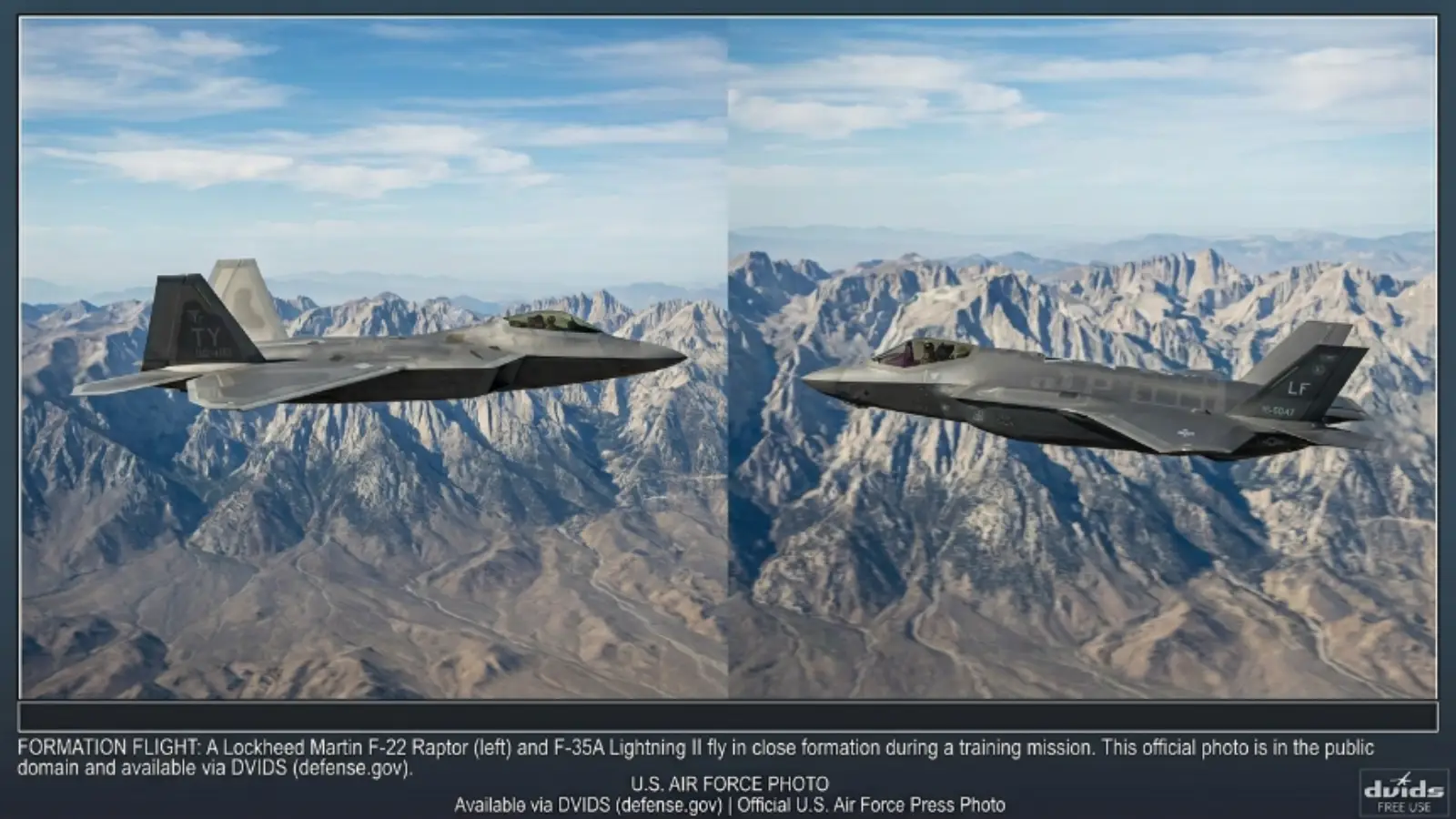
The debate over the F-35 Joint Strike Fighter vs F-22 Raptor has never been more relevant. In March 2025, the U.S. Air Force awarded Boeing the contract for the F-47 NGAD, the sixth-generation platform that will eventually replace the Raptor. That announcement drew a sharp line under a strategic question that has followed American defense planners for two decades: did the United States build the right stealth fighters, in the right numbers, for the right era?
With China’s J-20 and J-35 fleets expanding rapidly and Russia deploying Su-57s in limited numbers, the U.S. now operates two distinct fifth-generation platforms that are increasingly expected to work as a team rather than compete for the same missions. Understanding what each aircraft does — and what it cannot do — is essential context for anyone watching how American airpower will project itself across the Indo-Pacific and beyond.
This is the definitive F-35 vs F-22 breakdown for 2026.
F-35 Joint Strike Fighter vs F-22 Raptor: Specifications at a Glance
| Specification | F-22 Raptor | F-35A Lightning II |
|---|---|---|
| Manufacturer | Lockheed Martin / Boeing | Lockheed Martin |
| Role | Air Superiority Fighter | Multirole Strike Fighter |
| First Flight | 1997 | 2006 |
| Service Entry | 2005 | 2015 |
| Engine | 2× Pratt & Whitney F119-PW-100 | 1× Pratt & Whitney F135 |
| Thrust (with AB) | ~70,000 lbf combined | ~43,000 lbf |
| Top Speed | Mach 2.25 (~1,500 mph) | Mach 1.6 (~1,200 mph) |
| Supercruise | Yes (Mach 1.5+ without afterburner) | No |
| Climb Rate | 62,000+ ft/min | ~45,000 ft/min |
| Combat Radius | ~590 miles | ~670 miles (A variant) |
| Service Ceiling | 65,000 ft | 50,000 ft |
| Internal Weapons Bays | 3 bays | 2 main bays |
| Unit Cost (flyaway) | ~$334M (program avg.) | ~$82M (FY2025, A variant) |
| Operating Cost/hr | ~$85,000 | ~$42,000 |
| Aircraft Built | 186 (production ended 2012) | 1,150+ delivered, production ongoing |
| Export Eligible | No (Obey Amendment) | Yes (20+ partner nations) |
| Nuclear Capable | No | Yes (B61-12) |
Design and Technology: Built for Different Wars
The F-22 Raptor — Cold War Vision, 21st-Century Execution
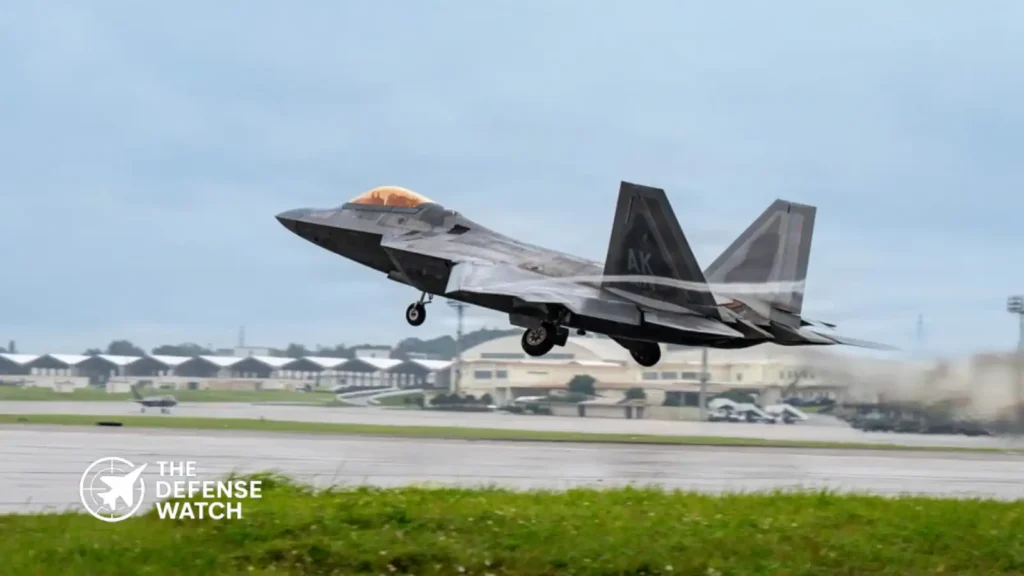
The Raptor was conceived in the 1980s to defeat the most advanced Soviet fighters expected in the 1990s. It emerged from the Advanced Tactical Fighter program as a machine optimized for one thing above all else: killing other aircraft before they know it is there.
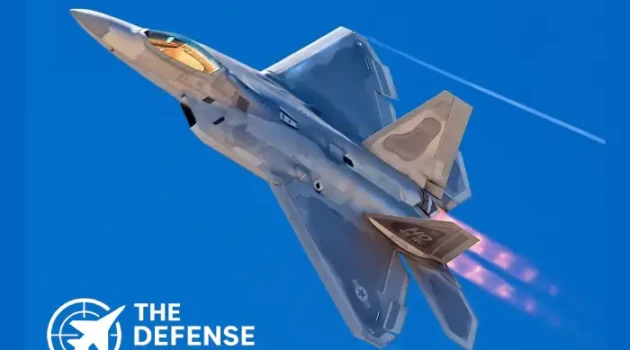
Its stealth geometry prioritizes low radar cross-section against airborne threats — meaning the shaping focuses on defeating the nose-on radar look angles that opposing fighters use during engagements. The F-22’s radar absorbent materials and precise edge alignment give it the lowest radar cross-section of any operational fighter in the world. This edge goes to the Raptor even when compared directly to its younger sibling.
- (adsbygoogle = window.adsbygoogle || []).push({});
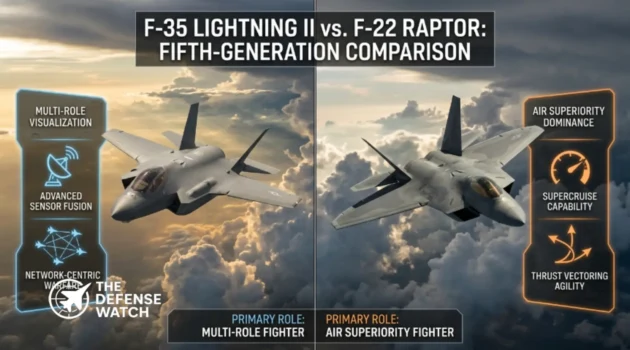
The twin Pratt & Whitney F119 engines deliver supercruise — the ability to sustain supersonic flight without engaging afterburners. This capability is tactically decisive: it extends the Raptor’s time in contested airspace at high speed without generating the large infrared signature that afterburner use produces. Combined with thrust-vectoring nozzles that bend the exhaust to control pitch and yaw, the F-22 can execute maneuvers in a dogfight that few aircraft can match or even anticipate.
The F-35 Lightning II — A Fighter Built for the Network Age
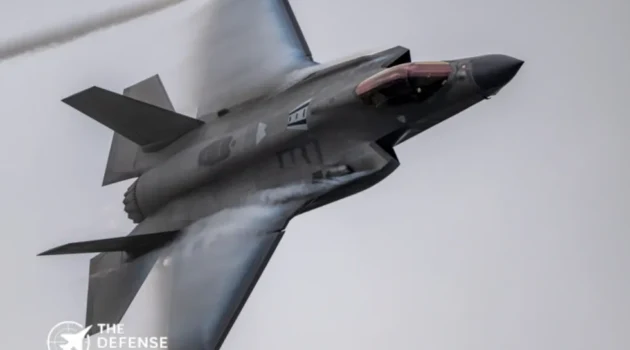
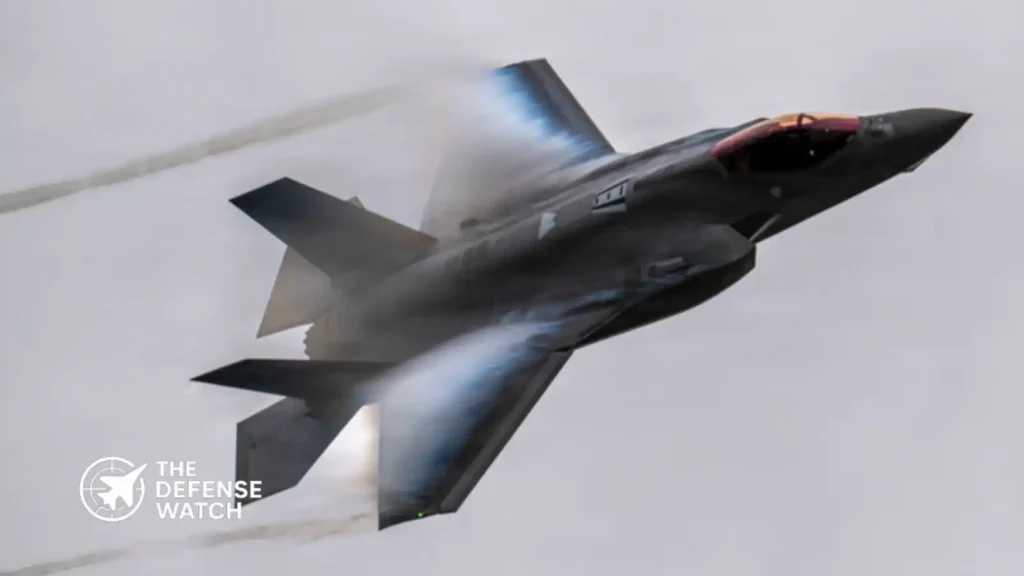
Where the Raptor was engineered to fight alone and win, the F-35 was designed to function as a node in a networked battlespace. Its AN/APG-81 AESA radar, the Distributed Aperture System (DAS) giving 360-degree infrared situational awareness, and the Electro-Optical Targeting System (EOTS) combine into a sensor fusion architecture that feeds a single, synthesized picture to the pilot through a helmet-mounted display.
The result is that an F-35 pilot sees more of the battlespace — from further away and across more domains — than any fighter pilot in history. The aircraft’s Multi-Function Advanced Data Link (MADL) allows it to share that picture with other F-35s and compatible platforms without broadcasting a detectable emissions signature. In practical terms, a flight of four F-35s can build a shared tactical picture that makes the entire formation dramatically more lethal than four independent aircraft would be.
atOptions = { ‘key’ : ‘e7d18db8b7513fb2a224cf4c3f18bbf0’, ‘format’ : ‘iframe’, ‘height’ : 90, ‘width’ : 728, ‘params’ : {} };The F-35’s stealth profile is optimized for ground-based radar threats — the low-frequency and high-frequency systems that surface-to-air missile networks rely upon. This makes it extremely effective at penetrating defended airspace to strike targets on the ground, a mission the Raptor was never primarily designed to execute.
Firepower and Weapons Loadout: Specialist vs Swiss Army Knife
F-22 Raptor Weapons
The Raptor carries all weapons internally to preserve its stealth profile. Its primary air-to-air armament consists of:
- 6× AIM-120D AMRAAM (beyond-visual-range, semi-active/active radar guided)
- 2× AIM-9X Sidewinder (short-range, infrared-guided)
- 1× M61A2 Vulcan 20mm rotary cannon (480 rounds)
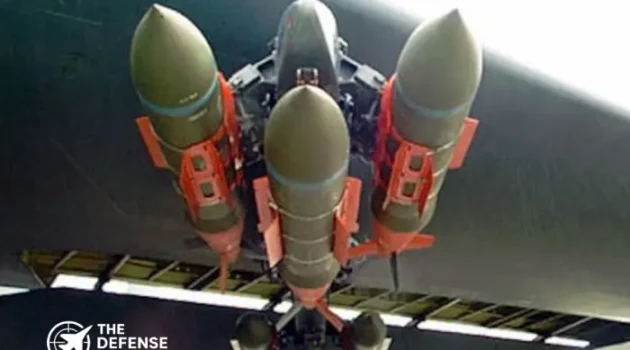
For the ground attack role, the Raptor can carry two GBU-32 JDAMs (1,000-lb precision guided bombs) in its main bays, though this secondary mission significantly underutilizes its capabilities.
F-35 Lightning II Weapons
The F-35 carries a far broader weapons suite, adaptable across variants and mission sets:
- AIM-120D AMRAAM (BVR air-to-air)
- AIM-9X Sidewinder (short-range air-to-air)
- AIM-132 ASRAAM / Meteor (European F-35 operators)
- GBU-31/32 JDAM (precision ground attack)
- JASSM-ER (long-range cruise missile, stealth)
- SPEAR-3 (network-enabled precision strike, UK variant)
- B61-12 nuclear gravity bomb (nuclear deterrence)
- AGM-154 JSOW (standoff anti-armor)
- 1× GAU-22/A 25mm cannon (A/C variants internal; B variant external pod)
The F-35 can also carry weapons externally on six hardpoints, sacrificing stealth for a heavier payload when operating in lower-threat environments. This flexibility allows it to function as both a deep-penetration stealth striker and a conventional bomb truck — a dual capability the Raptor cannot replicate.
(adsbygoogle = window.adsbygoogle || []).push({});Operational Range and Mobility
Both aircraft are broadly comparable in combat radius, with the F-35A holding a modest edge at approximately 670 miles versus the Raptor’s 590 miles. However, the context matters enormously.
The F-22’s supercruise capability means it can cover that radius at sustained supersonic speeds — spending more time in the target area and less time vulnerable during transit. The F-35 relies on afterburner for supersonic flight, burning fuel at a significantly higher rate.
For the Indo-Pacific theater — where distances between island chains and carrier groups often exceed 1,000 miles — both aircraft benefit significantly from aerial refueling. The F-35C carrier variant operates from U.S. Navy supercarriers, extending its operational reach considerably. The F-22 operates exclusively from land bases, a strategic limitation as the Pacific theater demands dispersed, expeditionary basing options.
The F-35B STOVL variant addresses this limitation indirectly. Marines and allied navies (UK, Italy, Japan) operate F-35Bs from amphibious assault ships and smaller carriers, bringing stealth strike capability into theaters where conventional carrier operations would be impractical.
Combat Effectiveness: What the Real Record Shows
Neither aircraft has engaged an enemy fighter in air-to-air combat. This fact is often cited as evidence of their deterrence value — peer adversaries have not chosen to contest U.S. airspace in environments where these jets operate.
The F-22 entered combat in September 2014, striking ISIS targets in Syria. It was the first operational use of the Raptor in any combat role — and it was used as a striker, not an air superiority platform, an irony not lost on defense analysts who criticized the decision to end production at just 186 airframes rather than the originally planned 750.
The F-35 has seen broader combat employment, including Israeli Air Force strikes in contested Syrian airspace and U.S. operations in the Middle East. Israel’s F-35Is — locally designated “Adir” — have reportedly conducted strikes in environments defended by Russian-supplied S-300 systems, validating the aircraft’s low-observable penetration capability in real-world conditions.

Exercise data paints a consistent picture. In training engagements, the F-22 consistently defeats fourth-generation opponents at exchange ratios that make air superiority planners confident. The F-35’s sensor fusion advantage becomes decisive in multi-ship engagements where network-shared targeting data allows F-35 pilots to engage threats their own radar has not yet directly detected.
(adsbygoogle = window.adsbygoogle || []).push({});Cost and Export Value: The Strategic Divide
The cost difference between these two aircraft is not merely a budgetary footnote — it fundamentally shapes how American airpower is structured and distributed.
The F-22’s unit cost of approximately $334 million (when total program costs are divided across 186 aircraft) made it unaffordable at the scale originally envisioned. Congress canceled the program in 2009 at 186 airframes — a decision that Air Force leadership has repeatedly described as a strategic mistake given the pace of Chinese fifth-generation development.
The Obey Amendment prohibits F-22 export to any nation, protecting its classified stealth and avionics technology. This means the Raptor remains an exclusively American asset, with no foreign operators to share development and sustainment costs.
The F-35 operates under a fundamentally different model. As an international program from conception, it distributes costs and production across partner nations. More than 20 countries have ordered the F-35, and the program has delivered over 1,150 aircraft to date. This scale drives unit costs down — the F-35A now costs approximately $82 million per aircraft in FY2025, a figure that has declined steadily as production rates increased. Operating costs run roughly $42,000 per flight hour versus the Raptor’s $85,000.
The F-35’s export footprint also creates significant geopolitical leverage. When Japan, South Korea, Australia, and NATO allies all fly the same platform with compatible data links, coalition operations become dramatically more effective. A combined allied F-35 network in the Pacific theater would present a coordinated sensor and strike capability that no adversary air defense system has yet been designed to defeat.
Strengths and Weaknesses: The Balanced Assessment
F-22 Raptor
Strengths: Unmatched speed, altitude, and maneuverability. Lowest radar cross-section of any operational fighter. Supercruise capability with sustained supersonic performance. Thrust-vectoring for extreme agility in within-visual-range engagements.
Weaknesses: Production ended at 186 airframes — far below planned quantities. No export market to share costs. High per-flight-hour operating costs. Cannot carry nuclear weapons. Limited ground attack capability. Aging avionics relative to the F-35’s sensor fusion architecture. No STOVL or carrier variant.
F-35 Lightning II
Strengths: Unmatched sensor fusion and networked warfare capability. Broadest weapons suite of any western fighter. Three variants covering land, carrier, and STOVL operations. Active production with declining unit costs. Nuclear-capable. Coalition interoperability with 20+ partner nations.
(adsbygoogle = window.adsbygoogle || []).push({});Weaknesses: Slower than the Raptor at Mach 1.6, with no supercruise. Less maneuverable in a close-in dogfight. Single engine reduces survivability margin compared to the twin-engine Raptor. Software and sustainment complexity has driven maintenance challenges. Cannon in the B variant is an external pod rather than internal.
Conclusion: Different Tools, Same Mission — Winning
The F-35 Joint Strike Fighter vs F-22 Raptor debate often gets framed as a contest. In reality, it is a division of labor.
If a future conflict with China or Russia reaches the point where U.S. fighters must contest enemy airspace against peer stealth aircraft, the F-22 is the platform that goes first — clearing lanes, suppressing enemy air defenses, and establishing air superiority that allows everything else to operate. In that scenario, the Raptor’s speed, agility, and stealth profile give it a decisive edge.
But the vast majority of combat scenarios the U.S. military will face are not symmetrical stealth-vs-stealth engagements. They involve precision strikes against defended targets, networked battlespace management, coalition coordination, and electronic warfare — all areas where the F-35’s capabilities are unmatched by any aircraft currently in service anywhere in the world.
atOptions = { ‘key’ : ‘3d48d603f906e3fe9f205be3c4433835’, ‘format’ : ‘iframe’, ‘height’ : 250, ‘width’ : 300, ‘params’ : {} };The Air Force understands this complementary relationship. The F-47 NGAD will eventually take the Raptor’s place as America’s dedicated air superiority platform, while the F-35 continues production and upgrades through the 2070s as the backbone of allied airpower.
In short: send the F-22 to win the fight. Send the F-35 to win the war.
FAQ: F-35 Joint Strike Fighter vs F-22 Raptor
In a direct dogfight, would the F-22 Raptor beat the F-35 Lightning II?In a within-visual-range dogfight, the F-22 holds a clear advantage. Its thrust-vectoring engines, higher top speed of Mach 2.25 versus the F-35’s Mach 1.6, and superior climb rate give it the maneuvering edge. However, modern air combat rarely comes down to close-range turning engagements — and the F-35’s sensor fusion gives it the advantage of detecting and targeting threats before they close to visual range.
Why did the U.S. stop building the F-22 Raptor?Congress ended F-22 production in 2009 at 186 airframes, citing the aircraft’s high unit cost (over $334 million per plane) and the belief that the post-Cold War threat environment did not justify the expense. Many Air Force leaders have since described this as a strategic error, given China’s rapid development of fifth-generation fighters including the J-20 and J-35.
Can the F-35 carry nuclear weapons, and can the F-22?Yes — the F-35 is certified to carry and deliver the B61-12 nuclear gravity bomb, making it a key component of U.S. extended nuclear deterrence in Europe and the Pacific. The F-22 Raptor is not nuclear-capable.
Which countries operate the F-35, and why can’t they buy the F-22?Over 20 nations operate or have ordered the F-35, including the UK, Japan, Australia, Israel, Italy, South Korea, Norway, and the Netherlands. The F-22 is prohibited from export by the Obey Amendment (1998), which protects its classified stealth technology and avionics from foreign access. The F-35 was designed as an international program from the outset.
With the F-47 NGAD replacing the F-22, what happens to the Raptor fleet?The F-47 is not expected to reach operational service until the early 2030s at the earliest. The F-22 fleet will continue in service through the transition period, likely into the mid-2030s. The Air Force is currently investing in avionics and radar upgrades to keep the Raptor combat-relevant while the F-47 program matures.

- (adsbygoogle = window.adsbygoogle || []).push({});