• Home
  • About
  • Defense Systems
  • Manufacturer
  • Comparisons
  • Compare 
  • Tools
TheDefenseWatch.com
  • Aerospace & Aviation
  • Military & Ordnance
  • Naval & Maritime
  • Cyber & Space Defense
  • Policy & Strategy
  • Global News
  • Tools Library
    • Smart Calculator
    • Drone Flight Time Calculator
    • Drone Range Calculator
    • Counter-Drone Jammer Effective Range Calculator
    • Counter-Battery Radar Detection Calculator
    • Artillery Fire Correction Calculator
    • Thermal Camera Detection Range Calculator
    • Missile Range & Time-of-Flight Calculator
    • Radar Detection Range Calculator
    • FPV Strike Drone Payload vs Range Calculator
    • Loitering Munition Endurance Calculator
    • Sniper Ballistic Drop & Windage Calculator
    • Bullet Drop Calculator
    • U.S. Army Combat Fitness Test (ACFT) Calculator
    • Military Pension Calculator
    • Military Retirement Calculator
    • Military Pension Calculator
    • Large Number Calculator
Font ResizerAa

TheDefenseWatch.com

The Defense Watch | U.S. & Global Defense News, Analysis & Military Updates

Search
  • Home
  • About
  • Defense Systems
  • Manufacturer
  • Comparisons
  • Compare 
  • Tools

Stay Updated

Get the latest update

Subscribe

Explore

  • Drone
  • Fighter Jets & Military Aircraft
  • Hypersonic Weapons
  • Aircraft Carriers
  • Strategic History & Missions
  • Tools Library
Home » North Korea Tests New Tank Active Protection System Against Anti Tank Missiles And Drone Threats
Military & OrdnanceTanks & Armored Vehicles

North Korea Tests New Tank Active Protection System Against Anti Tank Missiles And Drone Threats

Samuel Drake | Defense Analyst
Last updated: September 7, 2026 4:00 pm
Samuel Drake | Defense Analyst
Share
2 Min Read
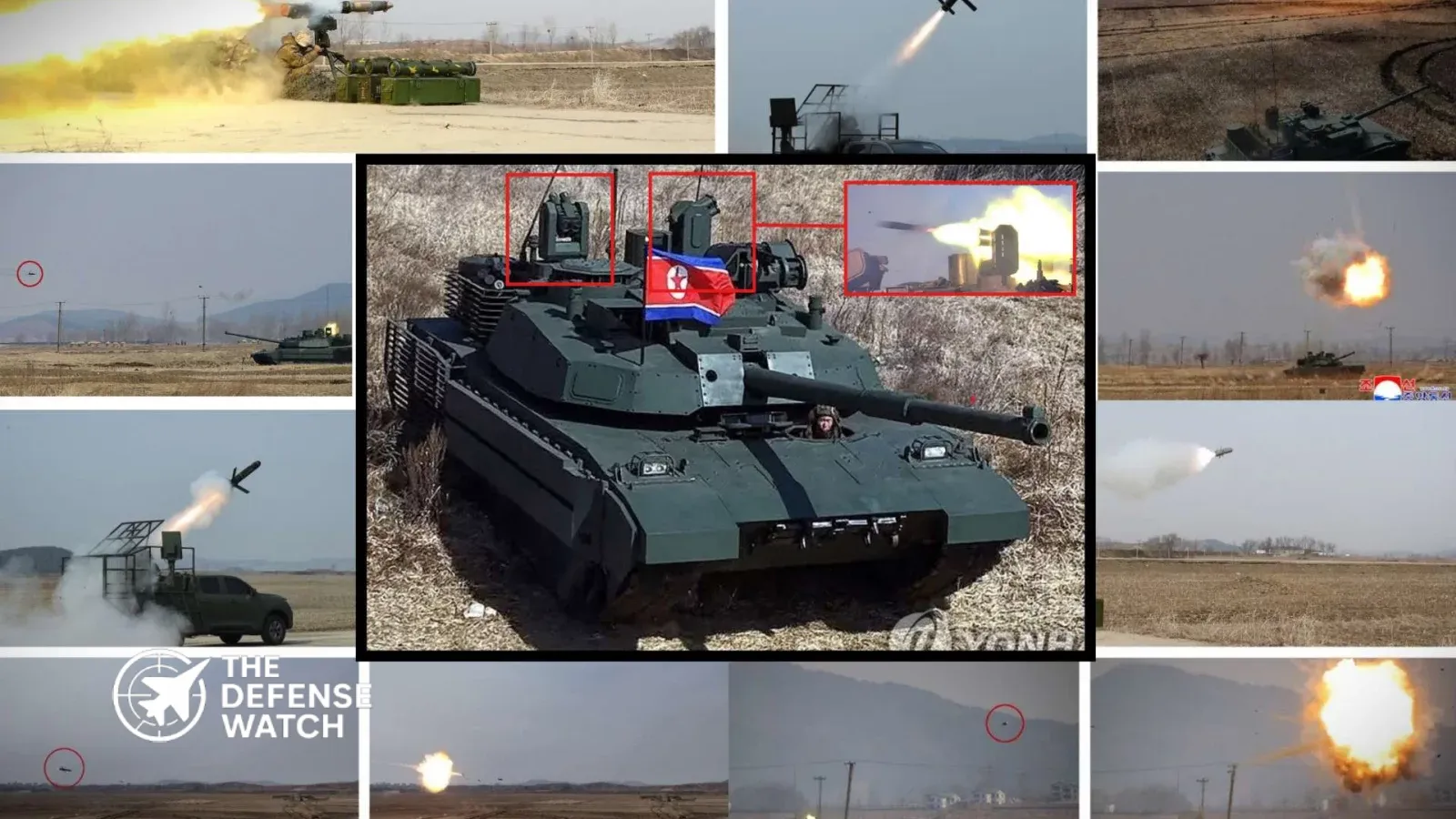
North Korea tank active protection system
Image : North Korea’s official state news agency
SHARE
¦ KEY FACTS AT A GLANCE
  • North Korea tested a new tank active protection system designed to intercept incoming threats.
  • The system demonstrated interception capability against anti tank guided missiles and drone threats.
  • Development reflects growing focus on survivability amid evolving battlefield threats.
  • Test likely conducted on a modernized North Korean main battle tank platform.
  • The system signals Pyongyang’s intent to modernize armored forces in line with global APS trends.

North Korea Tank Active Protection System Test Highlights New Battlefield Focus

North Korea tank active protection system capabilities were demonstrated in a recent test aimed at countering anti tank missiles and drone threats, according to reporting by Army Recognition. The test marks a notable step in Pyongyang’s effort to improve armored vehicle survivability in modern combat environments.

Contents
North Korea Tank Active Protection System Test Highlights New Battlefield FocusThe Big PictureWhat’s HappeningWhy It MattersStrategic ImplicationsCompetitor ViewWhat To Watch NextCapability GapThe Bottom Line

The Big Picture

Modern armored warfare has shifted rapidly due to the widespread use of precision guided munitions and low cost drones. Conflicts such as those observed in Ukraine and the Middle East have shown that even advanced tanks remain vulnerable without layered protection.

Active protection systems, or APS, have become a critical component of next generation armored vehicle design. Militaries including the United States, Israel, and Russia have invested heavily in these systems to counter anti tank guided missiles and loitering munitions.

North Korea’s latest test suggests it is aligning its armored doctrine with these global trends despite limited access to advanced defense technology ecosystems.

- Advertisement -

What’s Happening

North Korea conducted a test of a new tank active protection system designed to detect, track, and intercept incoming threats before impact.

The system reportedly engaged simulated or live anti tank guided missiles and drone based threats. Visual evidence released by state media indicates the use of radar or sensor arrays paired with countermeasure launchers mounted on a tank platform.

The test likely involved one of North Korea’s more modern tank designs, potentially from its Chonma or Songun series, though official confirmation remains limited.

The demonstration highlights an integrated approach combining detection sensors and hard kill interceptors, which are typical features of contemporary APS systems.

Why It Matters

The emergence of a North Korea tank active protection system reflects a direct response to the growing effectiveness of anti tank weapons on the battlefield.

Portable systems such as anti tank guided missiles have significantly reduced the survivability of legacy armored platforms. At the same time, drones equipped with explosive payloads or used for targeting have introduced new vulnerabilities from above.

By testing an APS capable of addressing both threats, North Korea is attempting to close a critical survivability gap in its armored forces.

This development also indicates a shift from reliance on passive armor toward active defensive measures, which can defeat threats before impact rather than absorbing damage.

- Advertisement -

Strategic Implications

North Korea’s move to develop APS technology has implications for regional military balance, particularly on the Korean Peninsula.

South Korea fields advanced anti tank systems and precision strike capabilities, many of which are designed to neutralize armored formations quickly in a conflict scenario. An operational APS could complicate these calculations by reducing the effectiveness of such weapons.

Improved survivability for North Korean tanks could enhance their role in offensive or defensive operations, especially in terrain where armored maneuver remains viable.

The development also signals a broader effort by Pyongyang to modernize its conventional forces alongside its strategic weapons programs.

Competitor View

Regional actors are likely to interpret this development through the lens of evolving ground combat dynamics.

South Korea and the United States have already integrated or are testing APS solutions on platforms such as the M1 Abrams and K2 Black Panther. From this perspective, North Korea’s effort represents an attempt to narrow a technological gap rather than leap ahead.

China and Russia, both of which have developed their own APS systems, may view North Korea’s progress as consistent with broader trends in armored warfare modernization.

At the same time, limitations in industrial capacity and sensor technology could constrain the effectiveness and scalability of North Korea’s system compared to established designs.

What To Watch Next

Future developments will likely focus on additional testing and potential deployment.

Key indicators include repeated trials under varied conditions, integration across multiple tank units, and evidence of serial production.

Observers should also monitor whether North Korea expands APS integration to other armored vehicles, such as infantry fighting vehicles or self propelled artillery systems.

Any indication of export or technology sharing would also carry broader regional implications.

Capability Gap

North Korea’s armored forces have historically relied on upgraded legacy designs with limited protection against modern threats.

The introduction of an APS aims to address vulnerabilities to top attack munitions, tandem warhead missiles, and drone delivered explosives.

However, APS systems require advanced sensors, rapid processing, and reliable interceptors. These components demand a high level of engineering precision and manufacturing quality.

Without sustained testing and refinement, the system may face challenges in reliability, reaction time, and coverage against multiple simultaneous threats.

The Bottom Line

North Korea’s tank active protection system test signals a focused effort to improve armored survivability, but its real impact will depend on operational reliability and large scale deployment.


TAGGED:Active Protection SystemAnti Tank MissilesNorth KoreaTanks
Share This Article
Facebook Copy Link Print
BySamuel Drake | Defense Analyst
Follow:
Samuel Drake is a defense analyst at TheDefenseWatch.com covering naval warfare, military ordnance, maritime technology, fleet modernization, and defense procurement. His reporting focuses on documented capabilities, procurement programs, and military technology.
Leave a Comment

Leave a Reply Cancel reply

Your email address will not be published. Required fields are marked *

Search Defense Systems

Latest Defense Systems

  • TRML-4D Radar TRML-4D Radar
  • F-47A Fighter Jet F-47A Fighter Jet
  • China DF-61 Missile China DF-61 Missile
  • B61 Nuclear Bomb B61 Nuclear Bomb
  • Japan E-767 Airborne Japan E-767 Airborne
  • Remington 870 Shotgun Remington 870 Shotgun
  • RUTA B1 Cruise Missile RUTA B1 Cruise Missile
  • XQ-67A Drone XQ-67A Drone
  • B-25 Mitchell Bomber B-25 Mitchell Bomber

Recent Compares

  • J-10C vs JF-17 Thunder: Which Fighter Is More Capable? J-10C vs JF-17 Thunder: Which Fighter Is More Capable? View Comparison →
  • Tejas vs Gripen: Key Differences and Capabilities Tejas vs Gripen: Key Differences and Capabilities View Comparison →
  • Tejas vs MiG-21 Bison: How India Replaced Its Iconic Supersonic Fighter Tejas vs MiG-21 Bison: How India Replaced Its Iconic Supersonic Fighter View Comparison →
  • F-35 vs F-16: Stealth, Sensors and Combat Roles F-35 vs F-16: Stealth, Sensors and Combat Roles View Comparison →
  • Tejas Fighter Jet vs F-16 Fighting Falcon: Capability Compared Tejas Fighter Jet vs F-16 Fighting Falcon: Capability Compared View Comparison →
  • Rafale Fighter Jet vs F-16 Fighting Falcon : Which Fighter Has the Edge? Rafale Fighter Jet vs F-16 Fighting Falcon : Which Fighter Has the Edge? View Comparison →
  • Su-57 Fighter Jet vs J-20 Fighter Jet: Stealth and Air Combat Compared Su-57 Fighter Jet vs J-20 Fighter Jet: Stealth and Air Combat Compared View Comparison →
  • Mirage 2000 vs Tejas Mk1A: Legacy Combat Power vs Indigenous Modernization Mirage 2000 vs Tejas Mk1A: Legacy Combat Power vs Indigenous Modernization View Comparison →
  • Rafale Fighter Jet vs F-22 Raptor: Which Air Dominance Fighter Has the Edge? Rafale Fighter Jet vs F-22 Raptor: Which Air Dominance Fighter Has the Edge? View Comparison →
  • Tejas Fighter Jet vs. Rafale Fighter Jet: India’s Indigenous Fighter Meets France’s Proven Multirole Combat Aircraft Tejas Fighter Jet vs. Rafale Fighter Jet: India’s Indigenous Fighter Meets France’s Proven Multirole Combat Aircraft View Comparison →

Recent Posts

  • Jensen Huang’s Nvidia Exit Raises New Questions for U.S.-China AI Competition
  • Jensen Huang Resigns as Nvidia CEO Amid Chip Export Scrutiny
  • Hegseth Highlights B-2 Bomber Strike on Iran as Proof of U.S. Long-Range Strike Power
  • China and US Militaries Hold Crisis Communication Talks in Washington
  • L3Harris Completes FleetLink Communications Testing on U.S. Navy Destroyer

You Might Also Like

IBCS intercept cruise missiles
Artillery & Missile SystemsMilitary & Ordnance

Army Achieves Breakthrough in Cruise Missile Intercepts with IBCS System

September 8, 2026
Extended-Range GMLRS M270A2 launcher
Artillery & Missile SystemsMilitary & Ordnance

Extended-Range GMLRS Completes M270A2 Launch Qualification, Doubles Strike Range To 150 Kilometers

September 12, 2026
SM 2 autopilot test station
Artillery & Missile SystemsMilitary & Ordnance

Raytheon Wins 16.9 Million Navy Contract for SM 2 Autopilot Test Station

September 8, 2026
M109A7 self-propelled howitzers
Military & OrdnanceTanks & Armored Vehicles

US Army 1st Armored Division Fields New M109A7 Self-Propelled Howitzers To Boost Modernized Fires Capability

September 12, 2026

Logo

Copyright © 2026 TheDefenseWatch.com

Helpful Links

  • Home
  • About Us
  • Privacy Policy
  • Terms of Use / Disclaimer
  • U.S. Privacy Notice – CCPA Compliance

Defense Systems

  • Defense Systems
  • Comparisons 
  • Manufacturer
  • Tactical Calculators

Popuplar

Which 5 Air Forces Possess the Costliest Fighter Jet Fleets in the World
Evolving Strategic Value: Carrier Strike Groups in the Indo-Pacific’s Future Security Architecture
Autonomous Weapon Systems Spark U.S. Ethics Debate Amid Rapid Military AI Integration

We report on developments involving military forces, governments, defense companies, research organizations, and security institutions around the world. 

Welcome Back!

Sign in to your account

Username or Email Address
Password

Lost your password?