(adsbygoogle = window.adsbygoogle || []).push({});Executive Summary:
Spanish defense company EM&E Group has introduced its ODIN family of Counter-Unmanned Aircraft Systems (C-UAS), a modular solution designed to detect, track, identify, and neutralize drone threats across fixed and mobile operational environments. The system combines sensors, electronic warfare capabilities, command-and-control functions, and kinetic effectors in a single architecture as militaries worldwide accelerate investments in layered air defense against unmanned systems.
EM&E Group Expands Counter-Drone Portfolio With ODIN C-UAS System
The ODIN C-UAS system has emerged as EM&E Group’s flagship response to the rapidly expanding drone threat environment. The company presented the system as a comprehensive and integrated counter-UAS solution capable of operating in multiple configurations, ranging from highly mobile deployments to permanent site protection. According to company information, ODIN combines detection, tracking, command-and-control, and neutralization capabilities within an open architecture framework that can be integrated into both military and critical infrastructure defense networks.¹
- EM&E Group Expands Counter-Drone Portfolio With ODIN C-UAS System
- ODIN Family Designed Around Multiple Operational Configurations
- ODIN-I Mobile Hard-Kill System
- ODIN-L Mobile Protection Solution
- ODIN-S Fixed-Site Defense Configuration
- Technical Architecture Focuses on Layered Drone Defense
- Why ODIN Matters for Modern Military Operations
- European Defense Industry Pushes Sovereign Counter-UAS Development
- Analysis: Counter-Drone Systems Are Becoming Core Air Defense Assets
The announcement reflects a broader trend across NATO and allied militaries, where inexpensive drones, loitering munitions, and coordinated unmanned attacks have transformed air defense requirements. Traditional short-range air defense systems were not originally designed to counter large numbers of small, low-cost aerial targets, creating demand for specialized C-UAS solutions.
ODIN Family Designed Around Multiple Operational Configurations
EM&E Group has developed several variants within the ODIN family to support different mission requirements.
ODIN-I Mobile Hard-Kill System
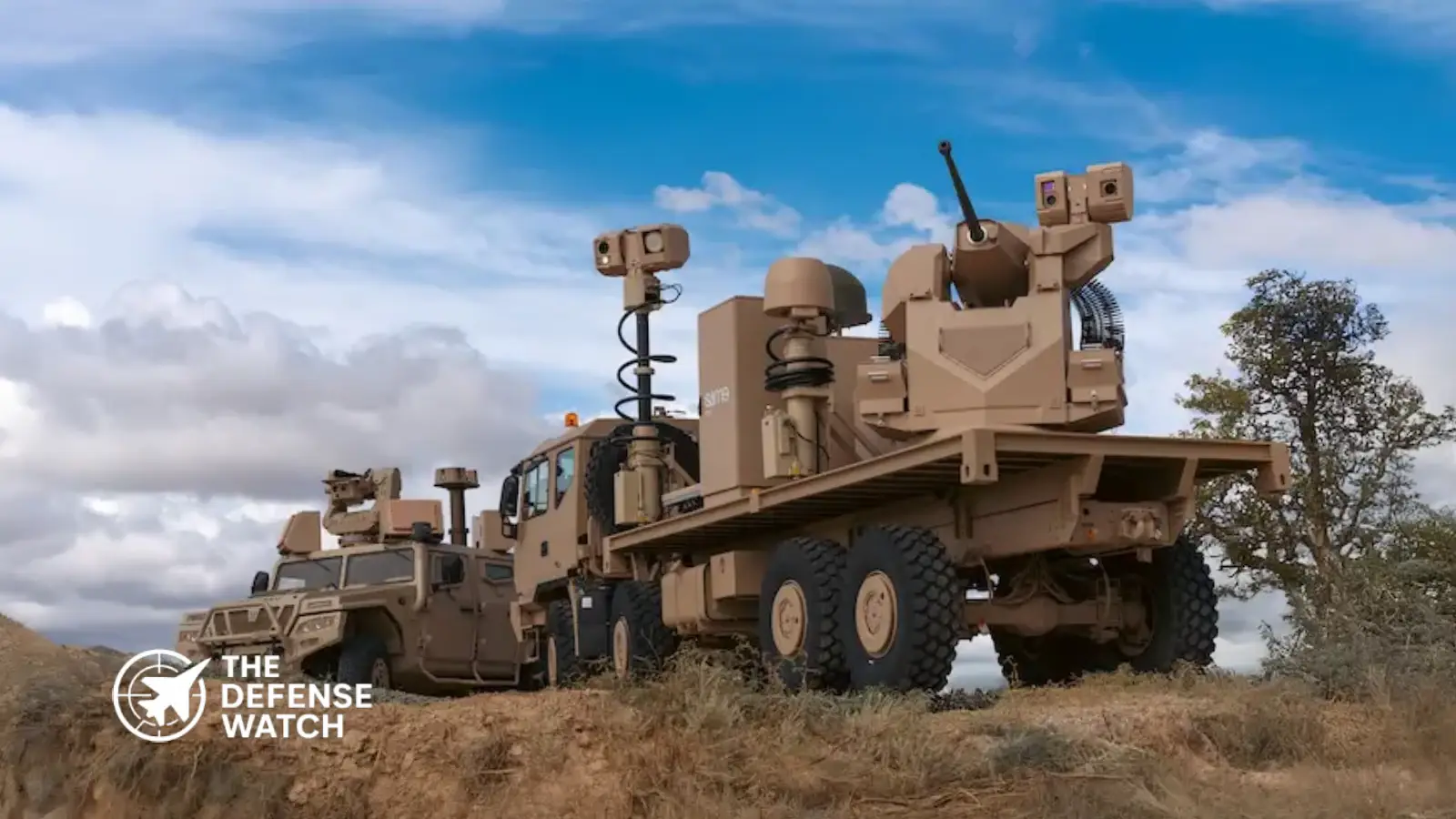
The ODIN-I configuration is a mobile, multi-sensor, multi-effector system that integrates a remotely operated weapon station with electronic warfare and detection capabilities. The platform can be mounted on military vehicles or trailer-based systems, enabling rapid deployment in operational environments.¹
Publicly disclosed information indicates that ODIN-I incorporates the Sentinel 30 remote weapon station armed with a 30 mm Mk44S Bushmaster chain gun, passive radio-frequency detection sensors, electro-optical and infrared targeting systems, and an adaptive electronic jammer. The system is designed to engage short-range aerial threats while maintaining protection against ground and maritime targets.³⁴
(adsbygoogle = window.adsbygoogle || []).push({});ODIN-L Mobile Protection Solution
The ODIN-L variant is optimized for the protection of deployed forces, temporary operating locations, and critical infrastructure. EM&E states that the system integrates sensors, effectors, and command-and-control capabilities into a mobile station capable of rapid deployment and adaptation to changing operational requirements.¹
ODIN-S Fixed-Site Defense Configuration
For permanent installations, ODIN-S provides continuous surveillance and protection through a fixed, gyro-stabilized platform. The system offers 360-degree azimuth coverage and integrates infrared, visible-spectrum, and laser range-finding sensors while maintaining connectivity with radar and combat management systems.¹
Technical Architecture Focuses on Layered Drone Defense
Modern counter-drone operations increasingly rely on layered defenses rather than a single interception method.
The ODIN architecture reflects this approach by combining:
| Capability | Function |
|---|---|
| Passive RF Detection | Identifies and locates drone control signals |
| Electro-Optical Sensors | Visual target detection and tracking |
| Infrared Sensors | Night and low-visibility operations |
| Electronic Warfare | Jamming and disruption of drone communications |
| Command and Control | Sensor fusion and threat management |
| Hard-Kill Interceptor | Physical destruction of hostile drones |
According to information disclosed during FEINDEF 2025, the jammer integrated into ODIN-I operates across frequencies commonly used by both commercial and military drones. The system can focus jamming power within narrower sectors to improve effectiveness while minimizing interference with friendly systems.³⁴
The platform also supports cooperative detection, enabling multiple systems to share targeting and tracking information across a wider battlespace.³
Why ODIN Matters for Modern Military Operations
The growing importance of systems such as ODIN is directly linked to lessons emerging from recent conflicts.
Drones are increasingly performing intelligence, surveillance, reconnaissance, strike, electronic warfare, and targeting missions at costs that are often dramatically lower than traditional military aircraft. This trend has forced defense planners to seek scalable and affordable countermeasures.
A notable aspect of the ODIN concept is its integration of both soft-kill and hard-kill options. Many counter-drone engagements begin with electronic attack techniques designed to disrupt communications or navigation signals. However, sophisticated autonomous drones and loitering munitions may require kinetic interception when electronic measures prove insufficient.
By integrating both approaches into a single platform, ODIN aims to provide commanders with greater flexibility against diverse threat profiles.
European Defense Industry Pushes Sovereign Counter-UAS Development
EM&E Group has also expanded cooperation with other European defense firms to strengthen integrated counter-drone capabilities.
(adsbygoogle = window.adsbygoogle || []).push({});In 2026, the company signed a memorandum of understanding with Indra Group and Intersoft Electronics Services to offer integrated C-UAS solutions for the Belgian defense market. The partnership combines EM&E’s electro-optics and weapon station expertise with Indra’s radar and command-and-control technologies and Intersoft’s radar and communications capabilities.²⁵
The initiative aligns with broader European efforts to strengthen defense-industrial autonomy and develop indigenous solutions for airspace protection against emerging unmanned threats.
Analysis: Counter-Drone Systems Are Becoming Core Air Defense Assets
The significance of ODIN extends beyond a single product launch.
For years, counter-UAS capabilities were often viewed as niche force-protection tools. That perception has changed dramatically. Drone warfare is now influencing operational planning from tactical infantry formations to strategic infrastructure defense.
Future counter-drone systems will likely require:
- Multi-sensor detection networks
- Artificial intelligence-assisted target classification
- Integrated electronic warfare capabilities
- Cost-effective kinetic interceptors
- Interoperability with wider air defense architectures
ODIN’s modular design suggests EM&E is positioning the system within this emerging market segment, where flexibility, mobility, and layered effects are becoming key procurement requirements.
As drone threats continue to evolve, militaries are increasingly seeking systems capable of detecting, identifying, tracking, and defeating targets across multiple domains. ODIN represents another example of how defense manufacturers are adapting legacy air defense concepts to meet the realities of modern unmanned warfare.