atOptions = { ‘key’ : ‘3d48d603f906e3fe9f205be3c4433835’, ‘format’ : ‘iframe’, ‘height’ : 250, ‘width’ : 300, ‘params’ : {} };Executive Summary:
The U.S. Space Force has awarded The Boeing Company a contract valued at up to $2 billion to design, build, and deliver two new satellites for the Mobile User Objective System (MUOS) Service Life Extension (SLE) program. Announced on June 24, 2026, the deal covers Space Vehicles 6 and 7, with planned launches no earlier than 2031 and 2032. The effort aims to extend the operational life of the military’s primary narrowband satcom constellation to 2035, preventing capability gaps for joint warfighters relying on secure UHF communications worldwide.
MUOS SLE Phase II Contract Details
The U.S. Space Force Space Systems Command awarded Boeing the Phase II contract following a competitive acquisition process. The agreement includes full development, delivery, system integration, and on-orbit test support for the two new space vehicles.
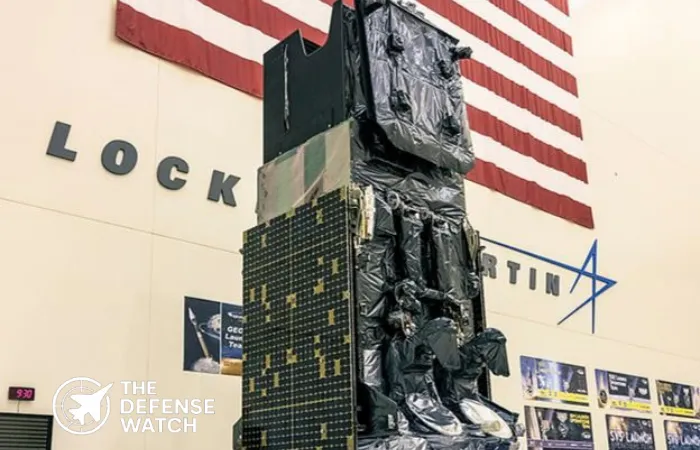
This builds directly on Phase I risk reduction and design activities completed earlier. Boeing previously contributed payloads to the existing MUOS constellation, positioning it as a strong competitor against incumbent Lockheed Martin, which built the original five satellites.
Technical and Operational Context of MUOS
MUOS provides global narrowband communications in the ultra-high frequency (UHF) band, functioning as a secure “cell phone network in space.” It supports voice, data, and limited video for mobile users—including dismounted soldiers, ships, aircraft, and special operations forces—particularly in challenging environments like dense foliage, urban areas, or adverse weather where UHF signals excel.
The current constellation consists of four operational satellites and one on-orbit spare, all in geostationary orbit. Each satellite carries a primary Wideband Code Division Multiple Access (WCDMA) payload for advanced 3G-like capabilities (up to 384 kbit/s) alongside a legacy payload to ensure backward compatibility with older UHF systems.
The new SV6 and SV7 will maintain and potentially enhance this WCDMA capability, addressing the approaching end-of-life for existing satellites while sustaining interoperability with fielded terminals.
Strategic Importance and Analysis
Why This Matters: Narrowband UHF SATCOM remains a foundational capability for tactical operations where high-bandwidth systems may be unavailable or vulnerable. In an era of great power competition, assured communications in contested environments are non-negotiable for command and control, especially for forces operating beyond line-of-sight.
Extending the MUOS constellation to 2035 provides critical breathing room as the Pentagon evaluates longer-term architectures, including potential integration with emerging proliferated low-Earth orbit systems or next-generation protected communications. The competitive award to Boeing also demonstrates the Space Force’s commitment to leveraging industry innovation and driving value through open competition, rather than sole-source reliance on legacy providers.
Operationally, the program mitigates risks of coverage degradation or capacity shortfalls that could impact joint and coalition operations across theaters. UHF’s ability to penetrate obstacles makes it particularly valuable for special operations, naval forces, and ground units in littoral or forested regions.
Technical and Schedule Considerations: Boeing plans to base the new satellites on its proven 702MP spacecraft platform. Launches are targeted no earlier than 2031–2032, reflecting the deliberate pace required for high-reliability military space systems. Delays in satellite programs are common due to rigorous testing and integration requirements, but the SLE approach—building on prior design work—aims to reduce such risks.
From a broader strategy perspective, sustaining dedicated narrowband capacity underscores the Department of Defense’s view that certain mission-critical communications cannot be fully outsourced to commercial providers amid rising threats of jamming, spoofing, and anti-satellite activities.
Program Background and Timeline
- Original MUOS Development: Initiated by the U.S. Navy in the early 2000s to replace the aging UHF Follow-On (UFO) system.
- Full Operational Capability: Declared in 2019.
- Constellation Status (as of 2026): Five satellites (four active + one spare).
- SLE Phase I: Competitive risk reduction awards to Boeing and Lockheed Martin in 2024.
- Phase II Award: Boeing selected for SV6 and SV7.
The Narrowband SATCOM Division within Space Systems Command’s System Delta 88 manages the effort.
(adsbygoogle = window.adsbygoogle || []).push({});Key Program Metrics
| Parameter | Details |
|---|---|
| Contract Value | Up to $2 billion |
| Satellites | SV6 and SV7 |
| Launch Windows | NET 2031 (SV6), NET 2032 (SV7) |
| Extended Lifespan | To 2035 |
| Primary Capability | Mil-UHF WCDMA narrowband |
| Orbit | Geostationary |
Implications for U.S. Defense Strategy
This investment reinforces U.S. military advantage in the space domain by ensuring resilient tactical communications. As adversaries invest in counter-space capabilities, maintaining assured access to narrowband networks supports multi-domain operations and deterrence.
The award also highlights evolving industrial base dynamics, with Boeing securing a significant role in a program historically led by Lockheed Martin. This competition could drive efficiencies and innovation in future satcom procurements.