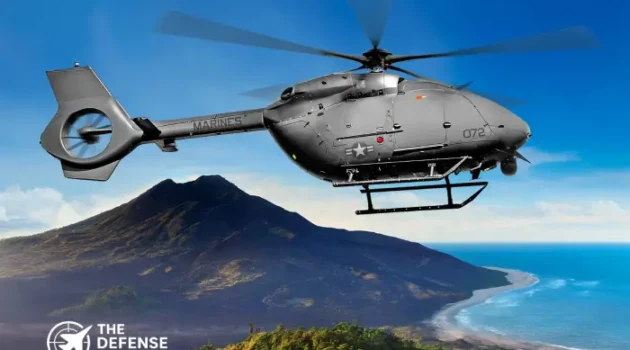
Executive Summary: The U.S. Marine Corps is rapidly advancing the MQ-72C Lakota Connector, an unmanned variant of the proven UH-72 platform, to solve “the last mile” of logistics in contested environments. By integrating Shield AI’s Hivemind autonomy, the MQ-72C is designed to deliver ammunition and supplies across the vast distances of the Pacific without risking aircrews.
The Evolution of the Lakota: From Utility to Autonomous Logistics
The MQ-72C Lakota, developed by Airbus U.S. Space & Defense, represents a strategic pivot in the Marine Corps’ Aerial Logistics Connector (ALC) program. Unlike the legacy manned UH-72A/B used primarily for domestic utility and training, the MQ-72C is a “clean-nose” redesign. By removing the cockpit, flight controls, and life-support systems, engineers have maximized internal volume for fuel and cargo.
This platform leverages the existing H145/UH-72 global supply chain, ensuring that the USMC can field a “risk-worthy” asset with high operational availability. The aircraft’s digital backbone, built on a Modular Open Systems Approach (MOSA), allows for the rapid integration of third-party sensors and mission sets beyond simple transport.
Technical Comparison: MQ-72C vs. Legacy UH-72
Feature UH-72B Lakota (Manned) MQ-72C Lakota (Autonomous) Range ~330 nm +350 nm (Expanded via fuel tanks) Payload ~3,903 lbs (Total Useful Load) Optimized for JMIC & Ordnance Status In Service (US Army/Navy) Prototyping / Flight Testing (2025-2026) Key Technology Helionix Avionics Suite Shield AI Hivemind / L3Harris C2 Force Design 2030: Strategic Context
The acceleration of the MQ-72C is a direct response to the threat posed by Anti-Access/Area Denial (A2/AD) bubbles in the Indo-Pacific. Under the Force Design 2030 mandate, the Marine Corps requires “stand-in forces” that can operate within the range of enemy precision fires.
- Contested Logistics: Traditional resupply via large vessels or manned heavy-lift helicopters (like the CH-53K) is increasingly vulnerable to sophisticated missile threats.
- Mass and Attrition: The MQ-72C provides a relatively low-cost, “attritable” alternative that can operate in swarms or continuous shuttle runs to sustain small, dispersed units.
- Expeditionary Advanced Base Operations (EABO): The aircraft’s ability to land in austere, unprepared clearings makes it ideal for supporting mobile missile batteries and ISR nodes on remote islands.
Technological Advantages of the MQ-72C
The integration of the Shield AI Hivemind autonomy software is the primary differentiator for the Lakota Connector. This “AI pilot” enables:
- GPS-Denied Navigation: The system can navigate and execute missions even when electronic warfare (EW) environments sever satellite links.
- Obstacle Avoidance: Real-time processing allows the MQ-72C to detect and avoid terrain and obstacles in low-altitude flight.
- Operational Simplicity: A single operator can manage multiple MQ-72Cs, reducing the manpower footprint required for sustainment.
- Modular Growth: Airbus has indicated the platform may eventually support “Launched Effects”—deploying smaller drones or loitering munitions from the helicopter in flight.
As of May 2026, the USMC continues to refine the MQ-72C’s performance through iterative flight tests, focusing on high-speed transport and autonomous landing on moving naval platforms. The success of the Lakota Connector could signal a broader shift across the Department of Defense toward converting proven rotorcraft into autonomous logistics workhorses.