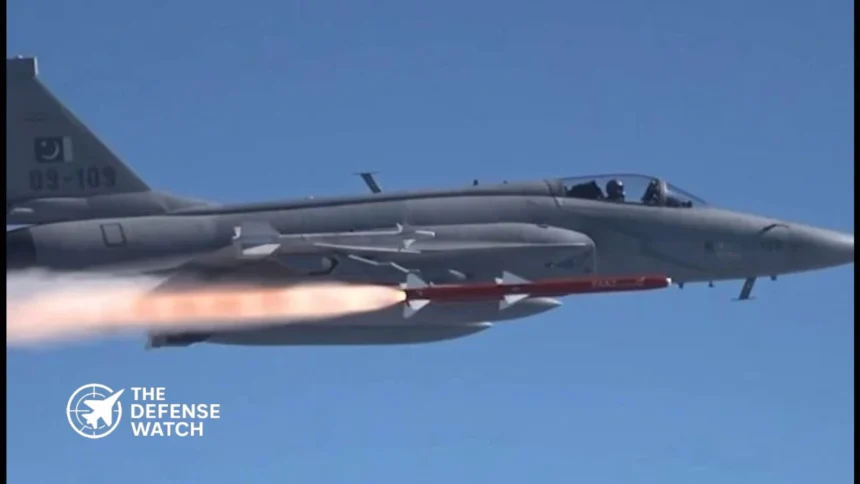
Pakistan has successfully flight-tested its first indigenously developed Fa’az air-to-air missile, giving the Pakistan Air Force (PAF) another step toward developing domestic weapons for fighter aircraft.
- From an exhibition prototype to a flight-tested weapon
- What is known about Fa’az’s guidance technology?
- Why domestic air-to-air missile development matters for the PAF
- Integration with the JF-17 and Pakistan’s wider fighter fleet
- Fa’az-2 and the longer-range development objective
- Testing is only the first step toward operational service
The test took place on November 3, 2026, according to the Inter-Services Public Relations (ISPR). The military described Fa’az as an air-to-air weapon equipped with an advanced terminal guidance system capable of engaging aerial targets at longer ranges.
The announcement provides the first official confirmation of a successful flight test of the missile program, which was publicly showcased during an international defense exhibition in 2023.
ISPR did not disclose the missile’s tested configuration, engagement range, speed, launch conditions, or expected date of operational induction. It also did not publish a detailed assessment of the test results.
From an exhibition prototype to a flight-tested weapon
Fa’az has been under development for several years. Pakistan’s state-owned Global Industrial and Defence Solutions (GIDS) first publicly displayed the missile family at the International Defence Industry Fair (IDEF) in Istanbul in July 2023.
At the exhibition, GIDS presented two air-to-air configurations:
- Fa’az-RF: An active radar-guided variant.
- Fa’az-IIR: A variant equipped with an imaging infrared seeker.
In August 2023, Defense News reported that both displayed missiles were mock-ups, according to GIDS chief executive Asad Kamal. The company advertised a range exceeding 100 kilometers and a maximum speed of Mach 3.5 for the two configurations. These were manufacturer-provided figures, not independently verified operational performance measurements.
The November 2026 test is therefore an important program milestone. It moves Fa’az beyond its earlier public presentation as a development concept, although one successful flight test does not establish that the missile has completed qualification or entered production.
What is known about Fa’az’s guidance technology?
The missile’s guidance architecture is particularly relevant to its intended beyond-visual-range (BVR) role.
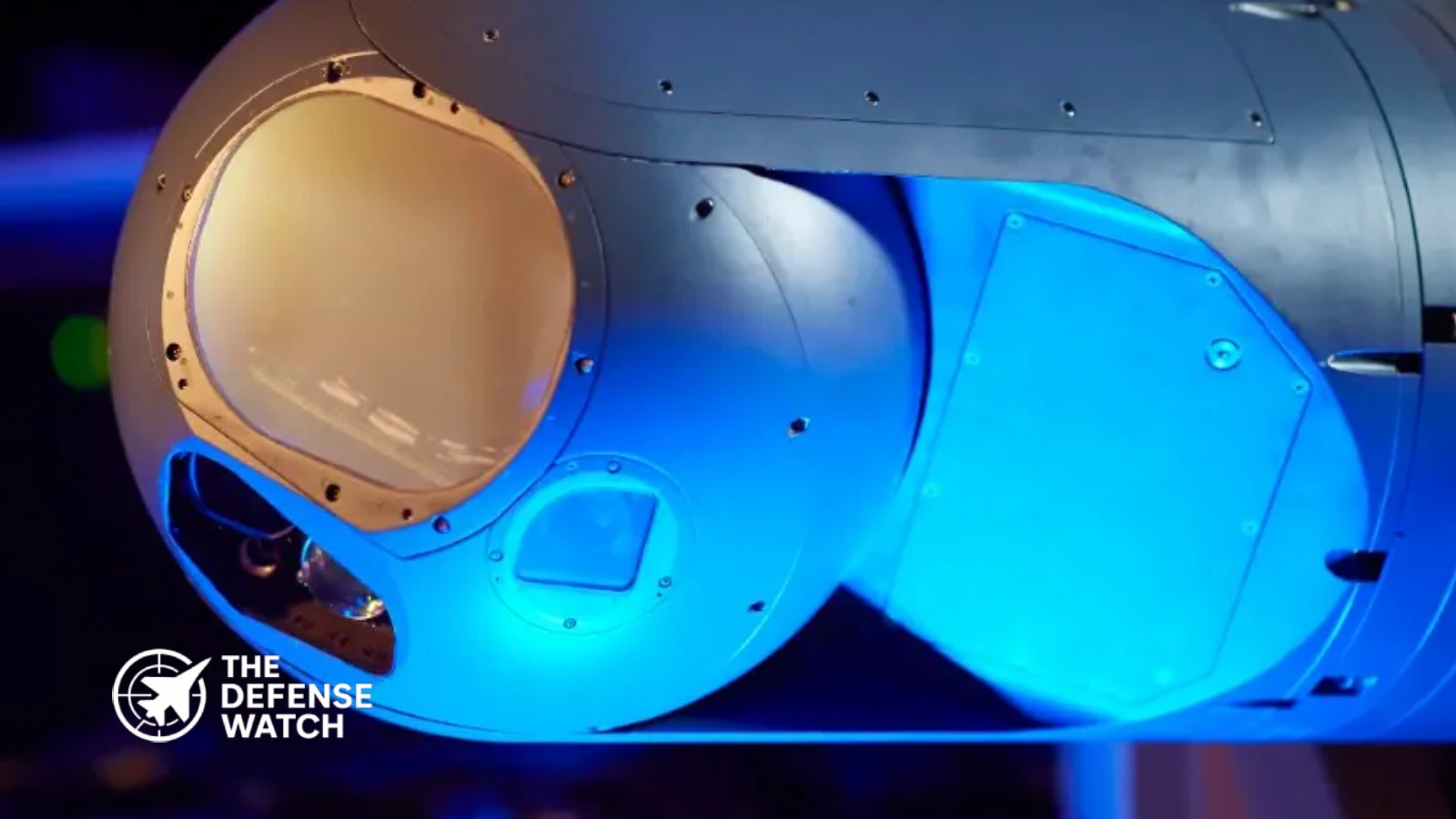
An active radar-guided missile uses an onboard radar seeker to locate and track its target during the terminal engagement phase. This allows the weapon to pursue an aircraft without depending entirely on continuous illumination from the launching fighter.
An imaging infrared seeker uses thermal imaging to identify and track targets based on their infrared signatures. Such a configuration offers a different engagement approach and can provide an alternative to radar-dependent targeting.
The two seeker configurations previously displayed by GIDS suggest that Pakistan is pursuing more than one approach to air-to-air missile guidance.
However, ISPR’s November 3 announcement only confirmed an advanced terminal guidance system. It did not identify which seeker configuration was tested or establish whether both variants have reached flight-test maturity.
Why domestic air-to-air missile development matters for the PAF
Developing an indigenous air-to-air missile could give Pakistan greater control over an important part of its fighter aircraft weapons inventory.
The PAF operates aircraft equipped with different foreign-origin missile systems, including American and Chinese weapons. These supply relationships can create dependencies involving procurement approvals, export restrictions, delivery schedules, maintenance support, and access to technical information.
A domestically developed missile could eventually provide greater flexibility in procurement and sustainment.
There are also potential industrial benefits. Missile development requires expertise in propulsion, guidance electronics, seeker technology, flight control, software, warhead integration, and environmental testing.
Building these capabilities locally could support future weapons programs beyond the Fa’az family.
Nevertheless, domestic development does not automatically mean complete independence from foreign components. Public information does not establish the extent of locally manufactured components or the program’s reliance on imported technologies.
Integration with the JF-17 and Pakistan’s wider fighter fleet
The JF-17 Thunder is an important platform in Pakistan’s efforts to expand domestic aerospace and weapons development.
Its development and production involve cooperation between Pakistan Aeronautical Complex (PAC) and China’s Chengdu Aircraft Corporation. The aircraft provides the PAF with a locally supported multirole fighter platform and an opportunity to integrate weapons developed through Pakistan’s defense industry.
The Fa’az program could eventually complement this approach by providing a domestically developed air-to-air weapon.
However, successful missile testing does not establish compatibility with every PAF fighter.
Operational integration requires more than attaching a missile to an aircraft. It involves launcher compatibility, electrical interfaces, mission-computer integration, radar or infrared target data, weapons-control software, and flight-clearance testing.
The aircraft must also be able to support the missile’s targeting and engagement requirements.
Although reporting on the November 3 test has associated the missile with the JF-17, the official announcement did not identify the launch aircraft in its published statement. The precise integration status across the PAF fleet remains unclear.
Fa’az-2 and the longer-range development objective
The Fa’az program has also been associated with an extended-range development effort known as Fa’az-2.
According to specialist defense reporting, the longer-range variant was being developed with a projected range of approximately 180 kilometers, compared with the advertised range exceeding 100 kilometers for the baseline Fa’az configurations.
These figures describe the program’s publicly reported development objectives, not confirmed results from the November 2026 test.
Janes identified Fa’az-1 and Fa’az-2 as the two main configurations of the missile family in its reporting on the 2023 exhibition. However, no official announcement accompanying the latest test confirmed that Fa’az-2 participated in the flight-test event.
For the PAF, the development of a longer-range air-to-air missile would be relevant to engagements involving airborne early warning aircraft, support platforms, and opposing fighters.
But actual effectiveness depends on more than advertised missile range. Target detection, tracking quality, launch altitude, aircraft speed, electronic warfare, target maneuverability, and midcourse guidance all influence the outcome of a beyond-visual-range engagement.
A published maximum range should not be treated as the distance at which a missile can reliably destroy a maneuvering aircraft.
Testing is only the first step toward operational service
The successful Fa’az flight test establishes progress, but several important milestones remain before its operational contribution can be assessed.
These include further flight testing, seeker validation, guidance accuracy assessments, aircraft integration, environmental qualification, and production readiness.
The military has not announced a production schedule, procurement quantity, or operational induction date.
It has also not disclosed whether the November 3 event involved an instrumented test against a simulated target, a live target engagement, or another type of flight-test profile.
That distinction matters when assessing the maturity of a new air-to-air missile.
For Pakistan, the most important outcome will be whether the Fa’az program can progress from successful testing to a reliable, maintainable, and operationally integrated weapon.
Until further technical information becomes available, the test is best understood as a meaningful advancement in Pakistan’s indigenous missile-development effort rather than confirmation of a fully operational new air-combat capability.