
- Home
- Defense Systems
- Fighter Jets
- North American F-86 Sabre
North American F-86 Sabre
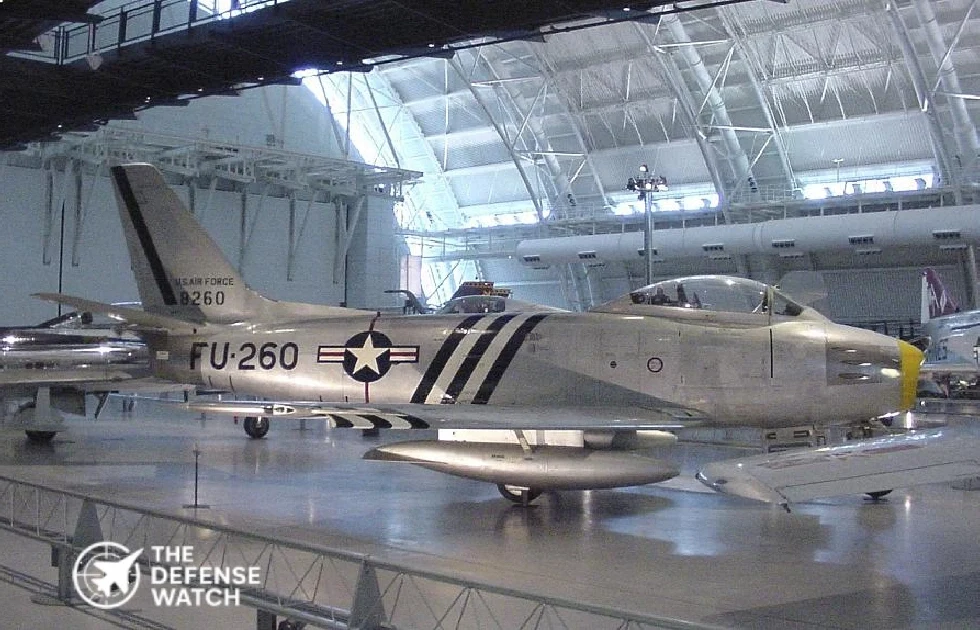
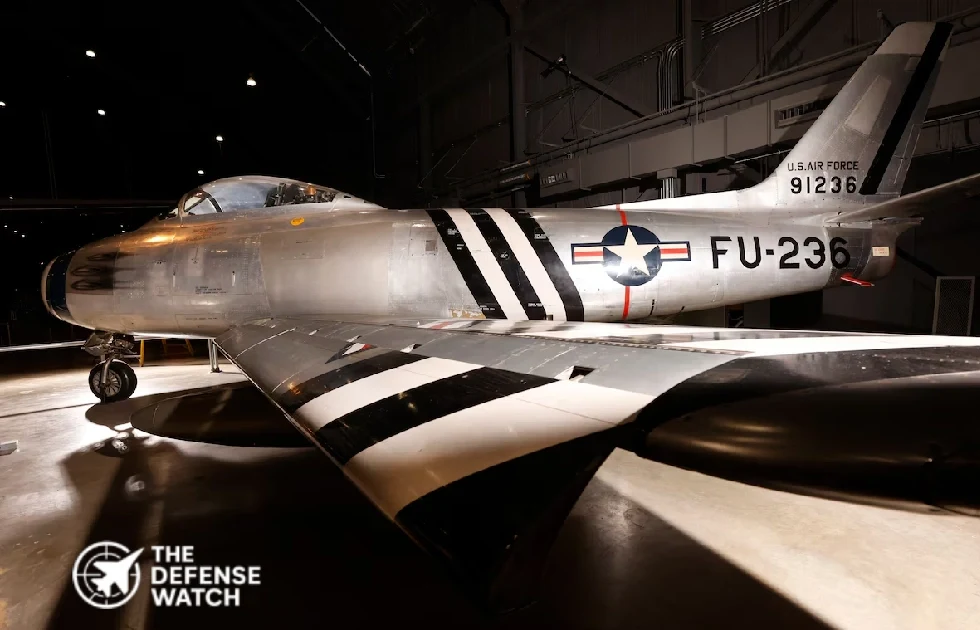
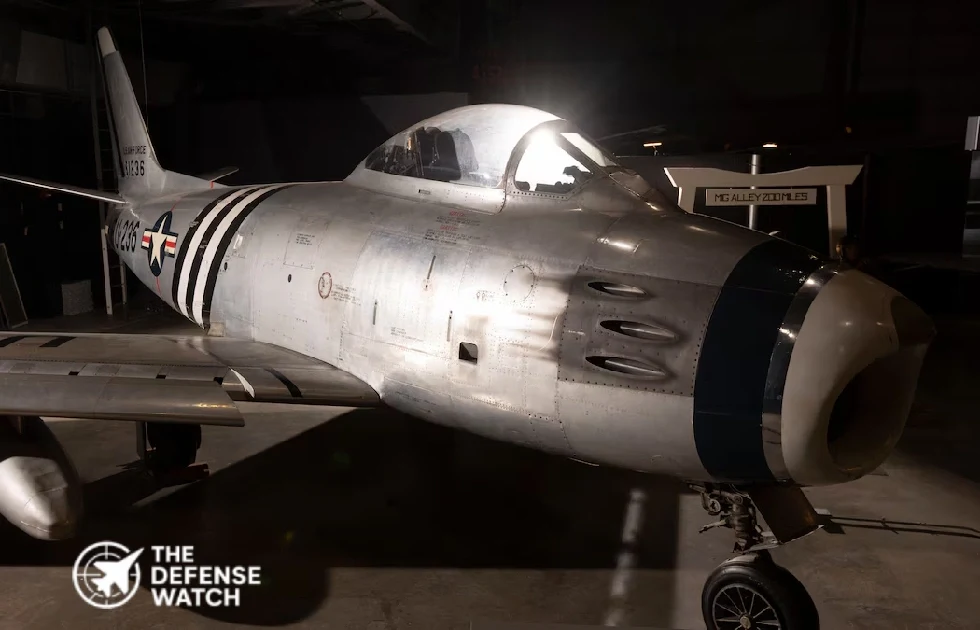
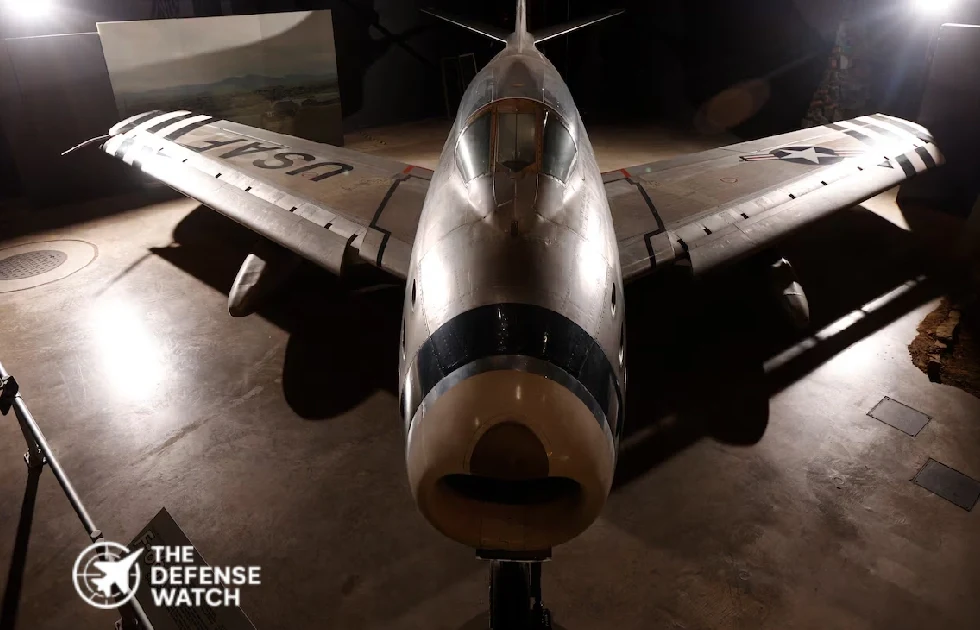
Defense Systems Full Specifications
General Information
| Name | North American F-86 Sabre |
| Manufacturer | North American Aviation |
| Country of Origin | United States |
| Type / Role | Jet fighter, fighter-bomber, interceptor depending on variant |
| Generation | 1st |
| Status | Retired from frontline service |
| First Flight | October 1, 1947 |
| Introduction / In Service Since | 1949, USAF |
| Number Built | Approximately 9,860 across the Sabre family, including international production |
| Operators | United States, Canada, United Kingdom, Australia, Japan, West Germany, Italy, Spain, Pakistan and others |
Dimensions & Structure
| Length | 37 ft 6 in (11.43 m) |
| Wingspan | 37 ft 1 in (11.30 m) |
| Height | 14 ft 8 in (4.47 m) |
| Wing Area | Approximately 313 sq ft (29.1 m²) |
| Empty Weight | Approximately 10,000 lb (4,536 kg), configuration dependent |
| Maximum Takeoff Weight (MTOW) | Varies by variant and load |
| Internal Weapons Bay | None |
| External Hardpoints | Typically 4 on fighter-bomber capable variants |
Performance
| Maximum Speed | Approximately 685 mph (1,102 km/h), F-86A reference |
| Range | Approximately 1,200 miles (1,931 km), published nominal figure |
| Combat Radius | Mission and variant dependent, substantially less than maximum range |
| Service Ceiling | Approximately 49,000 ft (14,935 m) |
| Rate of Climb | Variant dependent |
| Thrust-to-Weight Ratio | Varies with fuel, stores and aircraft weight |
| G Limits | Exact operational limits depend on variant and flight conditions |
Powerplant
| Engine Type | General Electric J47 axial-flow turbojet on F-86A |
| No. of Engines | 1 |
| Thrust (each) | Approximately 5,200 lbf (23.1 kN) for the F-86A |
| Thrust Vectoring | No |
| Fuel Capacity | Variant dependent; external drop tanks could extend range |
Armament
| Gun | 6 × .50-caliber machine guns on standard day-fighter variants |
| Missiles (Air-to-Air) | Not standard on early F-86A models; some later Sabre variants received Sidewinder capability |
| Missiles (Air-to-Ground) | No standard guided missile fit on the original F-86A |
| Bombs | Conventional bombs on compatible variants |
| Hardpoints | External stations varied by variant |
| Payload Capacity | Variant dependent; fighter-bomber models could carry bombs, rockets and external fuel tanks |
Avionics & Systems
| Radar | No dedicated interception radar on standard F-86A day fighter |
| Radar Range | Not applicable to the standard F-86A; dependent on radar-equipped variant |
| Electronic Warfare (EW) System | No modern integrated EW suite |
| Targeting System | Optical gunsight; improved fire-control equipment on later versions |
| Helmet Display | None |
| Navigation | Period-appropriate radio navigation and cockpit instruments |
| Autopilot / AI Assistance | No AI-assisted flight systems |
| Communication | Conventional military radio systems |
Stealth & Technology
| Radar Cross Section (RCS) | No verified standard published figure |
| Stealth Features | None |
| Infrared Signature Reduction | None |
| Sensor Fusion | None |
| Networking Capabilities | No modern digital tactical networking |
Variants
| Special Export Versions | F-86E |
Operational History
| Major Conflicts / Deployments | Korean War, 1950 to 1953, and subsequent service in several regional conflicts |
| Notable Operators | United States, Canada, Australia, Japan, Pakistan, Italy, Spain and West Germany |
| Combat Proven? | Yes |
| Mission Types | Air combat, interception, fighter escort, ground attack and training |
Cost & Program
| Unit Cost | Historical estimates vary; approximately $178,000 for the F-86A in period sources |
| Development Cost | A single comparable program total is not established here |
| Program Name | F-86 Sabre development and production program |
| Funding Countries | Primarily the United States, with allied procurement and assistance programs supporting foreign operators |
Additional Information
| Upgrades Planned | None for the retired original aircraft; individual historic aircraft may undergo restoration |
| Future Replacement | Superseded in USAF fighter service by newer designs, including the F-100 Super Sabre |
| Export Restrictions | Current transfers are subject to applicable national laws and regulations |
| Notable Achievements | First operational swept-wing fighter in the U.S. Air Force inventory; major role in Korean War jet combat |
| Competitors | Mikoyan-Gurevich MiG-15, MiG-17 and other contemporary jet fighters |
PROS
- Swept-wing design improved high-speed flight performance.
- Strong record in Korean War air combat.
- Six machine guns provided effective close-range air-to-air firepower.
- Later variants supported ground attack and interception missions.
- Export service and production variants supported widespread international use.
CONS
- Early models lacked modern beyond-visual-range missile capability.
- Limited sensor and radar capability on standard day-fighter variants.
- Single engine provided no backup in the event of engine failure.
- High fuel consumption and maintenance demands typical of early jet aircraft.
- Outclassed by later supersonic fighters as military aviation advanced.
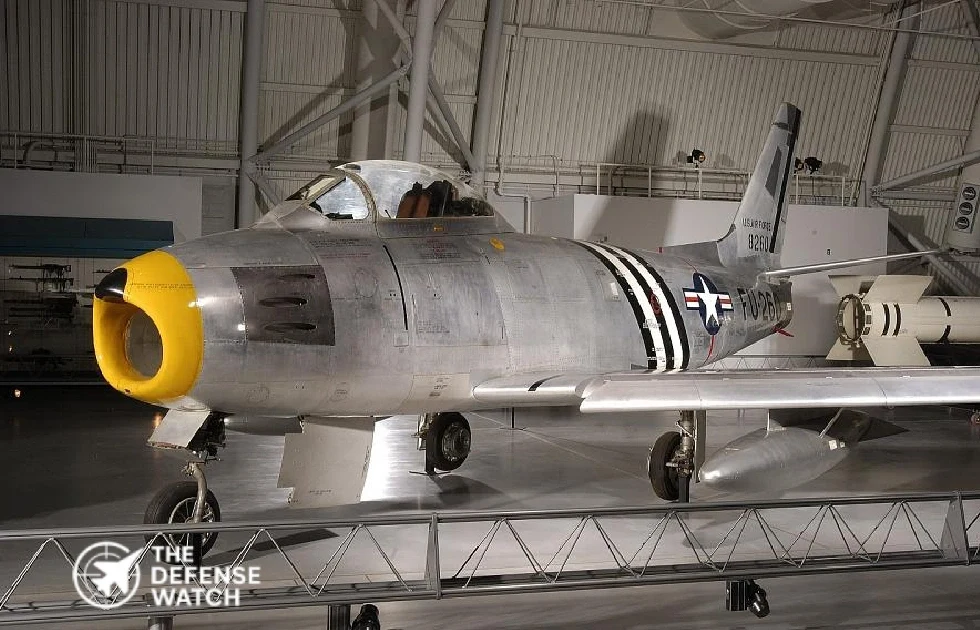
The North American F-86 Sabre was one of the most influential American jet fighters of the early Cold War. Developed to counter emerging high-speed threats, it combined swept wings, a streamlined airframe, and six .50-caliber machine guns in a design suited to high-speed air combat. The aircraft became particularly well known during the Korean War, where it fought Soviet-designed MiG-15 fighters in some of the first major jet-versus-jet battles in aviation history.
Manufacturer and Development
Developed by North American Aviation in the United States, the F-86 first flew on October 1, 1947, and entered US Air Force service in 1949. Its swept-wing configuration improved high-speed performance compared with earlier straight-wing jet fighters. Later versions incorporated an improved engine, upgraded fire-control equipment, and other changes to increase combat effectiveness. The aircraft also served with numerous allied air forces and was produced under license or developed into related versions in other countries.
Speed and Range
The F-86F, one of the best-known production variants, reached approximately 685 mph (1,102 km/h) under favorable conditions. Its operational range varied with the variant, fuel load, altitude, and mission profile. A representative maximum range was approximately 1,200 miles (1,930 km), while its practical combat radius was substantially shorter. The aircraft was powered by a single General Electric J47 turbojet engine and typically carried six .50-caliber M3 Browning machine guns. Some later variants incorporated different weapons and equipment.
Cost and Price
The original F-86 program dates to the late 1940s, so its historical unit cost varies by production batch and configuration. There is no single price that applies to every Sabre variant. Today, surviving aircraft are primarily museum exhibits, privately owned historic aircraft, or restoration projects. Their market values depend on condition, provenance, airworthiness, and maintenance requirements.
The F-86 Sabre remains an important milestone in fighter development, illustrating the transition from early jet aviation to the high-speed swept-wing designs that shaped subsequent generations of combat aircraft.
Variants
| Variant | Description |
|---|---|
| XF-86 | Experimental prototype designation |
| F-86A | Initial production day fighter |
| F-86E | Improved flight-control system and handling |
| F-86F | Improved engine and wing configurations |
| F-86D | All-weather radar-equipped interceptor, also called Sabre Dog |
| F-86H | Fighter-bomber variant with a more powerful engine |
| F-86K | Export-oriented interceptor with cannon armament |
| F-86L | Upgraded interceptor with improved air-defense integration |
Disclaimer Note
The information provided on TheDefenseWatch.com is for general informational purposes only. While we strive to ensure the accuracy, completeness, and timeliness of our content regarding defense and aerospace products, technologies, and specifications, we cannot guarantee that all information is 100% accurate or up-to-date due to the evolving nature of military technology and classified data.TheDefenseWatch.com does not warrant the reliability, suitability, or availability of the information for any specific purpose. Users are advised to consult official sources, such as manufacturers, government publications, or defense agencies, for precise and verified data before making decisions based on our content.We are not affiliated with any defense manufacturers, governments, or military organizations mentioned. Opinions, reviews, and ratings reflect expert analysis but are subjective and should not be considered endorsements. TheDefenseWatch.com is not responsible for any errors, omissions, or consequences arising from the use of this website’s content.External links are provided for convenience and do not imply endorsement. TheDefenseWatch.com reserves the right to update or modify content without prior notice. By using this website, you agree to our Privacy & Cookies Policy.




New Arrivals








Popular Comparisons
-
 J-10C vs JF-17 Thunder: Which Fighter Is More Capable?
View Comparison →
-
Tejas vs Gripen: Key Differences and Capabilities
View Comparison →
-
Tejas vs MiG-21 Bison: How India Replaced Its Iconic Supersonic Fighter
View Comparison →
-
F-35 vs F-16: Stealth, Sensors and Combat Roles
View Comparison →
-
Tejas Fighter Jet vs F-16 Fighting Falcon: Capability Compared
View Comparison →
-
Rafale Fighter Jet vs F-16 Fighting Falcon : Which Fighter Has the Edge?
View Comparison →
-
Su-57 Fighter Jet vs J-20 Fighter Jet: Stealth and Air Combat Compared
View Comparison →
-
Mirage 2000 vs Tejas Mk1A: Legacy Combat Power vs Indigenous Modernization
View Comparison →
-
Rafale Fighter Jet vs F-22 Raptor: Which Air Dominance Fighter Has the Edge?
View Comparison →
-
Tejas Fighter Jet vs. Rafale Fighter Jet: India’s Indigenous Fighter Meets France’s Proven Multirole Combat Aircraft
View Comparison →


- Pratt & Whitney Begins $100 Million Polish Expansion for F-35 Engine Parts

- Northrop Grumman Wins $43.9 Million Contract for Trident II Rocket Motor Facilities
- Ukraine Drone Strikes Disrupt Russian Data Centers, Raising Questions About AI Infrastructure Security
- Lockheed Martin Wins $114.6 Million Contract to Redesign F-35 Navigation Systems
- Project Agincourt Pushes Pentagon to Speed Up Autonomous Weapons Fielding
- Northrop Grumman Factory Expansion Aims to Increase B-21 Raider Production
- France Orders Four More SAMP/T NG Air Defense Systems
- France and UAE Revive Rafale F5 Fighter Development Partnership
- P-800 Oniks Missile: Range, Speed and BrahMos Comparison
- Ukrainian Drone Unit Caused 70% of Simulated U.S. Brigade Casualties in Germany Exercise

Fighter Jets
-
 F-100 Super Sabre
-
Northrop YF-23 Fighter
-
Rafale F5 Fighter
-
SU-57 Felon Stealth Fighter
-
Boeing F/A-XX Fighter
-
JF-17 Thunder Fighter Jet
-
F-47 Fighter Jet
-
MIG-31 Fighter Jet
-
J-10CE Fighter Jet
-
Chengdu J-10 Fighter Jet
-
Chengdu J-10C Fighter Jet
-
Gripen E Fighter Jet
-
Tejas Mk1A Fighter Jet
-
Tejas Mk‑2 Fighter Jet
-
F-16V Viper Block 70 Fighter Jet
-
F-15EX Eagle II Fighter
-
F-15E Strike Eagle Fighter
-
F/A-18E/F Super Hornet Fighter Jet
-
Saab Gripen F Fighter Jet
-
JAS 39E/F Gripen Fighter Jet
-
JAS 39 Gripen Fighter Jet
-
F-35A Lightning II Fighter Jet
-
F/A-18F Super Hornet
-
J-50 Fighter Jet







Recent Compares
-
J-10C vs JF-17 Thunder: Which Fighter Is More Capable?
View Comparison →
-
Tejas vs Gripen: Key Differences and Capabilities
View Comparison →
-
Tejas vs MiG-21 Bison: How India Replaced Its Iconic Supersonic Fighter
View Comparison →
-
F-35 vs F-16: Stealth, Sensors and Combat Roles
View Comparison →
-
Tejas Fighter Jet vs F-16 Fighting Falcon: Capability Compared
View Comparison →
Latest Defense Systems
10 Compares Defense Systems
-
J-10C vs JF-17 Thunder: Which Fighter Is More Capable?
View Comparison →
-
Tejas vs Gripen: Key Differences and Capabilities
View Comparison →
-
Tejas vs MiG-21 Bison: How India Replaced Its Iconic Supersonic Fighter
View Comparison →
-
F-35 vs F-16: Stealth, Sensors and Combat Roles
View Comparison →
-
Tejas Fighter Jet vs F-16 Fighting Falcon: Capability Compared
View Comparison →
-
Rafale Fighter Jet vs F-16 Fighting Falcon : Which Fighter Has the Edge?
View Comparison →
-
Su-57 Fighter Jet vs J-20 Fighter Jet: Stealth and Air Combat Compared
View Comparison →
-
Mirage 2000 vs Tejas Mk1A: Legacy Combat Power vs Indigenous Modernization
View Comparison →
-
Rafale Fighter Jet vs F-22 Raptor: Which Air Dominance Fighter Has the Edge?
View Comparison →
-
Tejas Fighter Jet vs. Rafale Fighter Jet: India’s Indigenous Fighter Meets France’s Proven Multirole Combat Aircraft
View Comparison →
- Pratt & Whitney Begins $100 Million Polish Expansion for F-35 Engine Parts
- Northrop Grumman Wins $43.9 Million Contract for Trident II Rocket Motor Facilities
- Ukraine Drone Strikes Disrupt Russian Data Centers, Raising Questions About AI Infrastructure Security
- Lockheed Martin Wins $114.6 Million Contract to Redesign F-35 Navigation Systems
- Project Agincourt Pushes Pentagon to Speed Up Autonomous Weapons Fielding