Phoenix Defense Ventures LLC has received a $310.5 million U.S. Air Force task order to provide flight instruction, classroom education, simulator operations and opposing-force training for crews operating the HH-60W Jolly Green II Combat Rescue Helicopter.
The Air Force Life Cycle Management Center awarded the task order on October 27, 2026, under the Training Systems Acquisition IV (TSA IV) program. The contract carries an expected completion date of December 31, 2027, with annual options extending through December 31, 2033.
The award is valued at $310,498,639. However, the contract announcement states that only $5,638 in fiscal 2027 operation and maintenance funding was obligated at the time of award. The initial obligation should not be confused with the overall task order value or the funding required over its full performance period.
Training Covers the Full HH-60W Aircrew Qualification Cycle
The contract covers several stages of aircrew development, from initial aircraft qualification to advanced mission preparation and instructor training.
According to the award announcement, Phoenix Defense Ventures will provide:
- Initial qualification training for new HH-60W aircrew members.
- Mission qualification training for operational assignments.
- Transition and conversion training for personnel moving between aircraft or mission roles.
- Instructor upgrade courses.
- Instrument refresher training.
- Programmed flight training and classroom academics.
- Simulator training operations.
- Opposition forces training to support realistic training scenarios.
The combination of flight instruction, simulator operations and opposing-force activities is intended to support training beyond basic aircraft handling. It covers the preparation required for crews to operate the helicopter within the Air Force’s combat rescue mission.
The award does not publicly specify the number of aircrew members to be trained, annual training throughput, simulator quantities or the number of flight-training hours covered by the task order.
A Nationwide and Overseas Training Network
Performance will extend across 13 locations in the United States, Japan and Italy.
The listed locations include:
| Location | State or country |
|---|---|
| Phoenix | Arizona |
| Kirtland Air Force Base | New Mexico |
| Moody Air Force Base | Georgia |
| Patrick Space Force Base | Florida |
| Nellis Air Force Base | Nevada |
| Davis-Monthan Air Force Base | Arizona |
| Joint Base Elmendorf-Richardson | Alaska |
| Gabreski Air National Guard Base | New York |
| Moffett Air National Guard Base | California |
| Fort Eustis | Virginia |
| Kadena Air Base | Japan |
| Aviano Air Base | Italy |
| Joint Base Andrews | Maryland |
This distribution indicates that the training requirement extends beyond a single schoolhouse or operating base. It provides a framework for supporting HH-60W training activities across multiple Air Force installations and overseas locations.
The announcement does not identify which specific courses will be conducted at each installation. It also does not provide a breakdown of the contract value by location.
Phoenix Defense’s Role Under the TSA IV Program
The task order falls under the Air Force Training Systems Acquisition IV contract, a multiple-award indefinite-delivery/indefinite-quantity procurement framework.
Phoenix Defense previously announced that it received a position on the TSA IV contract in June 2023. The company described the broader program as having a $32.5 billion ceiling and a 10-year ordering period through May 2033. That figure represents the overall program ceiling, not funding awarded to Phoenix Defense for the HH-60W requirement.
Phoenix Defense Ventures is a joint venture between Phoenix Logistics and Riptide Software. In a separate October 30 announcement, the company identified itself as the Air Force’s prime contractor for the HH-60W Combat Rescue Helicopter Training System.
The company also described additional responsibilities involving maintenance training device support, engineering sustainment, courseware development, contractor logistics support and program cybersecurity. These are company-announced elements of its broader training-system role and should be distinguished from the specific services listed in the $310.5 million task order.
The latest award followed a competitive fair-opportunity procurement in which five offers were received. This establishes that the task order was competed among eligible contractors, rather than awarded through a sole-source process.
Why HH-60W Training Matters to Combat Rescue Operations
The aircraft’s mission makes crew preparation particularly important.
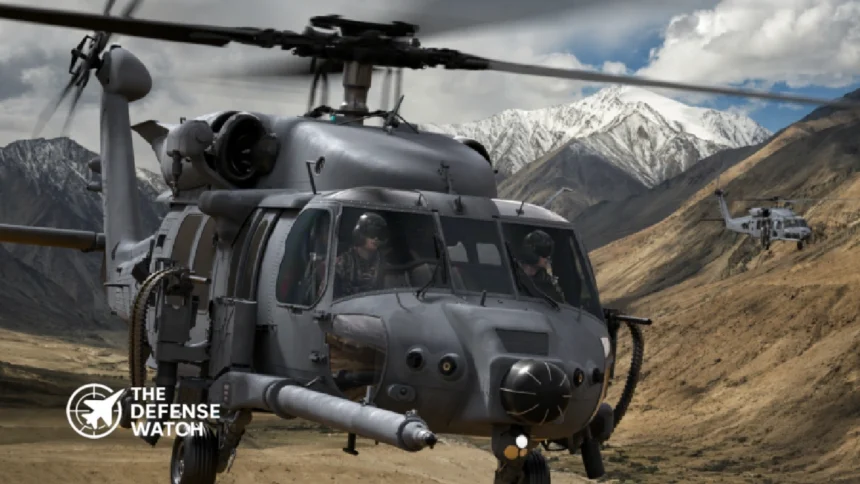
The HH-60W Jolly Green II is the U.S. Air Force’s dedicated Combat Search and Rescue helicopter, replacing the older HH-60G Pave Hawk.
Its primary mission is recovering downed aircrew and other isolated personnel from hostile or denied territory. The aircraft also supports medical evacuation, humanitarian assistance, disaster response and other personnel recovery missions.
According to an Air Combat Command fact sheet, the helicopter incorporates communications and navigation systems, an electro-optical and infrared camera, weather radar, defensive warning systems and countermeasures. Its rescue equipment includes a personnel recovery hoist and a system for locating personnel using modern survival radios.
The Air Force declared the HH-60W combat ready in October 2022 after it achieved initial combat capability and met the service’s minimum requirements for the combat search and rescue mission. The aircraft was developed to replace the Pave Hawk while improving communications, navigation and defensive capabilities.
These capabilities require crews to maintain proficiency in more than routine helicopter operations. Aircrew members must be prepared to operate in demanding environments, coordinate rescue activities and respond to changing mission conditions.
Simulator training can provide opportunities to practice complex procedures and emergency scenarios without requiring every training event to take place in an operational aircraft. Opposition-force training can also introduce simulated threats into exercises, helping crews prepare for contested mission environments.
The contract’s inclusion of initial, mission qualification, transition and instructor upgrade courses suggests that the Air Force is addressing several stages of the HH-60W personnel training pipeline.
However, the contract announcement does not disclose the specific simulator technology, training scenarios or performance standards Phoenix Defense will use.
Contract Funding and Performance Timeline
The $310,498,639 task order has an expected completion date of December 31, 2027. Annual options could extend the work through December 31, 2033.
The funding information deserves particular attention. The Air Force is initially obligating $5,638 from fiscal 2027 operation and maintenance funds.
This is a relatively small initial obligation compared with the announced task order value. It does not establish that the entire contract has already been funded. The actual funding profile will depend on subsequent obligations and the exercise of applicable options.
The contracting activity is the Air Force Life Cycle Management Center at Wright-Patterson Air Force Base, Ohio. The award identification number is FA8692-27-F-B002.
For Phoenix Defense Ventures, the award provides a substantial role in the Air Force’s combat rescue training enterprise. For the service, the immediate requirement is to maintain a training structure capable of supporting HH-60W aircrews across multiple domestic and overseas locations.
The available contract information does not establish how many aircraft or aircrew members will be supported annually. Those details, along with the distribution of funding across individual training locations, remain undisclosed.