North Korea Tests Strategic Cruise Missile With Dispersal Warhead
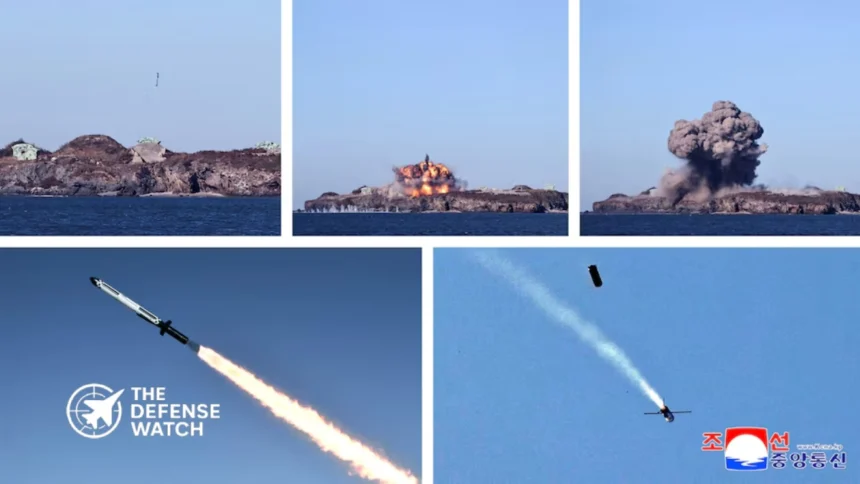
North Korea has tested a strategic cruise missile equipped with a dispersal warhead, adding another reported capability to its expanding missile weapons program. The November 2 test also evaluated the missile’s ability to conduct a vertical strike, according to a November 3 report by the Korean Central News Agency (KCNA).
- North Korea Tests Strategic Cruise Missile With Dispersal Warhead
- Warhead Test Claims a 5 to 6 Hectare Target Area
- Vertical-Strike Capability Adds Another Development Objective
- Second Warhead Test Within Three Days
- South Korea Questions the Significance of Pyongyang’s Claims
- Implications for Regional Missile Defense
The test was conducted by North Korea’s Missile Administration and supervised by General Kim Jong-sik, a senior ruling Workers’ Party official, according to reporting by South Korea’s Yonhap News Agency. Pyongyang described the activity as a test of a major weapons system intended to assess warhead effectiveness and missile flight characteristics.
The announcement follows a separate test of a cluster warhead designed for tactical ballistic missiles on October 31. Taken together, the two demonstrations indicate that North Korea is pursuing dispersal-type conventional warheads across more than one missile category. However, the available information does not establish whether the tested systems have entered operational service.
Warhead Test Claims a 5 to 6 Hectare Target Area
North Korea’s Missile Administration said its Warhead Institute evaluated a medium-sized dispersal warhead mounted on the strategic cruise missile.
KCNA reported that the warhead could affect a target area of approximately 5 to 6 hectares at what North Korean officials described as the highest-density level of destructive power.
That corresponds to approximately 12.4 to 14.8 acres. The figure is an official North Korean claim, not an independently verified measure of the weapon’s effectiveness.
The announcement did not provide important technical details, including:
- The number and type of submunitions carried by the warhead.
- The missile’s designation and launch platform.
- Its flight distance and operational range.
- The warhead’s composition and release mechanism.
- The test conditions used to measure the reported destructive area.
The absence of these details makes it difficult to assess the weapon’s actual performance or compare it with existing cluster-munition systems.
A dispersal warhead generally releases multiple smaller explosive or fragmentation elements over a designated area rather than concentrating the entire explosive effect at a single impact point. Such weapons can be intended for use against dispersed personnel, exposed equipment and multiple targets within a defined area.
North Korea has not publicly provided enough information to determine the precise configuration of the newly tested warhead.
Vertical-Strike Capability Adds Another Development Objective
Beyond the warhead itself, the test focused on the cruise missile’s terminal flight characteristics.
According to KCNA, North Korea’s Cruise Missile System Institute improved the missile’s terminal maneuverability to strengthen its vertical-strike capability. The institute reportedly adjusted the missile’s flight characteristics to account for the natural and geographical features of the intended target area.
This aspect of the test is relevant because cruise missiles generally approach targets through controlled flight paths, while a steep terminal attack requires additional guidance and maneuvering capability.
A vertical or near-vertical approach could offer advantages against certain fixed targets, particularly facilities with limited exposed access points. South Korean defense analyst Shin Jong-woo told Yonhap that the capability could be intended to improve attacks against underground military facilities and tunnel entrances.
However, the precise trajectory achieved during the North Korean test has not been independently established. KCNA did not publish verified measurements of the missile’s terminal angle, accuracy or guidance performance.
The announcement therefore demonstrates a development objective, but it does not establish that North Korea has achieved a reliable precision-strike capability against hardened underground targets.
Second Warhead Test Within Three Days
The November 2 cruise missile test followed North Korea’s October 31 trial of a cluster-bomb warhead designed for tactical ballistic missiles.
According to KCNA reporting published November 1, the earlier test involved a warhead identified as the Standard Type 2 cluster-bomb configuration. North Korean research institutes claimed it could affect an area of 12 to 13 hectares at its highest density.
The Missile Administration also described four categories of cluster warheads and said military units would be equipped to select and use different types according to operational requirements before the end of 2026.
The two reported tests suggest an effort to develop different warhead configurations for different delivery systems:
- Tactical ballistic missiles: A cluster-bomb warhead reportedly designed to cover a larger target area.
- Strategic cruise missiles: A medium-sized dispersal warhead reportedly tested alongside improvements to terminal flight characteristics.
These are separate reported weapon developments. Public information does not establish whether the two warheads share components, technology or a common production program.
South Korea Questions the Significance of Pyongyang’s Claims
The tests have drawn attention in South Korea, where military planners must account for North Korea’s expanding range of missile delivery systems and conventional warhead options.
South Korea’s Joint Chiefs of Staff said on November 3 that its military was monitoring North Korean activities and maintaining the capability to respond to potential provocations.
JCS spokesperson Capt. Jang Do-young also said South Korea had already developed precision-strike capabilities and relevant weapons systems that surpassed the technology claimed by North Korea, according to Yonhap.
South Korean authorities are also conducting analysis with the United States.
The response indicates that Seoul is not treating Pyongyang’s announcements as proof of a decisive change in the regional military balance. Nevertheless, the development of additional warhead configurations remains relevant to South Korea’s missile defense and military infrastructure protection planning.
Implications for Regional Missile Defense
The combination of ballistic and cruise missile delivery systems creates different challenges for regional defense planners.
Ballistic missiles generally follow high-speed trajectories, while cruise missiles can operate at lower altitudes and use terrain-following flight profiles. Their different flight characteristics require different detection, tracking and interception considerations.
Adding dispersal warheads introduces another challenge. A weapon designed to distribute multiple submunitions could threaten a wider area than a conventional unitary warhead, potentially increasing risks to personnel, exposed military equipment and infrastructure.
The reported vertical-strike development also deserves attention. If North Korea can reliably improve terminal maneuverability, it could expand the range of attack profiles available against fixed military installations.
However, the operational significance remains uncertain. North Korea has not disclosed the missile’s precise model, demonstrated range, accuracy, submunition characteristics or performance under realistic combat conditions.
The November tests also do not establish whether the weapons are compatible with North Korea’s nuclear-capable cruise missile systems. The term strategic, as used in North Korean military reporting, should not by itself be interpreted as confirmation of a nuclear payload.
For the United States and South Korea, the immediate concern is the possibility of a more diverse conventional missile threat. Determining whether these tests reflect mature operational capabilities or continuing weapons development will require further evidence.
Pyongyang’s reported intention to equip military units with several types of cluster warheads before the end of 2026 provides a stated development objective. Whether that timeline will be met, and how widely the systems will be deployed, remains unconfirmed.