







@2026 – All Right Reserved. TheDefenseWatch.com
- Home
- Defense Systems
- Compare
- Rafale Fighter Jet vs F-16 Fighting Falcon : Which Fighter Has the Edge?
Rafale Fighter Jet vs F-16 Fighting Falcon : Which Fighter Has the Edge?
Rafale Fighter Jet vs F-16 Fighting Falcon: Speed, Range and Combat Power
Executive Summary:
The Rafale and F-16 Fighting Falcon are both multirole fighters, but they were designed around different operational philosophies. The Rafale is a larger twin-engine aircraft built to combine air superiority, deep strike, reconnaissance, maritime attack and nuclear deterrence missions, while the F-16 is a smaller single-engine fighter optimized around agility, affordability, multirole flexibility and large-scale international deployment.
The comparison becomes especially interesting with modern versions. The Rafale F4 continues to add networking and sensor capabilities, while the F-16 Block 70/72 brings an APG-83 AESA radar, advanced avionics and a 12,000-hour structural life.
Tactical Overview
The Rafale entered French Navy service in 2004 and French Air Force service in 2006. It was designed from the beginning for both land and carrier operations and was intended to replace several earlier French combat aircraft types.
The F-16 has a much longer service history. The first operational F-16A entered U.S. service in 1979, and the aircraft has since evolved through numerous blocks. The current Block 70/72 is effectively a new-production fourth-generation-plus configuration with AESA radar, modern mission systems and an extended structural life.
This distinction matters because a comparison between a modern Rafale F4 and an early F-16 would not be meaningful. For a current technology comparison, the more useful reference is the Rafale F4 versus F-16 Block 70/72.
Key Takeaways
Rafale Advantage
- Twin-engine design with high payload and fuel capacity.
- 9.5-tonne external load across 14 weapon stations.
- RBE2 AESA radar, FSO infrared sensors and SPECTRA electronic warfare.
- Strong air-to-air, deep-strike, maritime and reconnaissance capabilities.
F-16 Advantage
- Smaller, lighter and highly maneuverable single-engine design.
- Block 70/72 incorporates the APG-83 AESA radar.
- Extensive global weapons integration and logistics infrastructure.
- 12,000-hour structural life for new-production Block 70/72 aircraft.
Strategic Context
The Rafale has the stronger overall aircraft-level capability in areas such as payload, internal fuel, twin-engine redundancy, electronic warfare and mission versatility. The F-16, however, remains highly competitive because of its lower-weight design, mature supply chain, extensive weapons integration, large global fleet and modern Block 70/72 upgrades. The better choice depends heavily on the air force’s mission requirements, budget, infrastructure and alliance relationships.
Technical Specifications Matrix
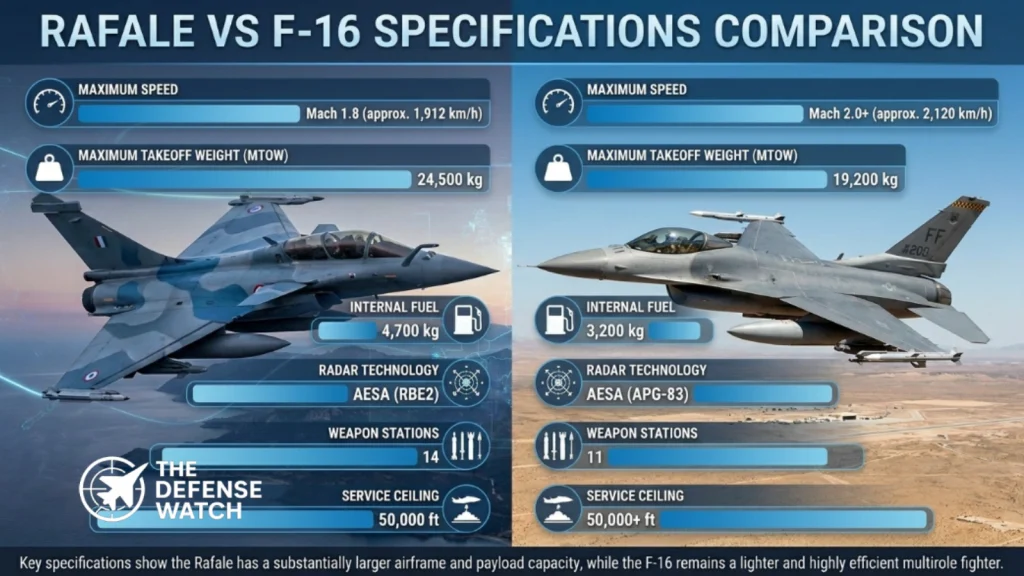
| Specification | Rafale F4 | F-16 Block 70/72 |
|---|---|---|
| Generation / Type | 4.5-generation-class multirole/omnirole fighter | Advanced 4th-generation multirole fighter |
| Engine | 2 × Safran M88 | 1 × F100 or F110 family engine, configuration dependent |
| Max Speed | Mach 1.8 / 750 knots | Approximately Mach 2 at altitude |
| Maximum Takeoff Weight | 24.5 tonnes | About 16.9 tonnes |
| External Load | 9.5 tonnes | Extensive external weapons and fuel carriage |
| Weapon Stations | 14 | Up to 9 external stations depending on configuration |
| Internal Fuel | 4.7 tonnes | Approximately 3.2 tonnes |
| Service Ceiling | 50,000 ft | Above 50,000 ft |
| Radar | Thales RBE2 AESA | Northrop Grumman APG-83 AESA |
| Passive Sensors | FSO infrared and optronic system | Modernized electro-optical targeting and mission systems, configuration dependent |
| Electronic Warfare | SPECTRA integrated EW suite | Modern defensive EW systems, configuration dependent |
| Air-to-Air Weapons | Meteor, MICA IR/EM and others | AIM-120, AIM-9X and other compatible weapons |
| Air-to-Ground Weapons | AASM/HAMMER, SCALP/Storm Shadow, guided bombs | JDAM, SDB, HARM, JSOW and other U.S. and allied weapons |
| Internal Cannon | 30 mm GIAT/Nexter 30M791 | M61A1 20 mm |
| Carrier Capability | Rafale M variant | No carrier variant |
| Crew | One or two, depending on variant | One or two, depending on variant |
| Structural Life | Continually upgraded through Rafale standards | 12,000 hours for Block 70/72 |
| Unit Cost | Contract and configuration dependent | Contract and configuration dependent |
Dassault lists the Rafale at 24.5 tonnes maximum takeoff weight, 4.7 tonnes of internal fuel, 9.5 tonnes of external load, 14 store stations and a maximum speed of Mach 1.8.
The U.S. Air Force lists the F-16 family at up to 37,500 pounds maximum takeoff weight, a Mach 2 maximum speed, more than 50,000 feet ceiling and a wide range of external weapons. These figures describe the broader F-16C/D family rather than every specification of the newest Block 70/72 configuration.
Deep-Dive Analysis
1. Airframe, Survivability and Maneuverability
Rafale
The Rafale is physically larger than the F-16 and uses two engines. Its delta-canard configuration gives the aircraft strong maneuverability while maintaining substantial internal fuel and weapons capacity.
Dassault lists a maximum load factor of +9g and a maximum speed of Mach 1.8. Its twin-engine architecture also provides an important level of redundancy for long-range missions and operations over maritime environments.
The Rafale is not a stealth fighter in the same class as the F-35 or F-22. Instead, survivability is based on a combination of reduced signatures, electronic warfare, passive sensing, maneuverability, standoff weapons and pilot situational awareness.
The SPECTRA electronic warfare system is particularly important. Dassault describes SPECTRA as an integrated system able to detect, identify and locate radar, missile and laser threats while supporting jamming, decoys and evasive maneuvers.
F-16
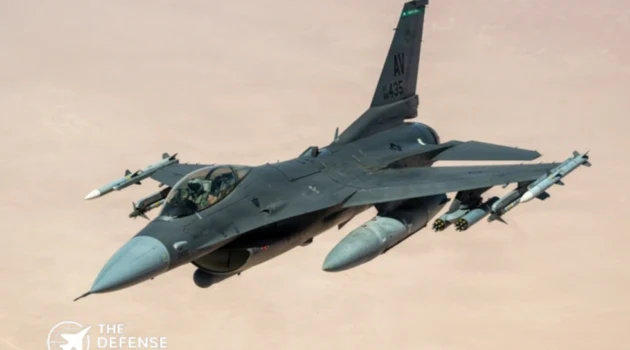
The F-16 takes a different approach. It is smaller and lighter, with a single engine and a highly maneuverable aerodynamic design.
The aircraft was deliberately developed as a relatively low-cost high-performance fighter. The U.S. Air Force describes its maneuverability and multirole performance as core characteristics.
The newest Block 70/72 retains this basic philosophy but adds modern avionics and structural improvements. Lockheed Martin says the Block 70/72 has a 12,000-hour structural life, more than 50 percent beyond previous production F-16 aircraft.
In a close-range engagement, neither aircraft can be judged simply by maximum speed. Pilot training, missile performance, helmet-mounted cueing, electronic warfare, data links and off-board targeting can have a greater effect on the outcome.
Edge: Rafale for overall survivability architecture and redundancy. F-16 for lightweight maneuverability and proven operational simplicity.
2. Sensors, Radar and Targeting Capabilities
Modern air combat is increasingly determined by who can detect, identify, track and engage an opponent first.
Rafale RBE2 AESA
The Rafale F4 uses the RBE2 AESA radar, which provides electronically scanned radar coverage and supports air-to-air and air-to-surface missions.
Dassault states that the RBE2 AESA is compatible with the long-range Meteor missile and supports detection and tracking of multiple targets.
The radar is only one part of the Rafale’s sensor architecture. Its Front Sector Optronics system provides passive infrared and visible-spectrum detection and tracking. This is significant because passive sensing can reduce the need for radar emissions in some tactical situations.
The aircraft also combines these sensors with SPECTRA electronic warfare, giving the pilot a broader picture of the electromagnetic environment.
F-16 APG-83 AESA
The F-16 Block 70/72 uses Northrop Grumman’s APG-83 AESA radar.
Lockheed Martin says the radar draws technology and hardware/software commonality from the APG-77 and APG-81 radar families used by the F-22 and F-35. It provides improved situational awareness, targeting and digital mapping compared with earlier F-16 radar systems.
This gives the modern F-16 a major advantage over older F-16 variants.
The important distinction is therefore not simply Rafale versus F-16. It is Rafale F4 versus the latest F-16 Block 70/72.
The Rafale has a more integrated combination of AESA radar, passive optronics and dedicated electronic warfare architecture. The F-16 counters with a mature AESA upgrade path, modern cockpit systems and extensive integration with U.S. and allied sensors and weapons.
Edge: Rafale at the aircraft-level sensor and EW architecture, with the F-16 remaining highly competitive through the APG-83 and networked combat systems.
3. Payload, Weapons and Operational Deployment
Rafale Weapons
Payload is one of the clearest differences.
Dassault lists the Rafale with 9.5 tonnes of external load and 14 store stations. The aircraft can employ Meteor and MICA air-to-air missiles, AASM/HAMMER precision weapons, SCALP cruise missiles, Exocet anti-ship missiles and guided bombs.
This allows one Rafale to perform missions that might otherwise require several aircraft types.
The Rafale can also conduct buddy-buddy aerial refueling, extending its operational flexibility when dedicated tanker support is limited.
The aircraft is available in the Rafale C, B and carrier-capable Rafale M configurations. That carrier capability is a major distinction from the F-16.
F-16 Weapons
The F-16’s greatest weapons advantage is not simply payload weight. It is weapons integration and global availability.
The F-16 has been integrated with a huge range of U.S. and allied weapons. Lockheed Martin says more than 3,300 carriage and release configurations have been certified for more than 180 weapon and store types.
Depending on customer and configuration, modern F-16s can employ weapons such as AIM-120 AMRAAM, AIM-9X, JDAM, Small Diameter Bombs, AGM-88 HARM and other precision weapons.
This makes the F-16 particularly attractive to countries already operating U.S. weapons and communications systems.
Combat History
The F-16 has an exceptionally extensive operational record. U.S. Air Force F-16s flew major combat missions during Desert Storm and Allied Force and subsequently participated in operations in Afghanistan and Iraq.
The Rafale has also accumulated significant combat experience. French Rafales have operated in Afghanistan, Libya, Mali, Iraq and Syria. France describes the aircraft as having demonstrated its multirole capabilities in these operational environments.
More recently, French Rafales operating in the Levant continued air defense, surveillance and coalition missions. During one 2024 deployment, Rafale C aircraft flew 128 missions and accumulated 657 flight hours.
Edge: Rafale for aircraft-level payload and mission breadth. F-16 for global weapons integration, fleet scale and logistics maturity.
Rafale vs F-16: Speed and Range
Maximum speed is one area where the F-16 has a numerical advantage.
The F-16 can reach approximately Mach 2 at altitude, according to the U.S. Air Force, while Dassault lists the Rafale at Mach 1.8.
That does not automatically make the F-16 the better fighter.
Maximum speed is rarely sustained during a combat mission. Weapons carriage, fuel, altitude, temperature, mission profile and external stores all influence actual performance.
The Rafale compensates with greater internal fuel capacity and a substantially higher maximum takeoff weight. Dassault lists 4.7 tonnes of internal fuel and 24.5 tonnes maximum takeoff weight.
The F-16 has a much smaller airframe, but its large global support network and ability to use external fuel tanks make it highly adaptable to different mission ranges. The U.S. Air Force lists more than 2,000 miles of ferry range for the F-16 family.
For combat radius, however, there is no single meaningful number for either aircraft. Radius changes significantly with weapons, fuel tanks, altitude, reserves, tanker support and mission profile.
Rafale vs F-16: Radar and Electronic Warfare
The radar comparison is closer than the basic aircraft specifications suggest.
The Rafale’s RBE2 AESA is integrated with its FSO passive sensor and SPECTRA electronic warfare system. The architecture is designed to combine active and passive information with threat detection and electronic countermeasures.
The F-16 Block 70/72’s APG-83 AESA is a major modernization compared with older mechanically scanned radar systems. It provides improved target detection, tracking, mapping and situational awareness.
The F-16 also benefits from decades of U.S. experience integrating it into larger combat networks.
Therefore, the aircraft should not be judged solely by radar range. In modern combat, the relevant question is how effectively the fighter combines its own radar, passive sensors, electronic warfare, datalinks, weapons and off-board information.
Rafale vs F-16: Payload and Mission Flexibility
This is one of the Rafale’s strongest advantages.
With a 24.5-tonne maximum takeoff weight and 9.5-tonne external load, the Rafale can carry a substantial weapons and fuel package.
Its weapon architecture covers:
- Air-to-air interception
- Beyond-visual-range combat
- Close air support
- Precision strike
- Deep strike
- Anti-ship warfare
- Tactical reconnaissance
- Nuclear deterrence for France
- Carrier operations with the Rafale M
Dassault describes the Rafale as an omnirole aircraft capable of performing several mission types during the same sortie.
The F-16 is also highly flexible, but its strength comes from its huge weapons ecosystem and widespread operator base.
For an air force already using U.S. weapons, the F-16 can provide a relatively straightforward path into modern multirole operations.
Cost, Logistics and Fleet Size
Cost comparisons between the Rafale and F-16 require caution.
A fighter’s purchase price can exclude or include engines, weapons, training, spare parts, simulators, infrastructure, support, upgrades and other equipment. A large export package therefore cannot be treated as the aircraft’s unit price.
The F-16’s original acquisition cost was much lower than modern fourth-generation-plus aircraft, but modern Block 70/72 aircraft are substantially more sophisticated than early F-16s.
The U.S. government’s Defense Security Cooperation Agency records a nonrecurring cost value for a Block 70/72 F-16C aircraft without engine, but this is not the same thing as a complete export flyaway price.
The Rafale also varies considerably by contract. Weapons, support, training and infrastructure can substantially affect the total package.
The F-16 nevertheless has a major economic advantage at the fleet level. Lockheed Martin reported approximately 3,100 F-16s operating in 27 countries, with more than 13 million sorties and 19.5 million flight hours.
That global footprint can reduce some training, logistics and interoperability challenges for countries already operating U.S. systems.
Operational Philosophy: Rafale vs F-16
The deepest difference between the two aircraft is not maximum speed or payload.
It is the philosophy behind the aircraft.
The Rafale was designed as a national strategic multirole fighter capable of performing a wide range of missions from land bases and aircraft carriers. France also operates it as part of its nuclear deterrence system.
The F-16 was designed as a relatively affordable high-performance fighter that could be purchased and operated by a large group of allied and partner nations.
That philosophy has created an enormous ecosystem around the F-16.
The aircraft has become a common platform for air forces seeking modern multirole capability without moving directly to a fifth-generation fighter.
Future Modernization
Neither aircraft is standing still.
Dassault is continuing the Rafale’s development through successive standards. The F4 program is focused heavily on networked combat and additional capabilities, while F5 development is intended to support collaborative combat with an unmanned combat aircraft.
Dassault says the Rafale F5 will be designed to work with a future UCAS and is intended to remain relevant into the decades ahead.
The F-16 has a different modernization path.
The Block 70/72 combines the mature F-16 airframe with the APG-83 AESA radar, updated avionics, modern cockpit systems and an extended 12,000-hour structural life.
This means both aircraft remain relevant, but through different strategies.
The Rafale is evolving toward a broader collaborative combat system.
The F-16 is extending the useful life and capability of an extremely mature fighter platform.
Strategic Verdict & Tactical Scenarios
When the Rafale Prevails
Long-range multirole missions
The Rafale’s larger airframe, twin engines, internal fuel capacity and high external payload make it well suited to missions where range, weapons load and endurance are important.
High-end electronic warfare
The combination of RBE2 AESA, FSO and SPECTRA gives the Rafale a particularly integrated sensor and electronic warfare architecture.
Maritime operations
The Rafale M provides a carrier-based capability that the F-16 does not offer.
Mixed mission sorties
The Rafale was specifically designed around the concept of performing different mission functions during the same sortie.
Heavy weapons carriage
The Rafale’s 9.5-tonne external load and 14 store stations give it a substantial payload advantage.
When the F-16 Prevails
Large fighter fleets
For countries seeking a large fleet supported by an established international ecosystem, the F-16 has a major advantage.
U.S. weapons integration
The F-16 can use a very large selection of U.S. and allied weapons, making it particularly attractive to countries already operating American equipment.
Cost-sensitive force structures
The F-16 was built around the concept of delivering high performance without the size and complexity of heavier twin-engine fighters.
Existing F-16 operators
Countries that already operate F-16s can benefit from established pilot training, maintenance infrastructure, spare parts and weapons inventories.
Modernized fourth-generation fleets
The Block 70/72 shows that the F-16 concept can remain relevant by combining the proven airframe with AESA radar, new avionics and a 12,000-hour structural life.
Final Verdict
The Rafale is the more capable aircraft at the platform level, particularly when the comparison focuses on payload, internal fuel, twin-engine redundancy, electronic warfare, sensor integration and mission flexibility.
The F-16 remains the stronger choice for many air forces at the force-structure level because of its global fleet, weapons ecosystem, interoperability, mature logistics network and availability in the modern Block 70/72 configuration.
In a direct technical comparison, the Rafale has the advantage in payload, fuel capacity, mission breadth and integrated electronic warfare. The F-16 counters with speed, lighter weight, mature logistics, global scale and a highly developed weapons ecosystem.
There is therefore no universal winner.
For a country seeking a heavy multirole fighter capable of carrying a large weapons load and performing air, land, maritime and strategic missions, the Rafale is the stronger choice.
For a country prioritizing fleet size, interoperability with U.S. systems, established logistics and a modern but comparatively compact multirole fighter, the F-16 Block 70/72 remains exceptionally competitive.
The key lesson is that Rafale vs F-16 is not simply a contest between two fighter jets. It is a comparison between two different models of air power: Rafale emphasizes broad aircraft-level capability, while F-16 emphasizes affordability, scale and an enormous allied ecosystem.
| |
| Price | |
| Our Rating | |
| Manufacturer | Dassault Aviation Lockheed Martin |
| Category | Fighter Jets Fighter Jets |
General Information
| Name | Dassault Rafale F-16 Fighting Falcon |
| Manufacturer | Dassault Aviation General Dynamics / Lockheed Martin |
| Country of Origin | France United States |
| Type / Role | Multirole Fighter Multirole Fighter |
| Generation | 4.5th 4th |
| Status | Active Service Active / In Service |
| First Flight | July 4, 1986 January 20, 1974 |
| Introduction / In Service Since | 2001 1978 |
| Number Built | 240+ Over 4,600 |
| Operators | France, India, Egypt, Qatar, Greece, Indonesia USA, Israel, Turkey, Greece, South Korea, etc. |
Dimensions & Structure
| Length | 15.27 m 49 ft 5 in (15.06 m) |
| Wingspan | 10.9 m 32 ft 8 in (9.96 m) |
| Height | 5.3 m 16 ft 8 in (5.09 m) |
| Wing Area | 45.7 m² 300 sq ft (27.87 m²) |
| Empty Weight | 10,600 kg 18,900 lb (8,573 kg) |
| Maximum Takeoff Weight (MTOW) | 24,500 kg 42,300 lb (19,187 kg) |
| Internal Weapons Bay | None None |
| External Hardpoints | 14 9 |
Performance
| Maximum Speed | Mach 1.8 (2,223 km/h) Mach 2.0 |
| Range | 3,700 km 2,620 mi (4,220 km) with drop tanks |
| Combat Radius | 1,000–1,850 km ~500 mi (800 km) |
| Service Ceiling | 50,000 ft 50,000 ft (15,240 m) |
| Rate of Climb | 305 m/s 50,000 ft/min |
| Thrust-to-Weight Ratio | 1.13 1.095 |
| G Limits | +9 / -3.6 +9 / -3 |
Powerplant
| Engine Type | Snecma M88-2 Turbofan Pratt & Whitney F100-PW-229 / GE F110-GE-129 |
| No. of Engines | 2 1 |
| Thrust (each) | 16,500 lbf 29,000 lbf (afterburner) |
| Thrust Vectoring | No No |
| Fuel Capacity | 4,700 kg (internal) 7,000 lb internal |
Armament
| Gun | GIAT 30mm cannon 1× M61A1 20mm Vulcan |
| Missiles (Air-to-Air) | MICA, Meteor AIM-9, AIM-120 |
| Missiles (Air-to-Ground) | SCALP-EG, AM39 Exocet AGM-65, AGM-88 |
| Bombs | Paveway, AASM JDAM, Paveway, Cluster bombs |
| Hardpoints | 14 9 |
| Payload Capacity | 9,500 kg 17,000 lb (7,700 kg) |
Avionics & Systems
| Radar | Thales RBE2 AESA AN/APG-68 / AN/APG-83 AESA |
| Radar Range | 200+ km ~160 km |
| Electronic Warfare (EW) System | SPECTRA Suite AN/ALQ-213, ALQ-131 |
| Targeting System | Thales Damocles / TALIOS Pod Sniper XR / LANTIRN |
| Helmet Display | Integrated HMD JHMCS |
| Navigation | GPS/INS GPS/INS |
| Autopilot / AI Assistance | Semi-Automated Digital Fly-by-Wire |
| Communication | Secure Datalink, SATCOM Link 16, Secure UHF/VHF |
Stealth & Technology
| Radar Cross Section (RCS) | ~1 m² ~1.2 m² |
| Stealth Features | Radar-absorbent materials Limited shaping, radar-absorbent coatings |
| Infrared Signature Reduction | Yes Moderate |
| Sensor Fusion | Full Partial (F-16V upgrade) |
| Networking Capabilities | NATO-compatible datalink Link 16, Joint operations compatible |
Variants
| Special Export Versions | Rafale EH/IH (India), Rafale EM/QM (Egypt/Qatar) F-16I (Israel), KF-16 (South Korea) |
Operational History
| Major Conflicts / Deployments | Libya, Mali, Iraq, Syria Gulf War, Kosovo, Iraq, Afghanistan |
| Notable Operators | France, India, Egypt USAF, Israel, Turkey, Taiwan, UAE |
| Combat Proven? | Yes Yes |
| Mission Types | Air superiority, strike, reconnaissance, deterrence Air superiority, strike, SEAD, CAS |
Cost & Program
| Unit Cost | $85–115 million ~$35 million (Block 70) |
| Development Cost | ~$45 billion ~$8 billion (program total) |
| Program Name | Rafale Program Lightweight Fighter (LWF) |
| Funding Countries | France United States, NATO partners |
Additional Information
| Upgrades Planned | F4 & F5 standard upgrades AESA radar, datalink, EW suite |
| Future Replacement | Next-Gen Fighter (FCAS) F-35A Lightning II |
| Export Restrictions | Minimal (case-by-case) Controlled under ITAR |
| Notable Achievements | Combat-proven multirole success Most exported Western fighter |
| Competitors | Eurofighter Typhoon, F/A-18E/F, Gripen E JAS 39 Gripen, MiG-29, Mirage 2000 |

|
Disclaimer Note
The information provided on TheDefenseWatch.com is for general informational purposes only. While we strive to ensure the accuracy, completeness, and timeliness of our content regarding defense and aerospace products, technologies, and specifications, we cannot guarantee that all information is 100% accurate or up-to-date due to the evolving nature of military technology and classified data.TheDefenseWatch.com does not warrant the reliability, suitability, or availability of the information for any specific purpose. Users are advised to consult official sources, such as manufacturers, government publications, or defense agencies, for precise and verified data before making decisions based on our content.We are not affiliated with any defense manufacturers, governments, or military organizations mentioned. Opinions, reviews, and ratings reflect expert analysis but are subjective and should not be considered endorsements. TheDefenseWatch.com is not responsible for any errors, omissions, or consequences arising from the use of this website’s content.External links are provided for convenience and do not imply endorsement. TheDefenseWatch.com reserves the right to update or modify content without prior notice. By using this website, you agree to our Privacy & Cookies Policy.
New Arrivals
Popular Comparisons
-
 Tejas Fighter Jet vs F-16 Fighting Falcon: Capability Compared
View Comparison →
Tejas Fighter Jet vs F-16 Fighting Falcon: Capability Compared
View Comparison → -
Su-57 Fighter Jet vs J-20 Fighter Jet: Stealth and Air Combat Compared
View Comparison →
-
Mirage 2000 vs Tejas Mk1A: Legacy Combat Power vs Indigenous Modernization
View Comparison →
-
Rafale Fighter Jet vs F-22 Raptor: Which Air Dominance Fighter Has the Edge?
View Comparison →
-
Tejas Fighter Jet vs. Rafale Fighter Jet: India’s Indigenous Fighter Meets France’s Proven Multirole Combat Aircraft
View Comparison →
-
F-22 Raptor vs. F-35 Joint Strike Fighter: Which Fifth Generation Fighter Has the Edge?
View Comparison →
-
F-35A vs. F-22 Raptor: Which U.S. Stealth Fighter Dominates Modern Air Combat?
View Comparison →
-
AGM-114 Hellfire vs. AGM-179 JAGM: Which U.S. Precision Missile Is Better?
View Comparison →
-
Patriot (PAC-3) vs. THAAD: Complete Missile Defense System Comparison, Capabilities, Range, and Strategic Roles
View Comparison →
-
AIM-120 AMRAAM vs. AIM-9X Sidewinder: Complete Air-to-Air Missile Comparison, Range, Speed, and Combat Roles
View Comparison →
- Taiwan Altius 600M Drone Program Faces Logistics Questions Over Missing Chargers

- Germany Moves To Expand Naval Signals Intelligence Fleet With Fourth Type 424 Ship
- Department Of War Commits $450 Million To Strengthen U.S. Tungsten Supply
- BlackSky Gen-3 Satellite Delivers First Imagery Within 20 Hours, Expanding 35-Centimeter ISR Capacity
- Shield AI Targets Europe With X-BAT Uncrewed Strike Fighter and Polish Production Plan
- Lockheed Martin Vectis Advances Toward 2027 Stealth Combat Drone Flight
- Netherlands Moves To Acquire Saab GlobalEye As NATO Replaces Aging AWAC
- Bulgaria Investigates Explosion At EMCO Weapons Storage Site
- North Korea Conducts Live Fire Drills With Missiles and Artillery
- U.S. Air Force Plans Major F-15EX Technical Refresh as Production Expands