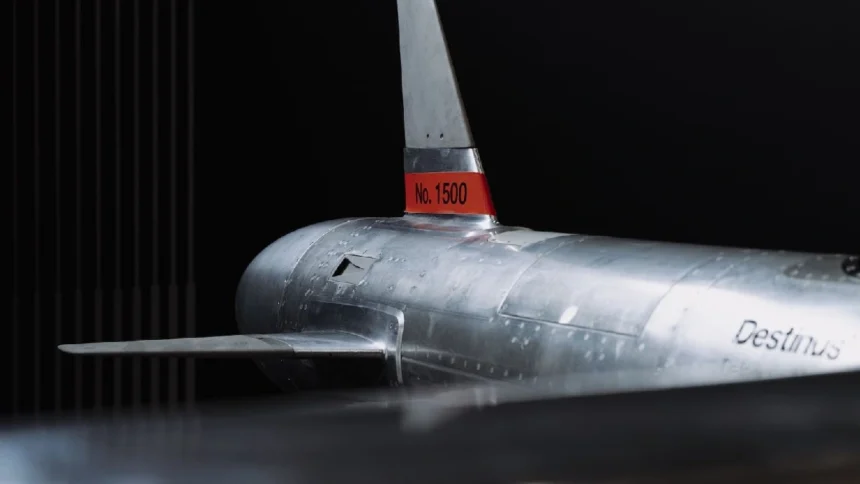
Dutch defense technology company Destinus says it has completed 1,750 Ruta B1 cruise missiles, with monthly production approaching 300 units. The milestone provides a measure of how quickly a European manufacturer can scale production of relatively affordable strike weapons as demand for conventional long-range attack capabilities grows.
The company announced the figure on October 29, 2026, describing the achievement as the result of expanding manufacturing operations and moving from prototype production to serial manufacturing. Destinus also said it develops and manufactures its own T150 turbojet engine and produces key missile components, including airframes, guidance systems and avionics.
The reported output is significant for European defense manufacturing, where the ability to replenish weapons stocks has become an important concern following Russia’s full-scale invasion of Ukraine. However, the production milestone does not establish how many missiles have been delivered to military customers, remain available in inventory or are ready for operational use.
Ruta B1 production reaches industrial scale
Destinus has built its Ruta B1 program around serial manufacturing rather than relying exclusively on small production batches.
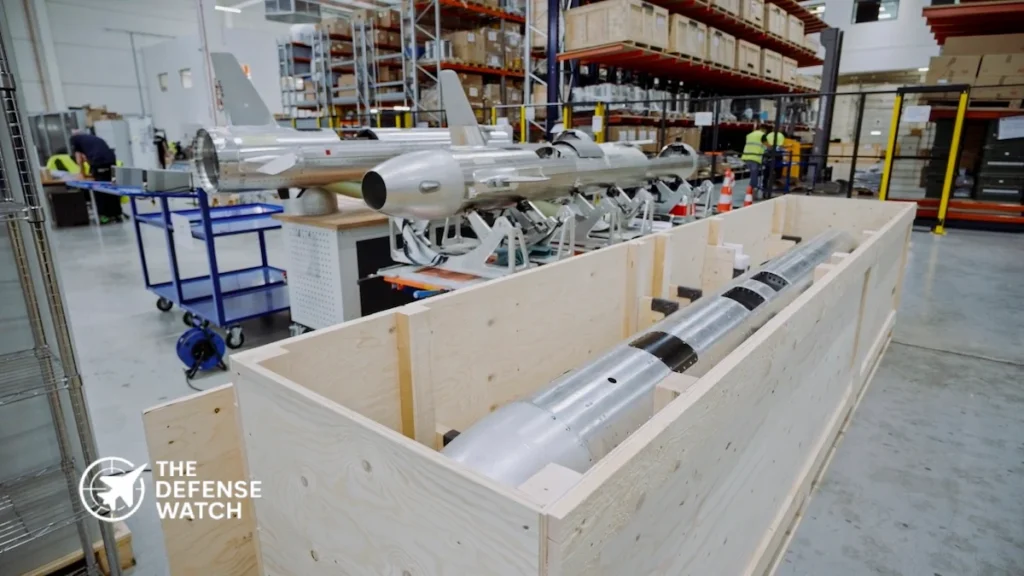
According to the company, its cumulative output has reached 1,750 missiles, while monthly production is approaching 300. Reuters separately reported the same production figures following discussions with the company. These remain company-reported numbers rather than independently audited production totals.
The distinction between prototype development and serial manufacturing matters. A missile manufacturer must do more than produce a design that flies successfully. It must maintain consistent quality across successive units, secure a dependable supply of components, manage production costs and deliver weapons at a rate that meets customer requirements.
Destinus says its manufacturing approach includes in-house development and production of several major subsystems. Its T150 turbojet engine powers the Ruta B1, and the company announced in June 2026 that it had completed its 1,000th T150 engine.
Producing propulsion systems internally can reduce dependence on external engine suppliers, although it does not eliminate other supply-chain constraints. Electronics, materials, testing facilities and quality-control processes must also keep pace as output increases.
The company has not published a detailed breakdown of Ruta B1 production costs, delivery schedules or the proportion of its output allocated to individual customers.
Why European missile production capacity matters
European governments have increased their attention to ammunition and missile production as they assess requirements for prolonged, high-intensity conflict.
The war in Ukraine has demonstrated the importance of maintaining supplies of weapons while replacing those expended during combat. It has also highlighted the industrial challenge of sustaining production over extended periods rather than relying on inventories accumulated before a conflict.
Cruise missiles occupy a particular role in this equation. They allow forces to attack selected targets at a distance without necessarily sending crewed aircraft into the target area. Their effectiveness depends on factors including navigation, target intelligence, mission planning, survivability and the defenses protecting the intended target.
The Ruta B1 production milestone addresses one part of this broader requirement: the industrial capacity to manufacture strike weapons in substantial quantities.
Yet manufacturing volume is not equivalent to military capability. Armed forces must also establish the units, logistics networks, storage facilities, maintenance arrangements and targeting processes required to use large missile inventories effectively.
Reuters reported on October 29 that Destinus chief executive Mikhail Kokorich identified military integration and logistics as potential constraints as European missile production expands.
For European defense planners, this creates a challenge that extends beyond the factory floor. Procurement decisions must account for the number of weapons required, their operational roles, the availability of launch systems and the resources needed to sustain their use.
Destinus expands beyond the Ruta B1
The Ruta B1 milestone comes as Destinus develops additional variants intended to expand the missile family’s capabilities.
The company has announced the Ruta Block 2, a larger system designed for longer-range precision strike missions. Reuters reported that Block 2 is designed to carry a 250-kilogram payload over more than 700 kilometers and that production has begun. These are reported design characteristics, not independently verified operational performance figures.
Destinus has also outlined plans for Ruta Block 3, a longer-range development targeting the 2,000-kilometer class. According to the company’s May 2026 announcement, the program’s flight-test campaign is planned to begin in 2027. Its proposed design includes a larger T220 turbojet engine and a 250-kilogram-class warhead. These remain planned characteristics, not evidence of a completed or operationally qualified weapon.
The variants illustrate two different industrial and operational priorities.
Block 1 provides the existing production baseline. Block 2 is intended to extend the family’s reach and payload capacity, while Block 3 is being developed for substantially longer-range missions.
The available information does not establish that the newer variants have achieved the same production maturity as the B1. Their development, testing and qualification schedules remain important factors in determining when they could become available in operational quantities.
Rheinmetall partnership could add German manufacturing capacity
Destinus is also working to expand its European industrial footprint through a planned partnership with German defense manufacturer Rheinmetall.
In April 2026, Rheinmetall announced an agreement to establish Rheinmetall Destinus Strike Systems, a joint venture intended to manufacture, market and deliver missile systems. Under the announced arrangement, Rheinmetall would hold a 51% stake and Destinus the remaining 49%, subject to regulatory approvals. The planned company is to be based in Unterlüß, Lower Saxony.
The partnership is intended to combine Destinus’ missile designs and technology with Rheinmetall’s manufacturing infrastructure and experience in defense production.
Destinus said in May that production at Rheinmetall’s Unterlüß site was planned to begin with Ruta Block 1 and Block 2 in 2026 and 2027, complementing its existing manufacturing operations in the Netherlands. The company also outlined a distributed industrial model involving the Netherlands, Ukraine and Germany.
This arrangement could provide an additional route for expanding European production, subject to the establishment of the joint venture, completion of the necessary approvals and the readiness of manufacturing and integration facilities.
It is important to distinguish planned capacity from output already achieved. The 1,750-missile figure relates to Destinus’ reported production milestone. It should not be interpreted as proof that the planned German facility has reached full-rate production.
Production numbers do not tell the whole story
Destinus’ reported manufacturing progress offers evidence that its Ruta B1 program has moved beyond limited prototype output. It also provides a useful indicator of the company’s ability to manufacture its own propulsion systems and integrate production across several major missile subsystems.
Several questions remain unanswered, however.
The company has not provided a public breakdown of how many of the 1,750 missiles have been delivered, how many are allocated to military customers or what proportion of production is available for new orders. Publicly available information also does not establish the missile’s full operating cost or independently verified performance under different combat conditions.
These details matter when assessing the practical value of expanded production. A large output figure can demonstrate industrial capacity, but it cannot by itself establish affordability, reliability, effectiveness against modern air defenses or the pace at which armed forces can field the weapon.
For European militaries, the relevant measure will be whether manufacturers can deliver suitable weapons at sustainable prices and whether those forces can integrate, maintain and replenish them over time.
Destinus’ 1,750-missile milestone is a tangible manufacturing achievement. Its longer-term significance will depend on how effectively that production capacity translates into reliable deliveries, operational availability and a sustainable European precision-strike supply chain.