China’s Defense Ministry has responded to questions about reports of a strategic missile test involving a newer-generation nuclear submarine, but its public comments did not confirm the reported event or identify the submarine involved.
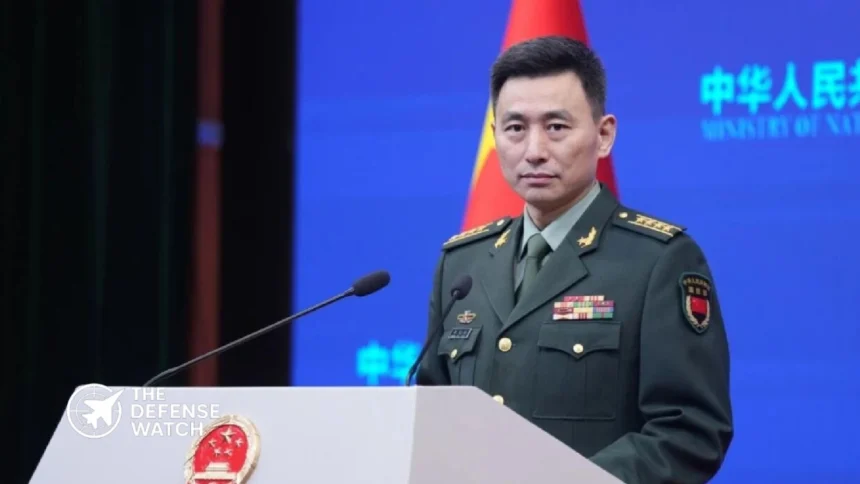
At a press conference on Thursday, Chinese Defense Ministry spokesperson Zhang Xiaogang was asked about an October 17 report by China’s state news agency Xinhua concerning a submarine referred to as Long March. According to the question reported by the state-run Global Times, the report described the submarine as having advanced to a third generation and successfully conducting a submarine-launched strategic missile test.
Zhang said he was not aware of the specific circumstances described in the question. He subsequently referred to China’s nuclear submarine development as a product of domestic technological development and self-reliance.
His remarks did not establish whether the reported test had occurred as described, which missile was involved, or whether the submarine belonged to China’s widely discussed Type 096 ballistic missile submarine program.
The distinction matters because a confirmed test, a developmental milestone and the introduction of a new operational submarine are separate events. Public reporting currently does not establish that all three have occurred.
What China has and has not confirmed
The Global Times report provides a record of the questions asked at the press conference and the spokesperson’s response. It does not provide independent verification of the submarine test.
The original question cited Xinhua’s October 17 reporting as the basis for describing the submarine as a newer-generation platform. It also referred to speculation among foreign observers that the submarine could be associated with the Type 096 program.
However, the available account leaves several important details unresolved:
- Submarine identity: The report does not establish that the submarine mentioned in the question was a Type 096.
- Missile designation: No specific missile type or designation is identified in the available account.
- Test details: The report does not provide independently verified information about the launch location, test conditions or missile flight.
- Operational status: The comments do not establish whether a new submarine has entered operational service.
- Program timeline: No confirmed schedule for the introduction of a newer-generation ballistic missile submarine was provided.
These limitations prevent a firm assessment of how far China’s next-generation submarine program has progressed.
China’s official statements and state media reporting provide useful information about the country’s public messaging, but they should not be treated as independent confirmation of the technical details surrounding a military test.
Why the Type 096 program matters
China operates a sea-based nuclear deterrent alongside its land-based nuclear forces and nuclear-capable aircraft. Ballistic missile submarines contribute to that deterrent by providing a mobile platform from which nuclear-armed ballistic missiles can be launched.
The strategic advantage of a submarine-based force is its ability to operate at sea while making its location more difficult for an adversary to determine. Its effectiveness depends on several factors, including submarine quietness, patrol endurance, missile reliability, secure communications and the ability to remain operational during a crisis.
A newer-generation submarine could improve some of these characteristics, but the precise improvements associated with China’s reported development remain uncertain.
The Type 096 is widely discussed in open-source defense analysis as a future Chinese ballistic missile submarine design intended to succeed or supplement the existing Type 094 class. However, China has not publicly provided a complete, authoritative technical description of the Type 096 that would allow its design, capabilities or service-entry timeline to be independently established.
Consequently, claims about its dimensions, acoustic performance, missile capacity and operational capabilities require careful attribution.
The available reporting on the October missile test does not resolve those questions.
A missile test is not the same as an operational capability
A successful submarine-launched missile test can demonstrate that particular elements of a weapons system function under specified conditions. It does not, by itself, establish that a complete operational capability is ready for deployment.
For a ballistic missile submarine force, the relevant components include the submarine platform, launch systems, missiles, navigation and guidance equipment, command-and-control arrangements, trained crews and maintenance infrastructure.
Testing can assess individual components or demonstrate their integration. Operational deployment requires a broader set of evaluations and supporting capabilities.
In China’s case, the reported test could not be independently assessed from the information available in the Global Times account. The report does not provide sufficient evidence to determine whether it involved a new missile, a new submarine design or an established system undergoing further testing.
The distinction is particularly important when interpreting reports that associate a weapons test with a specific next-generation platform.
China’s nuclear deterrence modernization
China has invested in the modernization of its nuclear forces across land, sea and air. Its submarine program is one element of this broader effort, which has attracted growing attention from the United States and other regional powers.
For the People’s Liberation Army Navy, ballistic missile submarines provide a different strategic function from conventionally armed attack submarines.
Attack submarines are primarily designed for missions such as hunting other submarines, attacking surface vessels and conducting other maritime operations. Ballistic missile submarines are designed principally to support the country’s strategic nuclear deterrent.
Their value depends less on their visible presence at sea than on their ability to remain survivable, communicate securely with national command authorities and maintain a credible retaliatory capability.
A more capable submarine could strengthen China’s ability to sustain that force over time. Nevertheless, the extent of any improvement would depend on the characteristics of the submarine, its missiles, its operational procedures and the maturity of the supporting infrastructure.
Without confirmed information about the reported test, it would be premature to conclude that China’s nuclear deterrent has reached a particular new level of capability.
The wider military context
The questions about China’s submarine program appeared alongside discussion of other military developments at the same Defense Ministry briefing, including the December Airshow China event and reports concerning the KJ-3000 airborne early warning and control aircraft.
The two programs address different military requirements.
A ballistic missile submarine supports strategic nuclear deterrence, while an airborne early warning and control aircraft provides airborne surveillance and helps coordinate military aircraft and other forces.
Both programs reflect China’s continuing investment in military technology, but developments in one should not be used as evidence of progress in the other.
The KJ-3000 was separately discussed in reporting by The War Zone on October 22, which examined satellite imagery showing four aircraft at or near the Xi’an-Yanliang aviation complex. The imagery prompted assessments that the aircraft could be approaching or entering serial production, although the available evidence did not conclusively establish that production had begun.
The submarine report presents a similar challenge for defense analysts: distinguishing evidence of development from assumptions about production, deployment and operational readiness.
In both cases, reliable assessment depends on identifying what the evidence actually demonstrates rather than treating a reported milestone as confirmation of an entire program’s status.
What evidence would clarify the submarine program?
Further information from Chinese authorities or independently verifiable evidence would be needed to establish the significance of the reported missile test.
The most useful developments would include an official identification of the submarine class, confirmation of the missile involved, details of the test’s objectives and results, or credible evidence connecting the event to a known development program.
Additional information about sea trials, construction milestones or the introduction of submarines into operational units could also help clarify the program’s progress. Such indicators would need to be evaluated individually rather than treated as interchangeable proof of operational readiness.
For now, the available report establishes that questions were raised about a purported strategic missile test and that China’s Defense Ministry spokesperson did not directly confirm the specific circumstances described.
It does not establish that a Type 096 submarine conducted the test, that a new submarine-launched missile has entered service, or that China has announced a new operational capability.
Those questions remain open pending stronger evidence.