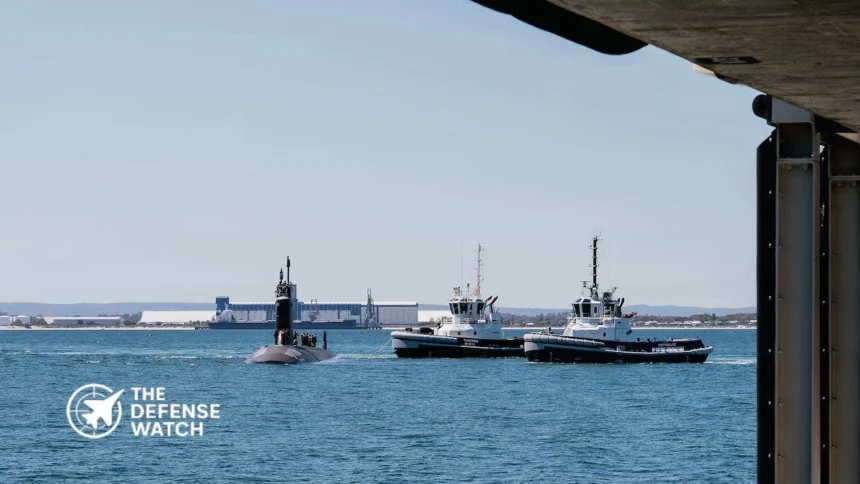
The arrival of the U.S. Navy’s USS Colorado at HMAS Stirling in Western Australia gives Australian technicians another opportunity to develop the maintenance skills needed to support allied nuclear-powered submarines operating from the region.
The Virginia-class fast-attack submarine arrived on Oct. 27, 2026, for a scheduled maintenance period expected to last about a month, according to the Australian Department of Defence. The work is part of preparations for Submarine Rotational Force-West (SRF-West), a trilateral initiative under the AUKUS security partnership between Australia, the United Kingdom and the United States.
Colorado has an additional role in those preparations. Australia has identified the submarine as the first boat scheduled to begin rotations under SRF-West in late 2027, making its current maintenance visit a practical step toward establishing a more sustained allied submarine presence in Western Australia.
Australian Technicians Take on More Submarine Maintenance Work
The maintenance period involves qualified Australian personnel working alongside specialists from the U.S. Navy’s Pearl Harbor Naval Shipyard and Intermediate Maintenance Facility.
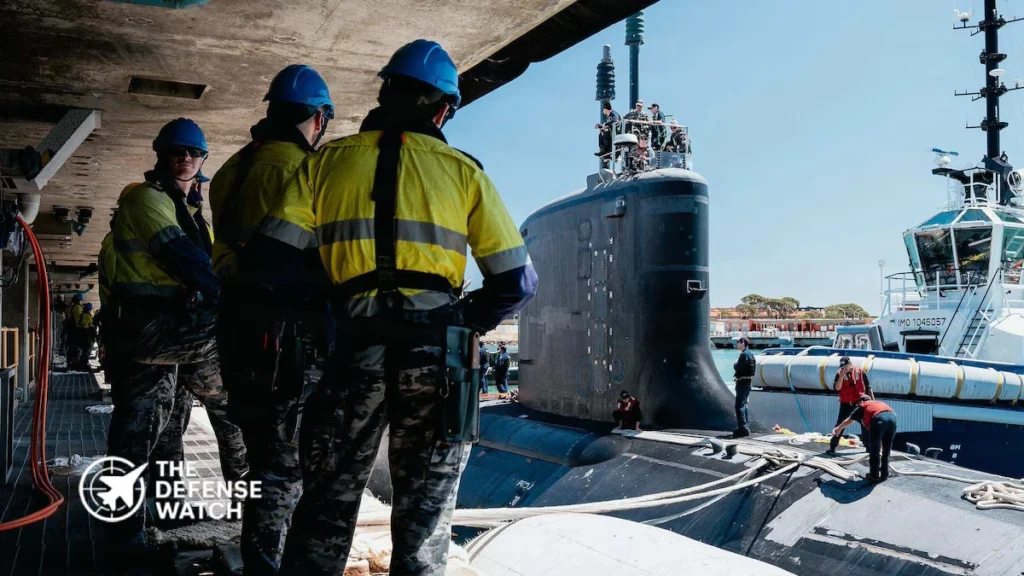
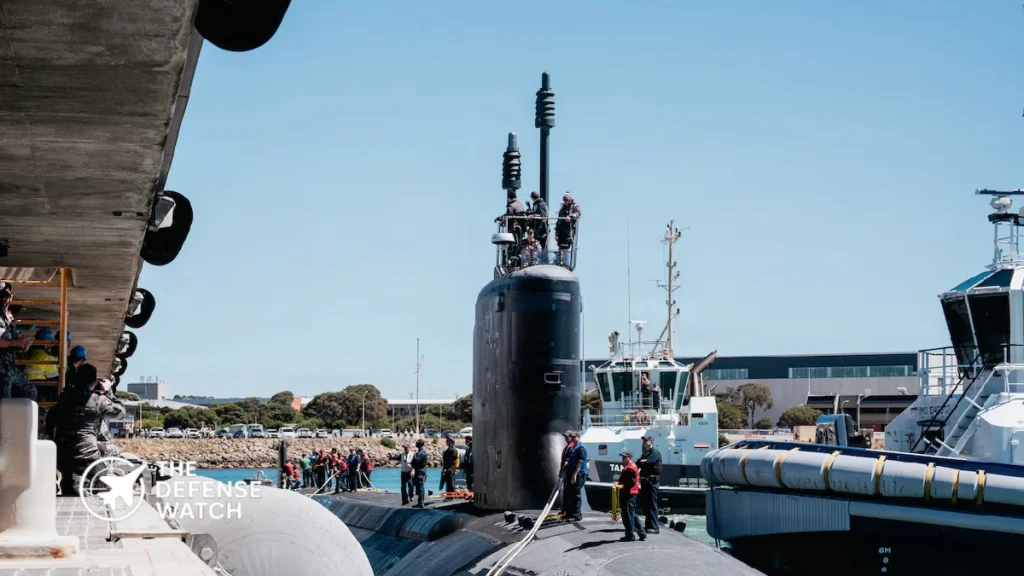
The submarine USS Colorado arrives at HMAS Stirling, Australia, Oct. 27, 2026, for a planned submarine maintenance period supporting the Australia, U.K., U.S. trilateral security agreement. During the monthlong period, more than 30 Australian civilian technicians will perform routine maintenance on a nuclear-powered submarine for the first time. (Image : DoW)
According to Australia’s Defence Department, planned activities include replacing the submarine’s thin-line towed array, conducting repairs and installing Australian-designed scaffolding around the submarine’s sail. The scaffolding, known as a racetrack, will give workers access to areas of the vessel during maintenance.
The program also includes work using locally produced submarine components and upgraded facilities at HMAS Stirling, including the recently improved Diamantina Pier. Australian, British and American personnel are also conducting technical demonstrations and simulated radiological safety exercises. The government said no radioactive waste would be transferred ashore during the simulated activities.
The work matters because operating a nuclear-powered submarine maintenance facility requires more than suitable docking space. Australia must develop trained personnel, specialized equipment, safety procedures, engineering support and reliable supply chains capable of supporting complex submarine systems.
Building those capabilities before regular rotations begin should reduce the amount of maintenance support that visiting submarines need to obtain elsewhere. However, the current program does not establish that Australia can independently perform every level of maintenance required by Virginia-class submarines.
The U.S. Navy and Australian authorities have not publicly detailed the full technical scope of Colorado’s maintenance period or provided a complete assessment of the work that Australian personnel can perform without American assistance.
AUKUS Moves From Infrastructure to Routine Sustainment
The Colorado maintenance period follows several earlier visits that have progressively expanded Australia’s experience with nuclear-powered submarine support.
In August and September 2024, the U.S. Navy conducted its first joint maintenance period on a nuclear-powered submarine in Australia, involving USS Hawaii and the submarine tender USS Emory S. Land. In late 2025, USS Vermont completed a maintenance period at HMAS Stirling without a supporting submarine tender, demonstrating greater reliance on shore-based infrastructure and a combined Australian and American workforce.
The Royal Navy’s HMS Anson also underwent maintenance activity in Australia in February and March 2026. According to the Australian government, that work incorporated Australian-made components and systems. Colorado’s visit builds on these efforts by expanding the range of maintenance activities undertaken by Australian personnel.
The progression is important for AUKUS Pillar I, which covers Australia’s planned acquisition of conventionally armed, nuclear-powered submarines. The partnership requires Australia to develop not only a future submarine fleet but also the industrial, regulatory and workforce capabilities needed to maintain it.
What Submarine Rotational Force-West Will Change
SRF-West is intended to establish a regular U.S. and British submarine presence at HMAS Stirling, near Perth.
Current plans call for rotations to begin in 2027. The Australian government has identified Colorado as the first submarine scheduled to participate, with the boat expected to return to Western Australia in late 2027.
The U.S. Naval Institute reported that the planned force could eventually include up to four American Virginia-class submarines and one British nuclear-powered attack submarine. These vessels would rotate through Australia rather than all being permanently based there.
For the United States, the arrangement offers another location for submarine support in the Indo-Pacific. Maintenance facilities closer to operating areas could help reduce some logistical demands associated with returning submarines to distant shipyards, although the actual benefit will depend on the work Australian facilities can perform and the availability of qualified personnel.
For Australia, the rotations provide practical experience before the country receives its own nuclear-powered attack submarines under AUKUS. The partnership envisages the transfer of Virginia-class submarines to the Royal Australian Navy in the 2030s, subject to the program’s requirements and milestones.
The arrangement will not eliminate Australia’s dependence on American and British expertise. Nuclear-powered submarines require specialized maintenance, trained personnel, strict safety procedures and access to complex components. Developing these capabilities will take sustained investment beyond the completion of individual maintenance periods.
Maintenance Capacity Is a Strategic Requirement
Australia’s ability to support visiting submarines will influence how effectively SRF-West operates. A rotational presence requires more than the arrival of submarines at a suitable port. The host country must be able to support maintenance schedules, repairs, technical inspections and logistics without creating unnecessary delays.
The current program’s emphasis on Australian technicians, local components and upgraded facilities is therefore operationally relevant. It tests whether infrastructure and training developed under AUKUS can support real maintenance tasks on active U.S. Navy submarines.
There are also limits to what can be concluded from the latest visit. The Australian government has announced the planned work, but it has not published a complete breakdown of maintenance hours, costs, workforce productivity or the proportion of work performed independently by Australian personnel. Those figures would help establish how much the country’s submarine sustainment capacity has improved.
For now, Colorado’s arrival provides another practical step toward the planned 2027 rotations. The larger test will be whether HMAS Stirling can sustain recurring submarine visits while Australia continues to develop the personnel and infrastructure needed for its future fleet.