
- Home
- Defense Systems
- Defense Systems
- IRIS-T SLS MK 4 Air Defense System
IRIS-T SLS MK 4 Air Defense System
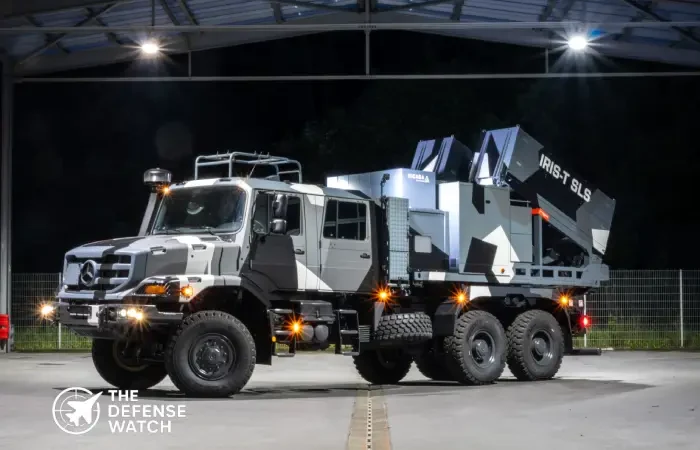
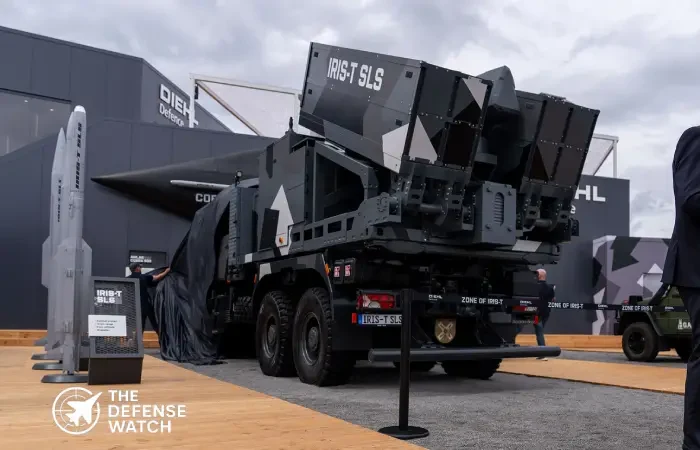
Defense Systems Full Specifications
1. General Information
| System Name | IRIS-T SLS MK 4 |
| Manufacturer | Diehl Defence |
| Country of Origin | Germany |
| Type / Role | Short-Range Surface-to-Air Missile (SHORAD) System |
| In Service | Entering service (2026 unveiling) |
| Year Introduced | 2026 |
| Unit Cost | ~€0.43–0.56 million per missile (system cost varies by configuration) |
2. Performance & Capabilities
| Maximum Engagement Range | 12 km |
| Maximum Engagement Altitude | 6 k |
| Target Types | Aircraft, Helicopters, Cruise Missiles, UAVs/Drones |
| Interception Probability | High (leveraging proven IRIS-T seeker) |
| Reaction Time | Very fast due to high automation |
| Radar Detection Range | Saab Giraffe 1X integrated |
3. Missile Specifications
| Missile Type | IRIS-T (surface-launched variant) |
| Missile Length | ~2.94 m |
| Missile Weight | ~87–90 kg |
| Warhead Type | High-explosive fragmentation with proximity fuze |
| Warhead Weight | ~11–12 kg |
| Speed | ~Mach 2 (680 m/s) |
4. Radar & Fire Control
| Radar Type | 3D Surveillance Radar (e.g., Saab Giraffe 1X) |
| Radar Name | Saab Giraffe 1X (on raisable mast) |
| Detection Range | Suitable for short-range threats |
| Tracking Capacity | Multiple targets |
| Guidance System | Imaging Infrared (IIR) homing |
| Fire Control System | Highly automated integrated C2 |
5. Launcher & Mobility
| Launcher Type | Mobile wheeled (e.g., Mercedes Zetros 6x6) |
| No. of Missiles per Launcher | 8 (ready-to-fire) |
| Reload Time | Dependent on logistics |
| Mobility Platform | Wheeled truck chassis |
| Crew Required | Minimal (high automation) |
6. Command & Control
| C2 System | Integrated network-enabled C2 |
| Connectivity | NATO-compatible data links |
| Network Capability | Yes |
| Operation Mode | Autonomous / Networked |
7. Operational Use
| Primary Operator | Germany, Sweden, Norway, and other NATO/European nations |
| Combat Proven | IRIS-T family yes (e.g., Ukraine) |
| Conflict History | Related variants in Ukraine |
| Notable Feature | All-in-one mobile SHORAD with fire-on-the-move potential |
PROS
- Highly mobile all-in-one vehicle design reduces setup time and logistical footprint.
- Proven IRIS-T missile heritage with excellent maneuverability and seeker performance.
- Cost-effective per-shot for countering drones and low-cost threats.
- High automation supports reduced crew size and fast response.
- Potential for fire-on-the-move capability enhances protection for mobile forces.
CONS
- Short engagement range limits role to point or very short-range area defense.
- Dependent on line-of-sight infrared guidance, which can face environmental limitations.
- Newer MK 4 variant may require further operational testing and integration.
- Smaller missile load compared to larger battery systems.
- Primarily European supply chain, which may complicate U.S. Foreign Military Sales processes.
IRIS-T SLS MK 4: Advanced Mobile Short-Range Air Defense System
The IRIS-T SLS MK 4 represents a significant evolution in short-range air defense, offering a highly mobile, all-in-one solution for protecting maneuver forces and critical assets from modern aerial threats. Unveiled in June 2026, this fourth-generation system builds on the proven IRIS-T family to address evolving challenges like drone swarms, low-flying helicopters, and cruise missiles in contested environments.
Manufacturer and Origin
Developed by German company Diehl Defence, the IRIS-T SLS MK 4 leverages the core IRIS-T air-to-air missile, originally a multinational European program involving Germany, Italy, Greece, Norway, Spain, and Sweden. The surface-launched variant adapts the missile with software modifications for ground-based operations while retaining its advanced imaging infrared seeker and thrust-vector control for exceptional maneuverability.
Capabilities
The MK 4 integrates radar (typically Saab Giraffe 1X), command-and-control, launcher, and missiles onto a single wheeled platform, such as a Mercedes-Benz Zetros 6×6, enabling rapid deployment and “fire-on-the-move” potential. It features an effective engagement range of up to 12 km and altitude coverage up to 6 km, with capacity for eight ready-to-fire missiles (quad-packed). The system excels against a wide array of targets, including aircraft, UAVs, helicopters, and cruise missiles, thanks to its jamming-resistant IR seeker and high automation for minimal crew requirements.
Performance
The missile achieves speeds around Mach 2 (approximately 680 m/s), providing quick reaction times ideal for short-range threats. Its design emphasizes a small inner dead zone and 360-degree engagement capability.
Cost
Individual IRIS-T SLS missiles are cost-effective, estimated at approximately €0.43–0.56 million each, making the system attractive for high-volume engagements against lower-end threats compared to more expensive medium-range alternatives.
The IRIS-T SLS MK 4 enhances layered air defense architectures favored by NATO partners, offering flexible, network-enabled protection for forward-deployed units.
Disclaimer Note
The information provided on TheDefenseWatch.com is for general informational purposes only. While we strive to ensure the accuracy, completeness, and timeliness of our content regarding defense and aerospace products, technologies, and specifications, we cannot guarantee that all information is 100% accurate or up-to-date due to the evolving nature of military technology and classified data.TheDefenseWatch.com does not warrant the reliability, suitability, or availability of the information for any specific purpose. Users are advised to consult official sources, such as manufacturers, government publications, or defense agencies, for precise and verified data before making decisions based on our content.We are not affiliated with any defense manufacturers, governments, or military organizations mentioned. Opinions, reviews, and ratings reflect expert analysis but are subjective and should not be considered endorsements. TheDefenseWatch.com is not responsible for any errors, omissions, or consequences arising from the use of this website’s content.External links are provided for convenience and do not imply endorsement. TheDefenseWatch.com reserves the right to update or modify content without prior notice. By using this website, you agree to our Privacy & Cookies Policy.
More Defense Systems from Diehl Defence
New Arrivals

Popular Comparisons
-
 J-10C vs JF-17 Thunder: Which Fighter Is More Capable?
View Comparison →
J-10C vs JF-17 Thunder: Which Fighter Is More Capable?
View Comparison → -
Tejas vs Gripen: Key Differences and Capabilities
View Comparison →
-
Tejas vs MiG-21 Bison: How India Replaced Its Iconic Supersonic Fighter
View Comparison →
-
F-35 vs F-16: Stealth, Sensors and Combat Roles
View Comparison →
-
Tejas Fighter Jet vs F-16 Fighting Falcon: Capability Compared
View Comparison →
-
Rafale Fighter Jet vs F-16 Fighting Falcon : Which Fighter Has the Edge?
View Comparison →
-
Su-57 Fighter Jet vs J-20 Fighter Jet: Stealth and Air Combat Compared
View Comparison →
-
Mirage 2000 vs Tejas Mk1A: Legacy Combat Power vs Indigenous Modernization
View Comparison →
-
Rafale Fighter Jet vs F-22 Raptor: Which Air Dominance Fighter Has the Edge?
View Comparison →
-
Tejas Fighter Jet vs. Rafale Fighter Jet: India’s Indigenous Fighter Meets France’s Proven Multirole Combat Aircraft
View Comparison →


- Pratt & Whitney Begins $100 Million Polish Expansion for F-35 Engine Parts

- Northrop Grumman Wins $43.9 Million Contract for Trident II Rocket Motor Facilities
- Ukraine Drone Strikes Disrupt Russian Data Centers, Raising Questions About AI Infrastructure Security
- Lockheed Martin Wins $114.6 Million Contract to Redesign F-35 Navigation Systems
- Project Agincourt Pushes Pentagon to Speed Up Autonomous Weapons Fielding
- Northrop Grumman Factory Expansion Aims to Increase B-21 Raider Production
- France Orders Four More SAMP/T NG Air Defense Systems
- France and UAE Revive Rafale F5 Fighter Development Partnership
- P-800 Oniks Missile: Range, Speed and BrahMos Comparison
- Ukrainian Drone Unit Caused 70% of Simulated U.S. Brigade Casualties in Germany Exercise


Fighter Jets
-
 F-100 Super Sabre
-
North American F-86 Sabre
-
Northrop YF-23 Fighter
-
Rafale F5 Fighter
-
SU-57 Felon Stealth Fighter
-
Boeing F/A-XX Fighter
-
JF-17 Thunder Fighter Jet
-
F-47 Fighter Jet
-
MIG-31 Fighter Jet
-
J-10CE Fighter Jet
-
Chengdu J-10 Fighter Jet
-
Chengdu J-10C Fighter Jet
-
Gripen E Fighter Jet
-
Tejas Mk1A Fighter Jet
-
Tejas Mk‑2 Fighter Jet
-
F-16V Viper Block 70 Fighter Jet
-
F-15EX Eagle II Fighter
-
F-15E Strike Eagle Fighter
-
F/A-18E/F Super Hornet Fighter Jet
-
Saab Gripen F Fighter Jet
-
JAS 39E/F Gripen Fighter Jet
-
JAS 39 Gripen Fighter Jet
-
F-35A Lightning II Fighter Jet
-
F/A-18F Super Hornet







Recent Compares
-
J-10C vs JF-17 Thunder: Which Fighter Is More Capable?
View Comparison →
-
Tejas vs Gripen: Key Differences and Capabilities
View Comparison →
-
Tejas vs MiG-21 Bison: How India Replaced Its Iconic Supersonic Fighter
View Comparison →
-
F-35 vs F-16: Stealth, Sensors and Combat Roles
View Comparison →
-
Tejas Fighter Jet vs F-16 Fighting Falcon: Capability Compared
View Comparison →
Latest Defense Systems
10 Compares Defense Systems
-
J-10C vs JF-17 Thunder: Which Fighter Is More Capable?
View Comparison →
-
Tejas vs Gripen: Key Differences and Capabilities
View Comparison →
-
Tejas vs MiG-21 Bison: How India Replaced Its Iconic Supersonic Fighter
View Comparison →
-
F-35 vs F-16: Stealth, Sensors and Combat Roles
View Comparison →
-
Tejas Fighter Jet vs F-16 Fighting Falcon: Capability Compared
View Comparison →
-
Rafale Fighter Jet vs F-16 Fighting Falcon : Which Fighter Has the Edge?
View Comparison →
-
Su-57 Fighter Jet vs J-20 Fighter Jet: Stealth and Air Combat Compared
View Comparison →
-
Mirage 2000 vs Tejas Mk1A: Legacy Combat Power vs Indigenous Modernization
View Comparison →
-
Rafale Fighter Jet vs F-22 Raptor: Which Air Dominance Fighter Has the Edge?
View Comparison →
-
Tejas Fighter Jet vs. Rafale Fighter Jet: India’s Indigenous Fighter Meets France’s Proven Multirole Combat Aircraft
View Comparison →
- Pratt & Whitney Begins $100 Million Polish Expansion for F-35 Engine Parts
- Northrop Grumman Wins $43.9 Million Contract for Trident II Rocket Motor Facilities
- Ukraine Drone Strikes Disrupt Russian Data Centers, Raising Questions About AI Infrastructure Security
- Lockheed Martin Wins $114.6 Million Contract to Redesign F-35 Navigation Systems
- Project Agincourt Pushes Pentagon to Speed Up Autonomous Weapons Fielding