







@2026 – All Right Reserved. TheDefenseWatch.com
- Home
- Defense Systems
- Compare
- Tejas Fighter Jet vs. JF-17 Thunder: Which Lightweight Fighter Has the Edge?
Tejas Fighter Jet vs. JF-17 Thunder: Which Lightweight Fighter Has the Edge?
Tejas Fighter Jet vs. JF-17 Thunder: High-Level Comparison
1. Executive Summary / Tactical Overview
The HAL Tejas and the JF-17 Thunder represent two of Asia’s most important indigenous lightweight multirole fighter programs. Both were developed to replace aging fleets while offering affordable operating costs, modern avionics, and multirole combat capability.
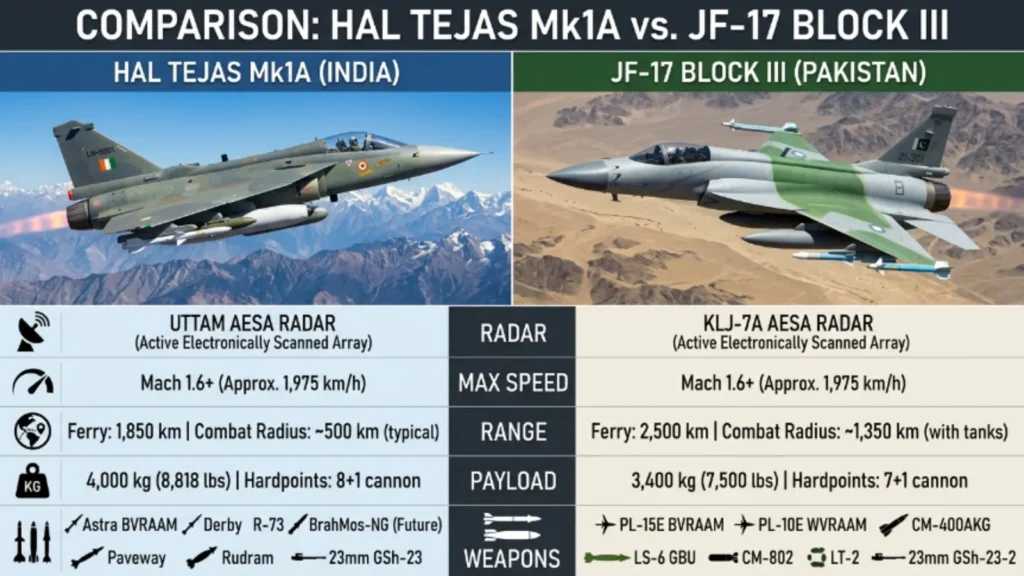
The Tejas emphasizes advanced composite construction, agility, and Western-origin avionics integrated with Indian weapons. The JF-17 Thunder focuses on affordability, export potential, and continuous modernization through the Block III standard featuring an AESA radar and advanced Chinese weapon systems. Both aircraft provide credible fourth-generation capabilities, but they reflect different operational priorities and defense ecosystems.
2. Technical Specifications Table
| Metric | HAL Tejas Mk1A | JF-17 Thunder Block III |
|---|---|---|
| Manufacturer | Hindustan Aeronautics Limited (HAL) | Pakistan Aeronautical Complex (PAC) & Chengdu Aircraft Corporation |
| Generation | 4.5 Generation | 4.5 Generation |
| Crew | 1 | 1 |
| Length | 13.2 m | 14.9 m |
| Wingspan | 8.2 m | 9.45 m |
| Maximum Takeoff Weight | ~13,500 kg | ~12,700 kg |
| Engine | GE F404-IN20 | Klimov RD-93MA |
| Maximum Speed | Mach 1.6 | Mach 1.6 |
| Combat Radius | ~500 to 700 km | ~1,200 km (mission dependent) |
| Ferry Range | ~1,850 km | ~2,000 km |
| Service Ceiling | 50,000 ft | 55,500 ft |
| Hardpoints | 8 | 7 |
| Maximum Payload | ~5,300 kg | ~3,700 kg |
| Radar | EL/M-2052 or Uttam AESA (Mk1A) | KLJ-7A AESA |
| Electronic Warfare | Integrated EW Suite | Advanced EW Suite |
| Helmet Mounted Sight | Yes | Yes |
| Data Link | Secure Tactical Data Link | Secure Tactical Data Link |
3. Key Capability Pillars
Airframe and Survivability
The Tejas uses more than 45% carbon fiber composites by weight, resulting in a lightweight airframe with reduced radar signature, improved fatigue life, and excellent agility. Composite construction also lowers maintenance requirements.
The JF-17 uses a more conventional metallic airframe, prioritizing affordability and ease of production. While not designed for stealth, the Block III incorporates radar signature reduction measures and improved electronic warfare systems.
Advantage: Tejas
Avionics and Sensor Fusion
The Tejas Mk1A introduces India’s Uttam AESA radar or the Israeli EL/M-2052 AESA radar, paired with modern electronic warfare systems, digital cockpit displays, and an open architecture mission computer.
The JF-17 Block III features the Chinese KLJ-7A AESA radar, a large-area display, infrared search and track (on some configurations), advanced electronic warfare equipment, and modern data networking.
Both fighters represent a significant improvement over earlier variants and provide strong situational awareness.
Slight Advantage: Tejas, due to its open architecture and integration flexibility.
Weapons and Payload
Tejas
Air-to-Air
- Astra Mk1
- Derby ER
- Python-5
- ASRAAM
Air-to-Ground
- Laser-guided bombs
- Smart Anti-Airfield Weapon (SAAW)
- BrahMos NG (future integration)
Anti-Ship
- Various precision-guided weapons under development
JF-17
Air-to-Air
- PL-10
- PL-12
- PL-15E
Air-to-Ground
- LS-6 precision bombs
- GB series guided bombs
Anti-Ship
- C-802AK
- CM-400AKG
The JF-17 currently offers a broader selection of Chinese precision-guided munitions and anti-ship missiles available for export users.
Advantage: JF-17
Flight Performance
The Tejas is known for excellent agility, high angle-of-attack performance, and responsive fly-by-wire controls. Its lightweight design provides strong close-range maneuverability.
The JF-17 offers stable multirole performance, longer operational range for strike missions, and good acceleration, though it is generally considered less agile than Tejas.
Advantage: Tejas
Radar and Beyond Visual Range Combat
Both aircraft now field AESA radars capable of simultaneously tracking multiple airborne targets.
The Tejas integrates Astra Mk1 beyond visual range missiles, while future upgrades will expand indigenous weapon integration.
The JF-17 Block III fields the PL-15E long-range missile, giving it one of the longest-range export BVR capabilities currently available.
Advantage: JF-17
Maintenance and Operating Cost
Both aircraft were developed as affordable fighters compared with heavier Western platforms.
The JF-17 has gained export success through lower acquisition costs and simplified logistics.
The Tejas benefits from extensive composite construction and an expanding domestic industrial base but currently has a higher acquisition cost than the JF-17.
Advantage: JF-17
Upgrade Potential
The Tejas program is expected to evolve through Mk1A, Mk2, and future advanced variants with indigenous sensors, weapons, and electronic warfare systems.
The JF-17 continues evolving through successive blocks, with Block III representing its most capable version and future upgrades focusing on avionics and weapon integration.
Both aircraft have significant growth potential.
Result: Even
4. Strategic Verdict
The HAL Tejas and the JF-17 Thunder are among the most capable lightweight multirole fighters developed outside the traditional Western and Russian aerospace industries.
The Tejas Mk1A offers superior airframe technology, better agility, extensive composite construction, modern avionics, and strong indigenous growth potential. It is particularly well suited for air defense, interception, and multirole operations where maneuverability and advanced flight control systems are priorities.
The JF-17 Block III excels in affordability, export accessibility, operational range, and long-range Chinese weapon integration, including the PL-15E missile. It provides a cost effective solution for nations seeking a capable multirole fighter with modern sensors and a mature precision strike capability.
Overall Comparison
| Category | Winner |
|---|---|
| Airframe Design | Tejas |
| Agility | Tejas |
| Radar Technology | Draw |
| BVR Weapons | JF-17 |
| Strike Capability | JF-17 |
| Payload | Tejas |
| Combat Radius | JF-17 |
| Electronic Warfare | Draw |
| Upgrade Potential | Draw |
| Operating Cost | JF-17 |
Final Assessment
For countries prioritizing advanced airframe technology, maneuverability, and long-term indigenous development, the HAL Tejas Mk1A has the advantage.
For operators seeking a lower-cost multirole fighter with strong export support, longer mission range, and access to long-range Chinese air-to-air weapons, the JF-17 Thunder Block III remains a highly competitive choice. Both aircraft are credible 4.5 generation fighters designed to meet different operational and strategic requirements.

| |
| Price | |
| Our Rating | |
| Manufacturer | Hindustan Aeronautics Limited (HAL) PAC - Pakistan Aeronautical Complex |
| Category | Fighter Jets Fighter Jets |
General Information
| Name | HAL Tejas Mk1A JF-17 Thunder / FC-1 Xiaolong |
| Manufacturer | Hindustan Aeronautics Limited (HAL) Pakistan Aeronautical Complex (PAC) & Chengdu Aircraft Industry Group (CAIG) |
| Country of Origin | India Pakistan / China |
| Type / Role | Multirole Light Fighter Multirole Fighter |
| Generation | 4.5th 4.5th |
| Status | In production / Entering service Active Service |
| First Flight | 28 March 2024 (prototype) August 25, 2003 |
| Introduction / In Service Since | 2025 2010 |
| Number Built | 83 on order (IAF) 175+ units |
| Operators | Indian Air Force (IAF) Pakistan, Myanmar, Nigeria, Azerbaijan |
Dimensions & Structure
| Length | 13.2 m 14.33 m (47 ft) |
| Wingspan | 8.2 m 9.44 m (31 ft) |
| Height | 4.4 m 4.57 m (15 ft) |
| Wing Area | 38.4 m² 24.4 m² (263 sq ft) |
| Empty Weight | 6,560 kg 6,586 kg (14,520 lbs) |
| Maximum Takeoff Weight (MTOW) | 13,500 kg 13,500 kg (29,762 lbs) |
| Internal Weapons Bay | None (external only) None |
| External Hardpoints | 8 8 (including wingtip rails) |
Performance
| Maximum Speed | Mach 1.8 (2,205 km/h) Mach 1.8 (1,910 km/h / 1,187 mph) |
| Range | 3,000 km (ferry) 3,482 km (2,164 mi) with external drop tanks |
| Combat Radius | 500 km 900 km (560 mi) on internal fuel |
| Service Ceiling | 16,000 m (52,500 ft) 16,916 m (55,500 ft) |
| Rate of Climb | 213 m/s 300 m/s (59,000 ft/min) |
| Thrust-to-Weight Ratio | 1.07 1.07 (with full afterburner) |
| G Limits | +8 / –3.5 g +8 / -3 |
Powerplant
| Engine Type | GE F404-IN20 afterburning turbofan Klimov RD-93MA afterburning turbofan |
| No. of Engines | 1 1 |
| Thrust (each) | 84 kN (with afterburner) 50.4 kN dry / 91.2 kN with afterburner |
| Thrust Vectoring | No No |
| Fuel Capacity | 3,060 L internal (+ drop tanks) 2,268 kg (5,000 lbs) internal |
Armament
| Gun | 23 mm GSh-23 cannon 1 × 23 mm GSh-23-2 twin-barrel autocannon |
| Missiles (Air-to-Air) | Astra Mk 1/2, Derby, R-73 PL-5E, PL-10, PL-12, PL-15E (BVR) |
| Missiles (Air-to-Ground) | Spice-2000, Crystal Maze, Harop (UCAV control capable) Ra'ad ALCM, CM-400AKG, C-802AK Anti-Ship |
| Bombs | Mk-82/84, LGBs, SAAW LT-2 (Laser-guided), LS-6 (GPS-guided), Mk-82/84 |
| Hardpoints | 8 8 |
| Payload Capacity | 5,300 kg 3,600 kg (7,936 lbs) |
Avionics & Systems
| Radar | Uttam GaN-based AESA KLJ-7A Active Electronically Scanned Array (AESA) |
| Radar Range | 200 km (class) 160–170 km (against fighter-sized target) |
| Electronic Warfare (EW) System | Unified EW Suite (DARE) Integrated digital EW suite & Missile Approach Warning System |
| Targeting System | Litening Pod Aselsan ASELPOD / WMD-7 targeting pods |
| Helmet Display | HMDS Helmet-Mounted Display and Sight (HMD/S) |
| Navigation | GPS/INS INS + GPS/Beidou satellite navigation |
| Autopilot / AI Assistance | Digital Fly-By-Wire Three-axis digital Fly-By-Wire (FBW) system |
| Communication | V/UHF + Indigenous Data Link Secure, jam-resistant tactical data link |
Stealth & Technology
| Radar Cross Section (RCS) | ≈ 0.5 m² Reduced frontal RCS compared to older blocks |
| Stealth Features | 45 % composite airframe Radar-absorbent material coatings & minor airframe shaping |
| Infrared Signature Reduction | Yes Limited |
| Sensor Fusion | Yes Partial multi-sensor architecture |
| Networking Capabilities | Secure Indigenous Data Links Real-time command data sharing with ground/AWACS |
Variants
| Special Export Versions | Customized for foreign clients (planned) JF-17N (Nigeria) – customized avionics and weapon suite; JF-17M (Myanmar) – tailored for local integration; JF-17E (Export) – export-optimized with optional Western avionics and weapon compatibility. |
Operational History
| Major Conflicts / Deployments | None – Mk1 used in training & exercises Operation Swift Retort (2019), Counter-insurgency ops |
| Notable Operators | Indian Air Force Pakistan Air Force, Azerbaijan Air Force |
| Combat Proven? | No (Mk1A new platform) Yes |
| Mission Types | Air superiority, ground attack, reconnaissance Air Defense, Interdiction, Close Air Support, Anti-Ship Strike |
Cost & Program
| Unit Cost | ≈ $48 million USD $25 million – $35 million (estimated variant dependent) |
| Development Cost | ≈ $2.5 billion (LCA program) $500 million (jointly shared initial program) |
| Program Name | Light Combat Aircraft (LCA) Super-7 / JF-17 Thunder Program |
| Funding Countries | India Pakistan and China |
Additional Information
| Upgrades Planned | Mk2 with GE F414 engine & canards Enhanced software integration and localized missile adaptations. |
| Future Replacement | Advanced Medium Combat Aircraft (AMCA) Project AZM Next-Gen Fighter / Fifth-Gen acquisitions. |
| Export Restrictions | None (‘Make in India’ program) Subject to joint approval by Pakistan and China. |
| Notable Achievements | Uttam AESA radar now 100 % indigenous Successful integration of true long-range PL-15E BVR system. |
| Competitors | JF-17 Block III, Saab Gripen C/D, KAI FA-50 HAL Tejas (India), JAS 39 Gripen (Sweden), F-16 Fighting Falcon (USA) |

|
Disclaimer Note
The information provided on TheDefenseWatch.com is for general informational purposes only. While we strive to ensure the accuracy, completeness, and timeliness of our content regarding defense and aerospace products, technologies, and specifications, we cannot guarantee that all information is 100% accurate or up-to-date due to the evolving nature of military technology and classified data.TheDefenseWatch.com does not warrant the reliability, suitability, or availability of the information for any specific purpose. Users are advised to consult official sources, such as manufacturers, government publications, or defense agencies, for precise and verified data before making decisions based on our content.We are not affiliated with any defense manufacturers, governments, or military organizations mentioned. Opinions, reviews, and ratings reflect expert analysis but are subjective and should not be considered endorsements. TheDefenseWatch.com is not responsible for any errors, omissions, or consequences arising from the use of this website’s content.External links are provided for convenience and do not imply endorsement. TheDefenseWatch.com reserves the right to update or modify content without prior notice. By using this website, you agree to our Privacy & Cookies Policy.
New Arrivals
Popular Comparisons
-
 Su-57 Fighter Jet vs J-20 Fighter Jet: Stealth and Air Combat Compared
View Comparison →
Su-57 Fighter Jet vs J-20 Fighter Jet: Stealth and Air Combat Compared
View Comparison → -
Mirage 2000 vs Tejas Mk1A: Legacy Combat Power vs Indigenous Modernization
View Comparison →
-
Rafale Fighter Jet vs F-22 Raptor: Which Air Dominance Fighter Has the Edge?
View Comparison →
-
Tejas Fighter Jet vs. Rafale Fighter Jet: India’s Indigenous Fighter Meets France’s Proven Multirole Combat Aircraft
View Comparison →
-
F-22 Raptor vs. F-35 Joint Strike Fighter: Which Fifth Generation Fighter Has the Edge?
View Comparison →
-
F-35A vs. F-22 Raptor: Which U.S. Stealth Fighter Dominates Modern Air Combat?
View Comparison →
-
AGM-114 Hellfire vs. AGM-179 JAGM: Which U.S. Precision Missile Is Better?
View Comparison →
-
Patriot (PAC-3) vs. THAAD: Complete Missile Defense System Comparison, Capabilities, Range, and Strategic Roles
View Comparison →
-
AIM-120 AMRAAM vs. AIM-9X Sidewinder: Complete Air-to-Air Missile Comparison, Range, Speed, and Combat Roles
View Comparison →
-
BGM-109 Tomahawk vs. AGM-158 JASSM: Which Long Range Precision Strike Missile Offers Greater Strategic Advantage?
View Comparison →
- U.S. Air Force Plans Major F-15EX Technical Refresh as Production Expands

- Eutelsat Orders 229 OneWeb Satellites To Extend LEO Network Through 2034
- Australia Declares JASSM-ER and LRASM Operational on F/A-18F Super Hornets
- GCAP Electronics Contract Advances Integrated Sensing And Communications For Sixth Generation Fighter
- Northrop Grumman Expands B-21 Raider Production With New Utah Facility
- Kongsberg Integrates Echodyne Radar With PROTECTOR Stations for Counter-UAS Missio
- Anthropic Says Yemen Weapons Cell Used Claude Code to Develop Missile Guidance Software
- Northrop Grumman Expands Air Defense and Weapons Collaboration Across Central Europe
- Rolls-Royce B-52 Engine Contract Rises To $3.04 Billion
- General Dynamics Secures $184.25 Million NGEAU Contract For Navy Growler Upgrades