
- Home
- Defense Systems
- Military Helicopters
- AH-64E Apache Helicopter
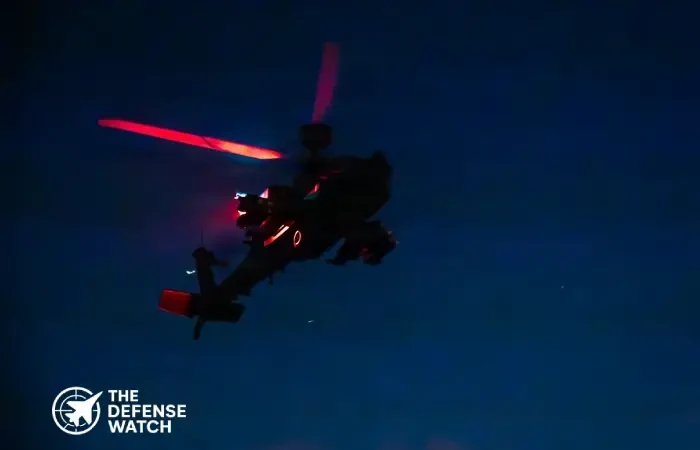
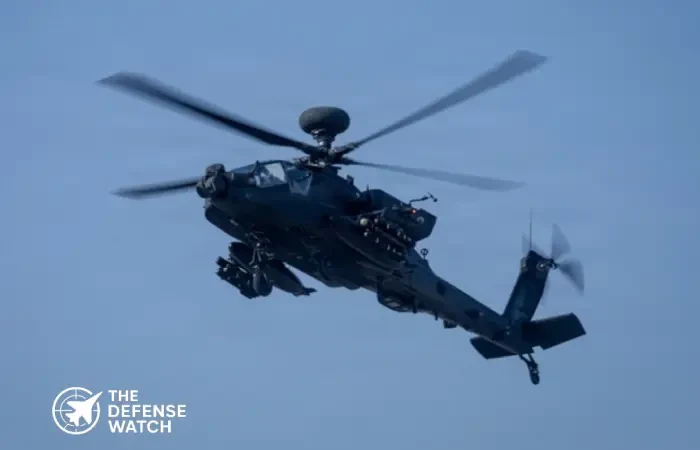
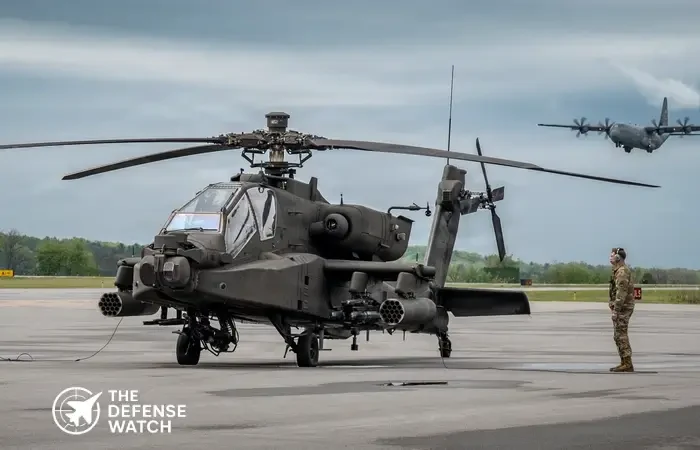
AH-64E Apache Helicopter
Defense Systems Full Specifications
1. General Information
| Name / Designation | AH-64E Apache Guardian |
| Type / Role | Attack Helicopter / Armed Reconnaissance |
| Country of Origin | United States |
| Manufacturer | Boeing Defense, Space & Security |
| Introduced / Service Entry | 2011 (AH-64E) |
| Operational Status | Active |
| Operators | USA, UK, India, Israel, Netherlands, and others |
2. Performance
| Maximum Speed (Road) | 279–293 km/h (150+ knots) |
| Cruise Speed | 265 km/h |
| Range | 480 km (Combat Range) / 1,900 km (Ferry Range) |
| Endurance | 2.5–3+ hours |
| Service Ceiling | 6,096–6,400 m (20,000+ ft) |
| Rate of Climb | ~853 m/min (2,800+ ft/min) |
3. Dimensions & Weight
| Length | 17.73 m (58 ft) |
| Height | 4.64–4.95 m |
| Rotor Diameter | 14.63 m (48 ft) |
| Empty Weight | 5,165 kg |
| Maximum Takeoff Weight (MTOW) | 10,433 kg (23,000 lb) |
4. Armament & Payload
| Primary Armament | 30mm M230 Chain Gun |
| Secondary Armament | AGM-114 Hellfire Missiles / Hydra 70 Rockets / AIM-92 Stinger |
| Hardpoints / Weapon Stations | 4 (wing pylons) |
| Payload Capacity | Up to ~1,200+ kg external ordnance |
| Countermeasures | Flares, Chaff, ECM Suite, MAWS, RWR |
5. Avionics & Systems
| Radar Name | Longbow Fire Control Radar |
| Targeting System | FLIR / Laser Designator / Night Vision |
| Navigation System | GPS / INS / Digital Flight Controls |
| Communication System | Secure Voice / Data Link |
| Defensive Systems | Missile Approach Warning System (MAWS) / Radar Warning Receiver (RWR) |
6. Powerplant
| Engines | 2 × Turboshaft Engines |
| Engine Model | T700-GE-701D |
| Power Output | 1,994 shp each |
| Fuel Capacity | ~1,400+ L (internal) |
7. Crew & Capacity
| Crew | 2 (Pilot + Co-Pilot/Gunner) |
| Passenger Capacity | None (attack configuration) |
| Cabin Configuration | Tandem cockpit / Gunship |
| Cargo Load (Internal/External) | Limited external stores |
8. Operational Capabilities
| Mission Types | Close Air Support, Armed Reconnaissance, Anti-Armor |
| Night Operation Capability | Yes |
| All-weather Operation | Yes |
| Combat Proven | Yes |
PROS
- Exceptional sensor fusion and targeting accuracy via Longbow radar and advanced optics.
- High survivability with armored cockpit, redundant systems, and ballistic tolerance.
- Versatile multi-role capabilities, including deep attack and reconnaissance.
- Proven integration with UAVs and joint forces for enhanced situational awareness.
- All-weather, day/night combat effectiveness with extensive operational history.
CONS
- High maintenance and logistical demands, impacting readiness rates in prolonged operations.
- Significant per-unit and lifecycle costs.
- Vulnerability to advanced MANPADS and air defense systems in high-threat environments.
- Limited internal payload compared to larger transport helicopters.
- Crew workload can be demanding during extended missions without automation aids.
AH-64E Apache Guardian Attack Helicopter
The AH-64 Apache stands as one of the most formidable and iconic attack helicopters in modern military aviation. Designed for the U.S. Army to dominate the battlefield, this twin-engine, tandem-seat rotary-wing aircraft excels in anti-armor, close air support, and armed reconnaissance roles. First entering service in the 1980s and continuously upgraded, the current AH-64E Apache Guardian variant integrates cutting-edge sensors, networking capabilities, and enhanced performance to operate effectively in contested environments alongside manned and unmanned systems.
Manufacturer
The AH-64 was originally developed by Hughes Helicopters, later acquired by McDonnell Douglas, and is now produced by Boeing Defense, Space & Security in Mesa, Arizona. It is a wholly American platform, with the AH-64E representing the latest evolution tailored for U.S. and allied forces.
Speed and Range
The AH-64E achieves a maximum speed of approximately 279–293 km/h (150+ knots) and a cruise speed of around 265 km/h. Its combat radius is about 480 km, with a ferry range extending to roughly 1,900 km using external tanks. Typical endurance on internal fuel is 2.5–3 hours, supporting extended loiter times for persistent battlefield presence.
Cost/Price
Unit costs for the AH-64E vary by configuration and contract type. Flyaway costs for new-build or remanufactured aircraft are often cited in the $35–52 million range, with full foreign military sales packages (including weapons, training, and support) significantly higher.
The Apache’s core strengths lie in its sophisticated avionics suite, including the Longbow fire-control radar for beyond-line-of-sight targeting, Modernized Target Acquisition Designation System (MTADS), Pilot Night Vision System (PNVS), and FLIR for day/night, all-weather operations. It carries a formidable array of weaponry centered on the 30mm M230 chain gun, AGM-114 Hellfire missiles, Hydra 70 rockets, and air-to-air options like Stinger missiles. Its airframe incorporates extensive armor protection for the crew and critical components, along with redundant systems and countermeasures such as flares, chaff, and electronic warfare suites.
Operationally, the Apache has proven itself across conflicts from Panama and the Gulf War to operations in Afghanistan and Iraq. It provides critical synergy with ground forces, UAV teaming, and network-centric warfare, making it a cornerstone of U.S. Army aviation into the 2060s.
Disclaimer Note
The information provided on TheDefenseWatch.com is for general informational purposes only. While we strive to ensure the accuracy, completeness, and timeliness of our content regarding defense and aerospace products, technologies, and specifications, we cannot guarantee that all information is 100% accurate or up-to-date due to the evolving nature of military technology and classified data.TheDefenseWatch.com does not warrant the reliability, suitability, or availability of the information for any specific purpose. Users are advised to consult official sources, such as manufacturers, government publications, or defense agencies, for precise and verified data before making decisions based on our content.We are not affiliated with any defense manufacturers, governments, or military organizations mentioned. Opinions, reviews, and ratings reflect expert analysis but are subjective and should not be considered endorsements. TheDefenseWatch.com is not responsible for any errors, omissions, or consequences arising from the use of this website’s content.External links are provided for convenience and do not imply endorsement. TheDefenseWatch.com reserves the right to update or modify content without prior notice. By using this website, you agree to our Privacy & Cookies Policy.

New Arrivals

Popular Comparisons
-
 J-10C vs JF-17 Thunder: Which Fighter Is More Capable?
View Comparison →
J-10C vs JF-17 Thunder: Which Fighter Is More Capable?
View Comparison → -
Tejas vs Gripen: Key Differences and Capabilities
View Comparison →
-
Tejas vs MiG-21 Bison: How India Replaced Its Iconic Supersonic Fighter
View Comparison →
-
F-35 vs F-16: Stealth, Sensors and Combat Roles
View Comparison →
-
Tejas Fighter Jet vs F-16 Fighting Falcon: Capability Compared
View Comparison →
-
Rafale Fighter Jet vs F-16 Fighting Falcon : Which Fighter Has the Edge?
View Comparison →
-
Su-57 Fighter Jet vs J-20 Fighter Jet: Stealth and Air Combat Compared
View Comparison →
-
Mirage 2000 vs Tejas Mk1A: Legacy Combat Power vs Indigenous Modernization
View Comparison →
-
Rafale Fighter Jet vs F-22 Raptor: Which Air Dominance Fighter Has the Edge?
View Comparison →
-
Tejas Fighter Jet vs. Rafale Fighter Jet: India’s Indigenous Fighter Meets France’s Proven Multirole Combat Aircraft
View Comparison →


- Pratt & Whitney Begins $100 Million Polish Expansion for F-35 Engine Parts

- Northrop Grumman Wins $43.9 Million Contract for Trident II Rocket Motor Facilities
- Ukraine Drone Strikes Disrupt Russian Data Centers, Raising Questions About AI Infrastructure Security
- Lockheed Martin Wins $114.6 Million Contract to Redesign F-35 Navigation Systems
- Project Agincourt Pushes Pentagon to Speed Up Autonomous Weapons Fielding
- Northrop Grumman Factory Expansion Aims to Increase B-21 Raider Production
- France Orders Four More SAMP/T NG Air Defense Systems
- France and UAE Revive Rafale F5 Fighter Development Partnership
- P-800 Oniks Missile: Range, Speed and BrahMos Comparison
- Ukrainian Drone Unit Caused 70% of Simulated U.S. Brigade Casualties in Germany Exercise



Fighter Jets
-
 F-100 Super Sabre
-
North American F-86 Sabre
-
Northrop YF-23 Fighter
-
Rafale F5 Fighter
-
SU-57 Felon Stealth Fighter
-
Boeing F/A-XX Fighter
-
JF-17 Thunder Fighter Jet
-
F-47 Fighter Jet
-
MIG-31 Fighter Jet
-
J-10CE Fighter Jet
-
Chengdu J-10 Fighter Jet
-
Chengdu J-10C Fighter Jet
-
Gripen E Fighter Jet
-
Tejas Mk1A Fighter Jet
-
Tejas Mk‑2 Fighter Jet
-
F-16V Viper Block 70 Fighter Jet
-
F-15EX Eagle II Fighter
-
F-15E Strike Eagle Fighter
-
F/A-18E/F Super Hornet Fighter Jet
-
Saab Gripen F Fighter Jet
-
JAS 39E/F Gripen Fighter Jet
-
JAS 39 Gripen Fighter Jet
-
F-35A Lightning II Fighter Jet
-
F/A-18F Super Hornet






Recent Compares
-
J-10C vs JF-17 Thunder: Which Fighter Is More Capable?
View Comparison →
-
Tejas vs Gripen: Key Differences and Capabilities
View Comparison →
-
Tejas vs MiG-21 Bison: How India Replaced Its Iconic Supersonic Fighter
View Comparison →
-
F-35 vs F-16: Stealth, Sensors and Combat Roles
View Comparison →
-
Tejas Fighter Jet vs F-16 Fighting Falcon: Capability Compared
View Comparison →
Latest Defense Systems
10 Compares Defense Systems
-
J-10C vs JF-17 Thunder: Which Fighter Is More Capable?
View Comparison →
-
Tejas vs Gripen: Key Differences and Capabilities
View Comparison →
-
Tejas vs MiG-21 Bison: How India Replaced Its Iconic Supersonic Fighter
View Comparison →
-
F-35 vs F-16: Stealth, Sensors and Combat Roles
View Comparison →
-
Tejas Fighter Jet vs F-16 Fighting Falcon: Capability Compared
View Comparison →
-
Rafale Fighter Jet vs F-16 Fighting Falcon : Which Fighter Has the Edge?
View Comparison →
-
Su-57 Fighter Jet vs J-20 Fighter Jet: Stealth and Air Combat Compared
View Comparison →
-
Mirage 2000 vs Tejas Mk1A: Legacy Combat Power vs Indigenous Modernization
View Comparison →
-
Rafale Fighter Jet vs F-22 Raptor: Which Air Dominance Fighter Has the Edge?
View Comparison →
-
Tejas Fighter Jet vs. Rafale Fighter Jet: India’s Indigenous Fighter Meets France’s Proven Multirole Combat Aircraft
View Comparison →
- Pratt & Whitney Begins $100 Million Polish Expansion for F-35 Engine Parts
- Northrop Grumman Wins $43.9 Million Contract for Trident II Rocket Motor Facilities
- Ukraine Drone Strikes Disrupt Russian Data Centers, Raising Questions About AI Infrastructure Security
- Lockheed Martin Wins $114.6 Million Contract to Redesign F-35 Navigation Systems
- Project Agincourt Pushes Pentagon to Speed Up Autonomous Weapons Fielding