North Korean leader Kim Jong Un has opened a new military museum showcasing the country’s missile systems, drones and other weapons, while state media reported a successful tactical ballistic missile test conducted on October 12. The two events offer a public display of Pyongyang’s expanding weapons program, including its efforts to develop nuclear delivery systems and improve conventional strike capabilities.
The museum opening and missile test were reported by North Korean state media on October 13. South Korea’s military separately detected multiple ballistic missile launches from the Pyongyang area toward the East Sea on October 12, providing independent confirmation that launches occurred, although the technical claims surrounding the latest test remain unverified.
A museum built around North Korea’s weapons program
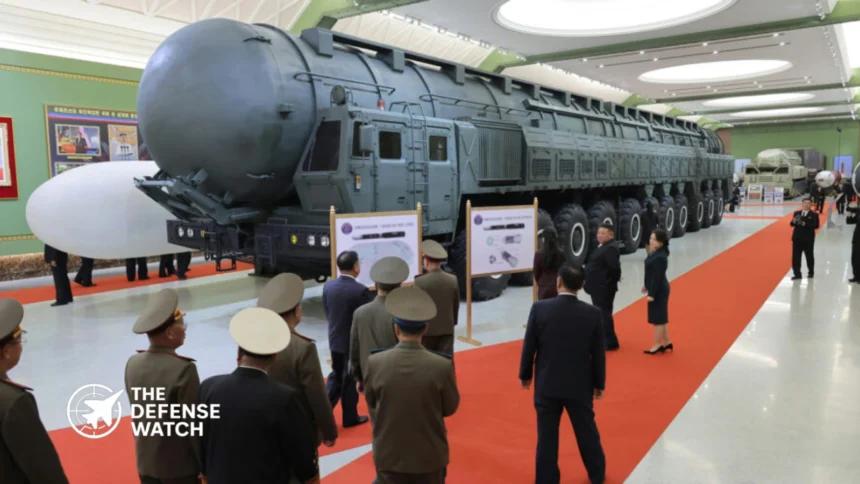
The new National Defense Revolution Museum displays weapons developed under Kim’s leadership, according to the Korean Central News Agency (KCNA). Photographs published by North Korean state media show Kim visiting the exhibition alongside his wife, Ri Sol Ju, and daughter, Ju Ae.
The exhibits include ballistic missiles, launch vehicles, drones and systems associated with North Korea’s nuclear weapons program. One prominent display is the Hwasong-20 intercontinental ballistic missile (ICBM), which Pyongyang has presented as part of its strategic weapons development effort.
NK News reported that the museum operates under North Korea’s Second Economy Commission, an institution associated with the country’s defense industrial sector. The precise location and dimensions of the facility were not disclosed in the initial reporting. Photographs suggest the exhibition may occupy an underground complex, although that assessment has not been independently confirmed.
The exhibition serves a purpose beyond preserving military equipment. By displaying missiles and other systems together, North Korea is presenting its weapons development as a sustained national program rather than a collection of separate projects.
The displays also provide an opportunity for Pyongyang to communicate its claimed technological progress to domestic audiences and foreign governments. However, exhibiting a weapon does not establish its production status, operational readiness, reliability or performance under combat conditions.
What North Korea claims about the October 12 missile test
KCNA reported that North Korea’s Missile Administration conducted a test of a tactical ballistic missile on October 12 to evaluate a technical upgrade to an important component of its weapons systems.
According to the state news agency, the test confirmed the success of the upgrade, which it said could improve the performance and sophistication of the country’s offensive weapons. The report did not publicly identify the upgraded component or provide enough technical information to assess the claimed improvement independently.
South Korea’s Joint Chiefs of Staff reported detecting multiple ballistic missiles launched from the Pyongyang area toward the East Sea on the same day. Reuters reported that at least one projectile traveled more than 900 kilometers, based on information from South Korean authorities.
The distinction between the two accounts matters. South Korea’s detection of the launches supports the occurrence of the missile activity, but it does not independently verify North Korea’s claims about the technical upgrade or the degree of improvement achieved.
The available public reporting also does not establish whether every projectile detected by South Korea was associated with the specific tactical ballistic missile test described by KCNA.
Why the missile upgrade matters
Tactical ballistic missiles generally serve shorter-range strike missions than intercontinental ballistic missiles. They can support attacks against military facilities, command infrastructure and other targets within a regional theater, depending on their design and payload.
For North Korea, improvements to tactical missile components could have practical implications for its conventional strike forces. Greater reliability, accuracy or operational flexibility could improve the military utility of such weapons, although Pyongyang has not provided sufficient technical details to establish which of these characteristics the latest test was intended to improve.
The lack of disclosed specifications is particularly important when assessing claims of improved missile performance. A successful test may demonstrate that a component functions under particular test conditions, but it does not necessarily establish how a weapon will perform across different launch environments, flight profiles or operational conditions.
North Korea’s broader missile portfolio includes short-range ballistic missiles, intermediate-range systems and ICBMs. These weapons serve different military purposes, from regional strike missions to potential attacks against targets much farther away.
The Hwasong-20 display at the museum and the separate tactical missile test therefore represent different parts of the country’s weapons program. The former is associated with strategic deterrence, while the latter concerns a more regional strike capability.
Regional context: Missile competition on the Korean Peninsula
The latest North Korean launches followed South Korea’s October 8 test of a domestically developed hypersonic weapon, which President Lee Jae Myung observed, according to Reuters and the Associated Press. The sequence of tests comes amid continuing military competition between the two Koreas and stalled diplomatic efforts over North Korea’s nuclear and missile programs.
The timing provides context for the latest activity, but public evidence does not establish that South Korea’s test directly caused North Korea’s October 12 launch.
Both countries have reasons to demonstrate advances in their strike capabilities. South Korea is pursuing greater conventional defense capacity, while North Korea continues to emphasize its nuclear deterrent and the development of weapons intended to threaten targets across the region and beyond.
For South Korea, Japan and the United States, North Korea’s missile development creates continuing requirements for early warning, tracking, air and missile defense, and coordination among allied forces.
The military significance of an individual test depends on more than the missile’s reported flight distance. Analysts also need information about guidance, reliability, launch preparation, survivability, production scale and the ability to deploy weapons under operational conditions. Those details were not established in the available reporting on the October 12 test.
What the museum reveals, and what it does not
The museum gives North Korea a permanent venue to present its weapons development achievements and reinforce Kim Jong Un’s association with the country’s military modernization.
Its displays can help outside observers identify systems that Pyongyang wants to showcase. However, official exhibitions are curated presentations, not independent technical assessments. The presence of a missile or drone does not confirm that the system has entered full-rate production or been deployed in operational units.
The same caution applies to the latest missile test. North Korea’s account indicates that it is continuing to work on components it considers important to its offensive weapons, but the absence of technical details prevents a reliable assessment of the upgrade’s actual effect.
For now, the clearest conclusion is that Pyongyang is continuing to publicize its missile and weapons development while conducting additional tests. Determining whether those activities have produced a measurable improvement in military capability will require more evidence than the official claims and exhibition photographs currently provide.