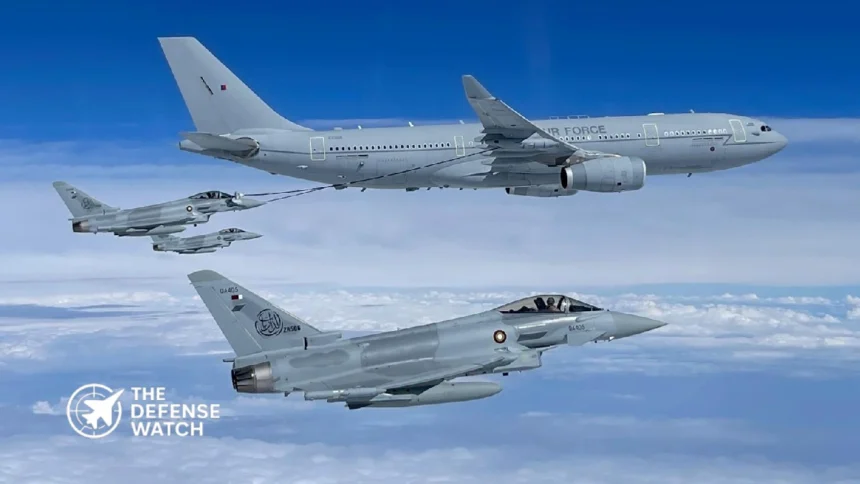
RAF Voyager Completes 14 Missions in Saudi Arabia
A Royal Air Force Voyager tanker has completed 14 operational missions since deploying to Saudi Arabia, providing air-to-air refueling support as the kingdom responds to renewed Houthi missile and drone attacks, according to a report published by UK Defence Journal on October 12, 2026.
The deployment follows a request from the Saudi government and forms part of Britain’s existing military support for Saudi air defense. The UK Ministry of Defence announced the decision on September 22, saying the Voyager would support Saudi defensive activity linked to the internationally recognized government of Yemen.
The 14-mission figure indicates that the aircraft has moved beyond the initial deployment stage and is conducting operational sorties. However, neither the reported total nor the public deployment announcement specifies how many aircraft received fuel, how much fuel was transferred, or which individual missions were supported.
Why Britain deployed the Voyager
The RAF tanker deployment comes amid renewed attacks against Saudi Arabia by Yemen’s Houthi movement. The British government said the decision followed a Saudi request and was intended to strengthen defensive operations against the threat from missiles and uncrewed aircraft.
The UK has also maintained a wider military contribution to Saudi air defense, including defensive equipment and British personnel supporting efforts to counter aerial threats. The Voyager adds an airborne support capability to that existing presence.
The distinction matters. A tanker does not normally engage incoming missiles or drones directly. Instead, it supplies fuel to compatible aircraft in flight, helping them remain on station longer or reach operational areas without making an immediate return to base.
UK Defence Journal reported that the deployment was announced alongside British air-defense support following attacks on Saudi targets, including King Khalid International Airport in Riyadh. The report said an attack on October 8 killed three people and damaged a Saudia aircraft. Those incident details should be distinguished from the separately confirmed British announcement of the tanker deployment.
What the Voyager contributes to air defense
The RAF Voyager is Britain’s military version of the Airbus A330 Multi Role Tanker Transport. In addition to its air-to-air refueling role, the aircraft supports strategic air transport, allowing the RAF to move personnel and equipment.
The fleet uses two refueling configurations. According to UK Defence Journal, the KC Mk 2 has two underwing refueling pods, while the KC Mk 3 adds a centerline hose for compatible aircraft requiring that refueling method.
For defensive air operations, aerial refueling can help fighter aircraft maintain patrols, respond to new threats and cover wider areas without returning to base as frequently. Its practical value depends on the aircraft involved, fuel requirements, mission duration, available airspace and the tanker support plan.
That capability is relevant when defending multiple locations against missiles and drones. Aircraft may need to respond to threats in different areas while maintaining sufficient fuel for interception, maneuvering and recovery.
However, the number of tanker missions alone does not establish how effective the overall defense has been. Assessing that would require information on the aircraft supported, the fuel delivered, the missions’ duration and the threats encountered. Those details have not been established in the public reporting reviewed for this article.
The deployment’s wider strategic context
Britain’s decision also reflects the relationship between regional security and its economic interests. In its September 22 announcement, the Ministry of Defence said instability in the Gulf could disrupt energy supplies, raise prices and increase costs for British businesses. It also linked the deployment to the security of Saudi Arabia and the internationally recognized government of Yemen.
The Voyager is a supporting asset rather than a substitute for ground-based air defense. Interceptors and other defensive systems engage incoming threats, while tanker aircraft help compatible aircraft remain available to carry out their assigned missions.
This division of roles is important because countering repeated missile and drone attacks requires more than the ability to detect and intercept individual threats. It also requires sufficient aircraft availability, trained crews, fuel, maintenance support and coordination between the different elements of the defense network.
The deployment does not, by itself, establish that British Voyager crews are participating in combat engagements or that the RAF has assumed responsibility for Saudi Arabia’s air defense. The UK government has described the aircraft’s purpose as supporting defensive activity.
What remains unclear
The reported 14 missions provide a useful indication of operational activity, but important details remain unavailable publicly.
The Ministry of Defence’s deployment announcement did not specify the aircraft’s planned duration in Saudi Arabia, the number of sorties expected over the deployment, or the quantity of fuel to be transferred. The available reporting also does not establish which Saudi or allied aircraft received support during the 14 missions.
These gaps limit what can be concluded about the deployment’s scale and operational results. Further official reporting would be needed to determine whether the mission total has increased, how the tanker is being integrated with regional air operations and whether the UK intends to extend its presence.
For now, the confirmed deployment announcement and the reported mission count show that Britain is providing a practical enabling capability to Saudi defensive operations. The wider effect will depend on how that support is used alongside the kingdom’s own air-defense systems and aircraft.