







@2026 – All Right Reserved. TheDefenseWatch.com
- Home
- Defense Systems
- Bombers & Strategic Aircraft
- A-50 Mainstay Aircraft
A-50 Mainstay Aircraft
Defense Systems Full Specifications
1. General Information
| Name | Beriev A-50 Mainstay |
| Manufacturer | Beriev Aircraft Company |
| Country of Origin | Russia (Soviet Union) |
| Introduction / In Service Since | 1984–1985 / Active |
| Status | In service (modernized variants) |
| Category | AEW&C / Special Mission |
| Crew | 15 (5 flight + 10 mission) |
| Unit Cost | ~$300–330 million (est.) |
2. Dimensions & Structure
| Length | 46.6 m |
| Wingspan | 50.6 m |
| Height | 14.8 m |
| Wing Area | 300 m² |
| Empty Weight | ~61,000–75,000 kg |
| Maximum Takeoff Weight (MTOW) | 170,000–190,000 kg |
3. Performance
| Maximum Speed | 850–900 km/h |
| Range | ~7,500 km |
| Combat Radius | ~1,000 km (4 h on station) |
| Service Ceiling | Up to 15,500 m |
| Rate of Climb | Not widely published |
4. Powerplant
| Engine Type | 4 × Soloviev D-30KP turbofans |
| Thrust (per engine) | ~117–120 kN (12,000 kgf) |
| Total Thrust | ~470–480 kN |
5. Payload & Armament
| Internal Payload Capacity | Mission electronics focused |
| Weapons Bay | None typical |
| Compatible Weapons | Limited self-defense (tail guns on some) |
| Hardpoints | Minimal / none for offensive stores |
6. Avionics & Systems
| Radar System | Shmel / Liana / Vega-M (rotodome) |
| Navigation | Integrated flight & nav suite |
| Electronic Warfare (EW) | Self-defense suite present |
| Stealth Features | None |
7. Operational History
| Primary Operator | Russian Aerospace Forces |
| Conflict Usage | Syria, Russo-Ukrainian War, earlier monitoring |
| Notable Missions | Airspace surveillance, fighter control |
8. Additional Information
| Variants | A-50, A-50U, A-50EI (India) |
| Successor / Future Replacement | A-100 Premier |
| Notable Features | Large rotodome, multi-target tracking |
| Estimated Operational Life | Extended via A-50U upgrades |
PROS
- Large detection range for air and surface targets (up to ~650 km for certain air contacts)
- Ability to track dozens to over 100 targets and direct multiple fighters simultaneously
- Robust Il-76-derived airframe with good payload and endurance potential
- Proven in multiple operational environments, including recent conflicts
- Modernized A-50U versions add digital avionics and improved crew facilities
CONS
- Aging base airframe and original analog systems on non-upgraded aircraft
- Limited production numbers and slow modernization rate
- Vulnerable to modern air defenses and electronic warfare due to non-stealth design
- High maintenance demands of four-engine heavy jet and complex radar
- Restricted export success compared with Western AEW&C platforms
A-50 Mainstay AEW&C Aircraft
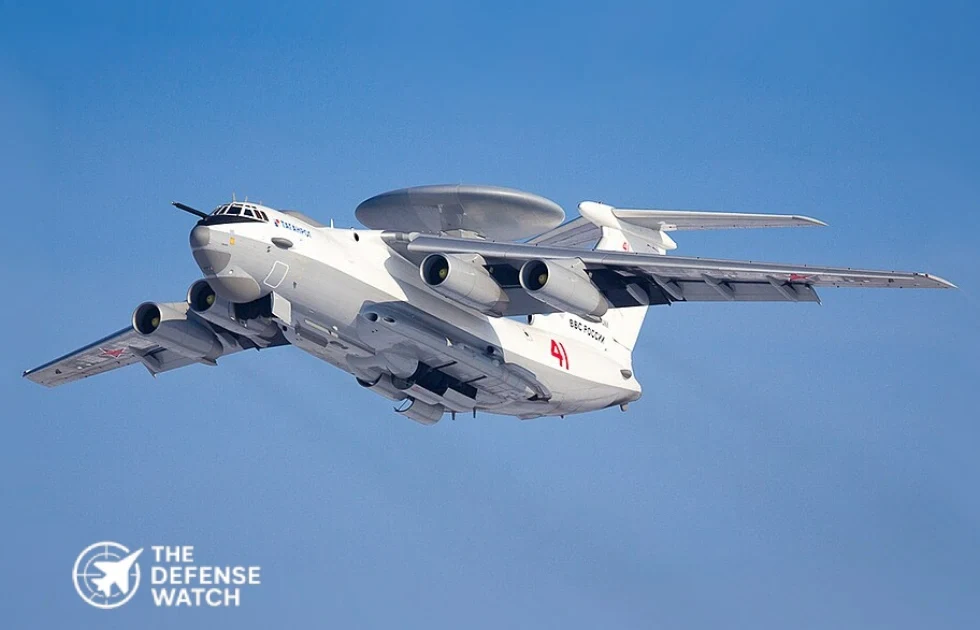
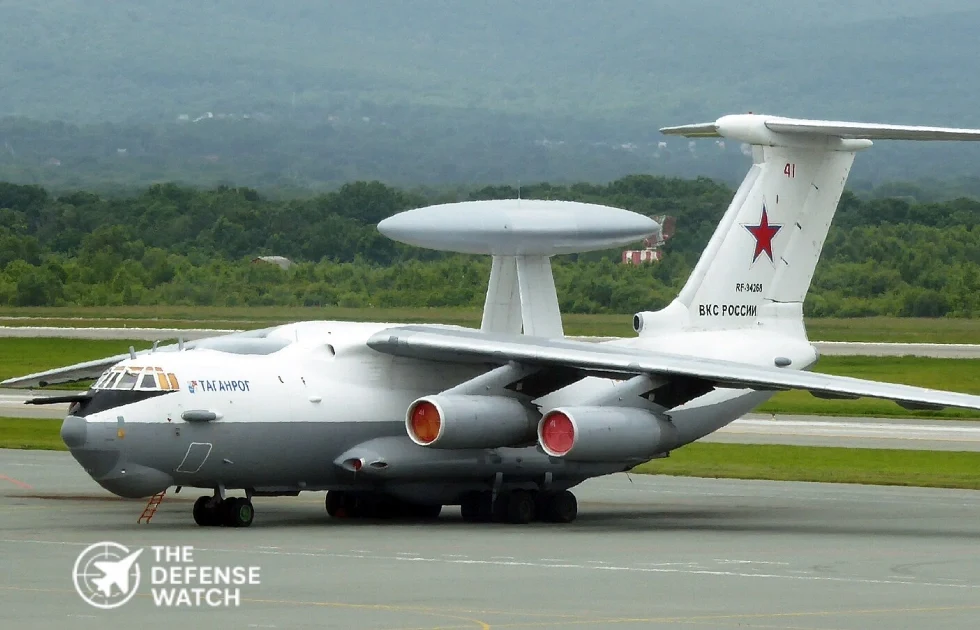
The Beriev A-50 Mainstay is a Soviet-era airborne early warning and control (AEW&C) aircraft developed to provide long-range radar surveillance, target tracking, and command-and-control for air defense operations. Based on the Ilyushin Il-76 transport airframe, it features a distinctive large rotating radome mounted above the fuselage that houses its primary surveillance radar. Designed during the Cold War to succeed the Tupolev Tu-126 Moss, the A-50 enables detection of airborne and surface targets over vast areas, coordination of fighter intercepts, and real-time data sharing with ground and airborne units. It has served primarily with Russian forces and select export operators, supporting missions ranging from airspace monitoring to combat operations. The platform remains relevant through modernization programs even as newer systems emerge.
Manufacturer
The A-50 was developed and manufactured by the Beriev Aircraft Company (TANTK Beriev) in Taganrog, Russia, in cooperation with the Ilyushin design bureau for the base airframe and NPO Vega (or related institutes) for the radar suite. Production began in the late 1970s, with the first flight occurring on 19 December 1978 and entry into service around 1984–1985. Approximately 40–42 aircraft were built before production largely halted after the dissolution of the Soviet Union. Upgraded variants continue to be supported by Russian industry.
Speed and Range
Powered by four Soloviev D-30KP turbofan engines, the A-50 achieves a maximum speed of approximately 850–900 km/h (530–559 mph) and a typical cruise speed near 750–800 km/h. Ferry range is cited at about 7,500 km (4,660 miles), with on-station endurance of roughly four hours at a 1,000 km radius from base; aerial refueling (supported on upgraded examples via Il-78 tankers) can extend mission time. Service ceiling reaches up to 15,500 m in some data sets, though patrol altitudes are commonly 5,000–12,000 m. These performance figures allow persistent coverage over large theaters while remaining compatible with the Il-76’s heavy-lift heritage.
Cost/Price
Open-source estimates place the unit cost of an A-50 or upgraded A-50U in the range of approximately $300–330 million, depending on configuration, radar suite, and any modernization package. Exact figures remain classified or vary with specific contracts and inflation adjustments; export variants such as India’s A-50EI (with Israeli radar) involve different pricing structures.
Disclaimer Note
The information provided on TheDefenseWatch.com is for general informational purposes only. While we strive to ensure the accuracy, completeness, and timeliness of our content regarding defense and aerospace products, technologies, and specifications, we cannot guarantee that all information is 100% accurate or up-to-date due to the evolving nature of military technology and classified data.TheDefenseWatch.com does not warrant the reliability, suitability, or availability of the information for any specific purpose. Users are advised to consult official sources, such as manufacturers, government publications, or defense agencies, for precise and verified data before making decisions based on our content.We are not affiliated with any defense manufacturers, governments, or military organizations mentioned. Opinions, reviews, and ratings reflect expert analysis but are subjective and should not be considered endorsements. TheDefenseWatch.com is not responsible for any errors, omissions, or consequences arising from the use of this website’s content.External links are provided for convenience and do not imply endorsement. TheDefenseWatch.com reserves the right to update or modify content without prior notice. By using this website, you agree to our Privacy & Cookies Policy.
New Arrivals
Popular Comparisons
-
 Tejas Fighter Jet vs F-16 Fighting Falcon: Capability Compared
View Comparison →
Tejas Fighter Jet vs F-16 Fighting Falcon: Capability Compared
View Comparison → -
Rafale Fighter Jet vs F-16 Fighting Falcon : Which Fighter Has the Edge?
View Comparison →
-
Su-57 Fighter Jet vs J-20 Fighter Jet: Stealth and Air Combat Compared
View Comparison →
-
Mirage 2000 vs Tejas Mk1A: Legacy Combat Power vs Indigenous Modernization
View Comparison →
-
Rafale Fighter Jet vs F-22 Raptor: Which Air Dominance Fighter Has the Edge?
View Comparison →
-
Tejas Fighter Jet vs. Rafale Fighter Jet: India’s Indigenous Fighter Meets France’s Proven Multirole Combat Aircraft
View Comparison →
-
F-22 Raptor vs. F-35 Joint Strike Fighter: Which Fifth Generation Fighter Has the Edge?
View Comparison →
-
F-35A vs. F-22 Raptor: Which U.S. Stealth Fighter Dominates Modern Air Combat?
View Comparison →
-
AGM-114 Hellfire vs. AGM-179 JAGM: Which U.S. Precision Missile Is Better?
View Comparison →
-
Patriot (PAC-3) vs. THAAD: Complete Missile Defense System Comparison, Capabilities, Range, and Strategic Roles
View Comparison →
- China’s J-XDS Prototype May Be Testing a New Radar

- L3Harris Pushes Modular, Distributed Architecture for Electronic Warfare
- Northrop Grumman to Deliver GHOST-R Prototype for U.S. Space Force
- Airborne Early Warning Aircraft Ranked: E-7 vs E-2D vs A-50
- Lockheed Martin Shifts Hypersonic Focus From Peak Speed to Sustained Flight and Production
- Spanish F-18s Conduct 15 Scrambles in Romania During First Month of NATO Mission
- South Korean Army Helicopter Crossed DMZ After Firefighting Mission Error
- Trump Announces Greenland Security Agreement With Denmark and Greenland
- Bell Boeing Wins $19.8M V-22 Tactical Software Support Contract
- Honeywell Wins $53.9M Navy Contract for WSN-7 Gyro Components