Lockheed Martin has received a U.S. Navy contract worth up to $122.45 million to continue development work on the navigation subsystem of the Trident II submarine-launched ballistic missile strategic weapons system.
The award, announced on November 4, 2026, covers Strategic Weapon System (SWS) Trident Fleet Support and Shipboard System Integration (SSI) Increment 8. It also includes work supporting the United Kingdom through a foreign military sale (FMS).
The contract, numbered N0003027C3015, was awarded to Lockheed Martin’s Rotary and Mission Systems business in Mitchel Field, New York. Work is scheduled to continue through October 31, 2030.
The award covers both cost-plus-incentive-fee and cost-plus-fixed-fee work. Its $122,449,494 value includes optional line items, meaning the full amount is not necessarily guaranteed spending.
Replacing Aging Navigation Technology
The most important element of the contract is the modernization of the Trident II navigation subsystem, which provides essential navigation information to the submarine’s strategic weapons system.
The U.S. Navy’s fiscal 2027 budget justification identifies SSI Increment 8 as a replacement effort for the Electrostatic Gyro Navigator (ESGN), a navigation component originally designed and deployed in the early 1980s.
The existing equipment has reached an age where its inertial technology requires modernization. The Navy’s plan includes replacing the navigation equipment, updating associated software and installing replacement Electronic Equipment Consoles.
The modernization also involves changes to supporting systems, including fire control interfaces, navigation training equipment and shipboard data and recording systems.
Importantly, the Navy plans to retain several existing shipboard infrastructure elements, including navigation center bedplates, cabling, ventilation and chilled-water arrangements, and electrical power connections.
This approach allows the Navy to refresh aging navigation technology without requiring a complete replacement of the submarine’s existing shipboard infrastructure.
According to the Department of the Navy’s FY2027 budget documentation, the current ESGN was designed with a 20-year service life. The replacement effort is intended to maintain the operational availability of U.S. and British ballistic missile submarines.
Why the Navigation Subsystem Matters
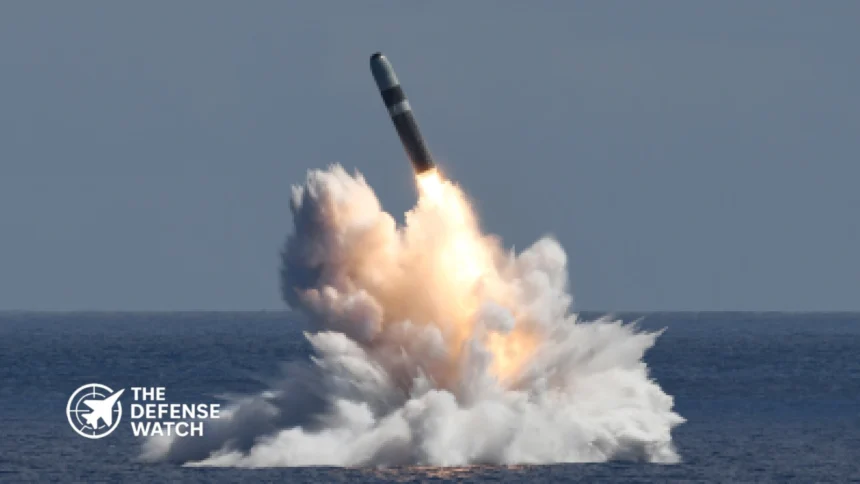
The Trident II D5 is the central missile system supporting the U.S. Navy’s sea-based nuclear deterrent. Its effectiveness depends on several interconnected subsystems, including navigation, fire control, missile guidance, launch equipment and supporting test systems.
The navigation subsystem has a specific role. It supplies the fire control system with information about the submarine’s position, velocity, heading, tilt and time. These inputs help the strategic weapons system establish the conditions required for missile launch.
This distinction matters because the submarine’s navigation equipment and the missile’s onboard guidance system perform different functions. SSI Increment 8 primarily addresses the shipboard navigation architecture. The contract announcement does not identify a new missile, a change to the Trident II’s range or a new nuclear warhead capability.
The modernization is therefore principally a reliability and equipment-obsolescence effort, rather than a new ballistic missile development program.
U.S. and UK Submarine Programs Share the Modernization Effort
The contract also has implications for the United Kingdom’s nuclear deterrent.
The U.S. Navy’s FY2027 budget documentation identifies the Ohio and Vanguard classes, alongside the future Columbia and Dreadnought classes, as beneficiaries of the wider shipboard strategic weapons system modernization effort.
The United States operates the Ohio-class ballistic missile submarine fleet, while the United Kingdom operates Vanguard-class submarines equipped with Trident II D5 missiles.
Both countries are also developing successor submarine classes. The U.S. Columbia-class program is intended to replace the aging Ohio-class fleet, while Britain’s Dreadnought-class program will replace its Vanguard-class submarines.
Maintaining compatible and supportable strategic weapons infrastructure is important to both countries because their sea-based deterrent capabilities depend on the continued availability of the Trident missile system.
The United Kingdom’s inclusion in the latest Lockheed Martin award reflects the shared technical and industrial arrangements supporting the two countries’ strategic deterrent systems. However, the contract announcement does not provide a separate financial breakdown for the British portion of the work.
Contract Funding and Industrial Distribution
The Navy awarded the contract through its Portfolio Acquisition Executive for Strategic Systems Programs in Washington, D.C. The acquisition is being conducted on a sole-source basis under 10 U.S. Code 3204(a)(1) and (4).
The announced work distribution is concentrated in three U.S. locations:
| Work location | Share |
|---|---|
| Mitchel Field, New York | 77% |
| Huntington Beach, California | 20% |
| Manassas, Virginia | 2% |
| Other locations | 1% |
The award includes three categories of fiscal 2027 Navy funding:
- Operations and maintenance: $3,967,324
- Other procurement: $12,257,072
- Shipbuilding and conversion: $12,966,189
These allocations total approximately $29.19 million in initially obligated funding, subject to the applicable funding conditions. The remaining contract value is not equivalent to money immediately obligated.
The award is also subject to the availability of funds under the cited federal acquisition provision. The Navy states that the fiscal 2027 operations and maintenance funding will expire at the end of the current fiscal year.
Part of a Wider Trident Modernization Program
Increment 8 is one component of the Navy’s broader Shipboard System Integration program, which has been addressing aging equipment and obsolescence across the Trident II strategic weapons system.
The Navy’s FY2027 budget describes a wider modernization effort involving fire control, navigation, launcher and shipboard data systems.
It also identifies the Shipboard Systems Modernization Portfolio (SSMP) as the framework for longer-term architectural modernization. Unlike individual SSI increments, which focus on targeted equipment replacements and technology refreshes, the wider portfolio includes work to redesign the shipboard systems architecture.
That distinction is important. Replacing aging navigation equipment addresses an immediate sustainment requirement, while the broader modernization program is intended to improve the ability to adapt the strategic weapons system to future technical and operational requirements.
The latest $122.45 million award provides continued development support for one part of that effort. It does not, by itself, establish the completion of the wider Trident modernization program or a new operational capability for the missile system.
Lockheed Martin’s work is expected to continue until October 2030, with the contract supporting both U.S. strategic submarine operations and the United Kingdom’s related strategic weapons requirements.