
Spirit UAS
Defense Systems Full Specifications
1. General Information
| Name | SPIRIT UAS |
| Manufacturer | Robinson Unmanned |
| Country of Origin | United States |
| Type / Role | Small unmanned aerial system, ISR and multi-mission support |
| First Flight / Introduced | Not publicly confirmed |
| Status | Commercially available platform, selected for military procurement |
| Unit Cost | Not publicly disclosed |
2. Performance
| Maximum Speed | More than 60 mph (100 km/h) |
| Cruise Speed | 40 mph (65 km/h) |
| Operational Range | Not publicly specified |
| Endurance | 38 minutes, one battery without payload; 53 minutes, two batteries without payload |
| Rate of Climb | Not publicly specified |
3. Dimensions
| Height | 12 in (305 mm), excluding battery and payload |
| Maximum Takeoff Weight (MTOW) | 13.5 lb (6.1 kg) |
4. Payload & Armament
| Payload Capacity | Up to 6.5 lb (3 kg) |
| Hardpoints | Not specified; two payload mounting positions |
| Weapons | No standard weapon configuration publicly documented |
| Sensors | Compatible EO/IR cameras and mission-specific sensors |
| Avionics | Pixhawk Cube autopilot; other options available |
5. Propulsion
| Engine Type | Electric propulsion |
| Engine Power | 44.4 V lithium-ion battery system |
| Propeller Type | Coaxial rotor configuration |
6. Communication & Control
| Control Type | Remote operation, autonomy-ready architecture |
| Data Link Range | Not publicly specified as a universal figure |
| Navigation | GPS, GLONASS, BeiDou, with RTK support |
| Ground Control Station | Compatible portable and ruggedized control systems |
7. Operational Use
| Primary Users | Military, government, public safety, and commercial operators |
| Combat Proven | No confirmed combat record identified in the cited sources |
| Notable Operations | Nepali Army contract, October 2026 |
PROS
- Compact design supports transport and rapid deployment.
- Coaxial rotors provide vertical takeoff and landing.
- Modular payload system supports multiple mission types.
- Up to 53 minutes of endurance with two batteries and no payload.
- Blue UAS Cleared status supports eligible U.S. government procurement.
CONS
- Limited endurance compared with larger military UAVs.
- Payload capacity restricts heavier sensors and equipment.
- Battery-powered operation requires battery management and recharging.
- Effective communications range depends on the selected equipment and operating conditions.
- No publicly listed standard unit price.
Spirit UAS: Robinson Unmanned Military Drone
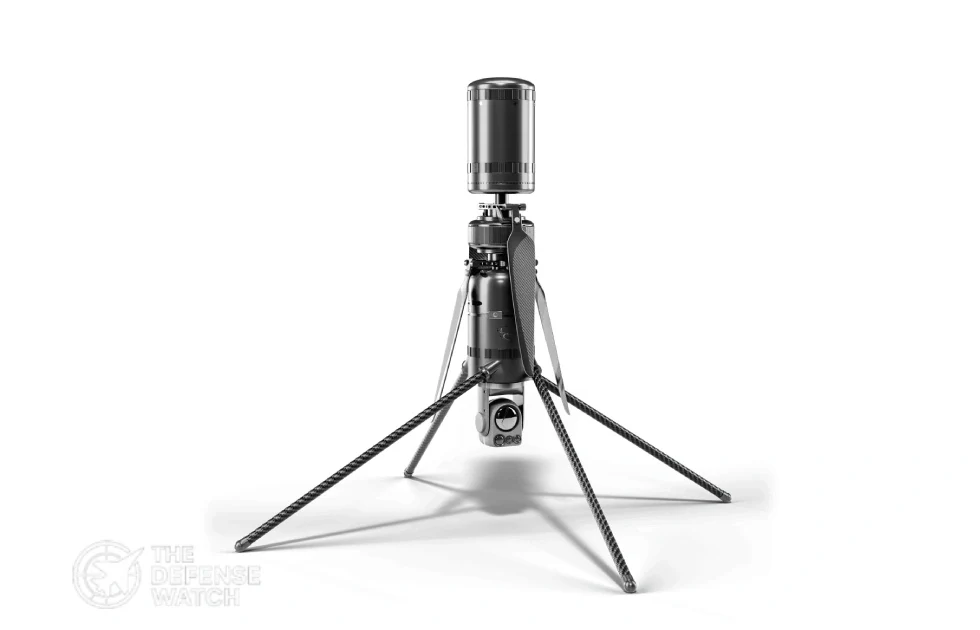
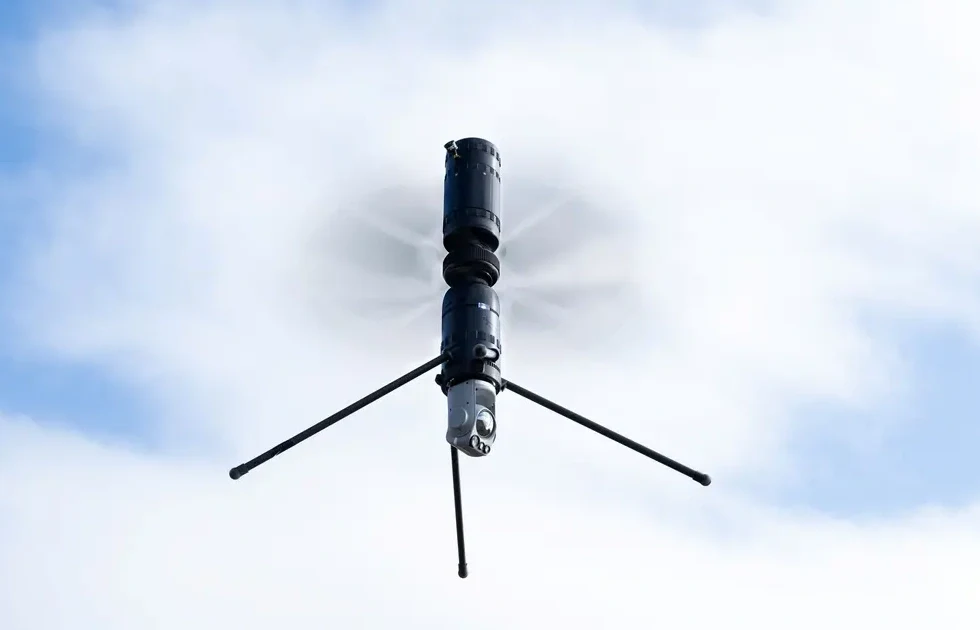
The SPIRIT UAS is a compact, battery-powered unmanned aircraft designed for tactical surveillance, reconnaissance, inspection, mapping, and other missions requiring rapid aerial deployment. Its coaxial rotor configuration and cylindrical body make it portable, while its modular payload system allows operators to adapt the aircraft to different operational requirements. Unlike armed combat drones, SPIRIT is primarily designed as a small, multi-mission aerial platform for intelligence collection and situational awareness.
Manufacturer and Origin
Developed by Robinson Unmanned, part of the Robinson Helicopter Company organization, SPIRIT is manufactured in the United States. Its design emphasizes portability, rugged construction, and compatibility with U.S. government procurement requirements. The platform is listed as a Blue UAS Cleared system and is designed to meet applicable National Defense Authorization Act supply-chain requirements.
Speed, Range and Capabilities
SPIRIT can exceed 60 mph (100 km/h) in manual operation, while its recommended autonomous operating speed is approximately 40 mph (65 km/h). Flight endurance reaches 53 minutes with two batteries and no payload, decreasing to approximately 32 minutes with the maximum payload. A single battery provides up to 38 minutes without a payload.
The aircraft supports a payload of up to 6.5 pounds (3 kg) and has a maximum takeoff weight of 13.5 pounds (6.1 kg). Its quick-change mounting system accommodates compatible cameras, electro-optical and infrared sensors, mapping equipment, and other mission-specific devices. GPS, additional satellite navigation options, and compatible command-and-control systems support mission planning and remote operation.
Cost and Price
Robinson Unmanned has not published a standard unit price for SPIRIT. Final costs depend on the selected sensors, communications equipment, battery configuration, ground control equipment, training, spare parts, and support package. Military buyers should request a configuration-specific quotation.
SPIRIT is suited to organizations seeking a portable, reusable surveillance platform rather than a long-endurance, fixed-wing aircraft or an armed strike UAV.
Operational Use
SPIRIT can support military reconnaissance, perimeter monitoring, search and rescue, and operations in difficult terrain. Its compact design and vertical takeoff and landing capability make it suitable for locations where conventional aircraft cannot operate easily. In October 2026, Robinson Unmanned announced a U.S. Foreign Military Sales contract covering SPIRIT aircraft, payload kits, training, and support for the Nepali Army. The contract value and aircraft quantity were not publicly disclosed.
Disclaimer Note
The information provided on TheDefenseWatch.com is for general informational purposes only. While we strive to ensure the accuracy, completeness, and timeliness of our content regarding defense and aerospace products, technologies, and specifications, we cannot guarantee that all information is 100% accurate or up-to-date due to the evolving nature of military technology and classified data.TheDefenseWatch.com does not warrant the reliability, suitability, or availability of the information for any specific purpose. Users are advised to consult official sources, such as manufacturers, government publications, or defense agencies, for precise and verified data before making decisions based on our content.We are not affiliated with any defense manufacturers, governments, or military organizations mentioned. Opinions, reviews, and ratings reflect expert analysis but are subjective and should not be considered endorsements. TheDefenseWatch.com is not responsible for any errors, omissions, or consequences arising from the use of this website’s content.External links are provided for convenience and do not imply endorsement. TheDefenseWatch.com reserves the right to update or modify content without prior notice. By using this website, you agree to our Privacy & Cookies Policy.
New Arrivals












Popular Comparisons
-
 J-10C vs JF-17 Thunder: Which Fighter Is More Capable?
View Comparison →
J-10C vs JF-17 Thunder: Which Fighter Is More Capable?
View Comparison → -
Tejas vs Gripen: Key Differences and Capabilities
View Comparison →
-
Tejas vs MiG-21 Bison: How India Replaced Its Iconic Supersonic Fighter
View Comparison →
-
F-35 vs F-16: Stealth, Sensors and Combat Roles
View Comparison →
-
Tejas Fighter Jet vs F-16 Fighting Falcon: Capability Compared
View Comparison →
-
Rafale Fighter Jet vs F-16 Fighting Falcon : Which Fighter Has the Edge?
View Comparison →
-
Su-57 Fighter Jet vs J-20 Fighter Jet: Stealth and Air Combat Compared
View Comparison →
-
Mirage 2000 vs Tejas Mk1A: Legacy Combat Power vs Indigenous Modernization
View Comparison →
-
Rafale Fighter Jet vs F-22 Raptor: Which Air Dominance Fighter Has the Edge?
View Comparison →
-
Tejas Fighter Jet vs. Rafale Fighter Jet: India’s Indigenous Fighter Meets France’s Proven Multirole Combat Aircraft
View Comparison →


- Israel Signs Deal for 12 AH-64E Apache Attack Helicopters

- Nepal Orders Robinson Unmanned SPIRIT Drones for Army Operations
- Draken Deploys Sting and Phantom Sky Training System Together for First Time
- Ukraine Says Neptune Strike Damaged Six Russian Su-34 Aircraft
- Why Pakistan Still Relies on F-16 Fighters Despite Chinese Advances
- US Military Weighs MOAB for Potential Future Strikes on Iran, CNN Reports
- Saab Wins $120 Million Order for New Gripen Flight Control Computer
- L3Harris Delivers First VAMPIRE Counter-Drone Systems to U.S. Army
- Lockheed Martin Invests $300 Million in Texas Munitions Expansion, Plans 6,000 U.S. Jobs
- Lockheed Martin Taps Avio for ER GMLRS and PrSM Rocket Motor Production


Fighter Jets
-
 MIG-31 Fighter Jet
-
J-10CE Fighter Jet
-
Chengdu J-10 Fighter Jet
-
Chengdu J-10C Fighter Jet
-
Gripen E Fighter Jet
-
Tejas Mk1A Fighter Jet
-
Tejas Mk‑2 Fighter Jet
-
F-16V Viper Block 70 Fighter Jet
-
F-15EX Eagle II Fighter
-
Boeing F/A-XX Fighter
-
F-15E Strike Eagle Fighter
-
F/A-18E/F Super Hornet Fighter Jet
-
Saab Gripen F Fighter Jet
-
JAS 39E/F Gripen Fighter Jet
-
JAS 39 Gripen Fighter Jet
-
F-35A Lightning II Fighter Jet
-
F/A-18F Super Hornet
-
J-50 Fighter Jet
-
Spanish EF-18 Hornet Fighter
-
F-47 Fighter Jet
-
F-35i Adir Fighter Jet
-
F-16 Fighting Falcon
-
AIDC T-5 Brave Eagle
-
F-CK-1 Ching-Kuo Fighter








Recent Compares
-
J-10C vs JF-17 Thunder: Which Fighter Is More Capable?
View Comparison →
-
Tejas vs Gripen: Key Differences and Capabilities
View Comparison →
-
Tejas vs MiG-21 Bison: How India Replaced Its Iconic Supersonic Fighter
View Comparison →
-
F-35 vs F-16: Stealth, Sensors and Combat Roles
View Comparison →
-
Tejas Fighter Jet vs F-16 Fighting Falcon: Capability Compared
View Comparison →
Latest Defense Systems
10 Compares Defense Systems
-
J-10C vs JF-17 Thunder: Which Fighter Is More Capable?
View Comparison →
-
Tejas vs Gripen: Key Differences and Capabilities
View Comparison →
-
Tejas vs MiG-21 Bison: How India Replaced Its Iconic Supersonic Fighter
View Comparison →
-
F-35 vs F-16: Stealth, Sensors and Combat Roles
View Comparison →
-
Tejas Fighter Jet vs F-16 Fighting Falcon: Capability Compared
View Comparison →
-
Rafale Fighter Jet vs F-16 Fighting Falcon : Which Fighter Has the Edge?
View Comparison →
-
Su-57 Fighter Jet vs J-20 Fighter Jet: Stealth and Air Combat Compared
View Comparison →
-
Mirage 2000 vs Tejas Mk1A: Legacy Combat Power vs Indigenous Modernization
View Comparison →
-
Rafale Fighter Jet vs F-22 Raptor: Which Air Dominance Fighter Has the Edge?
View Comparison →
-
Tejas Fighter Jet vs. Rafale Fighter Jet: India’s Indigenous Fighter Meets France’s Proven Multirole Combat Aircraft
View Comparison →
- Israel Signs Deal for 12 AH-64E Apache Attack Helicopters
- Nepal Orders Robinson Unmanned SPIRIT Drones for Army Operations
- Draken Deploys Sting and Phantom Sky Training System Together for First Time
- Ukraine Says Neptune Strike Damaged Six Russian Su-34 Aircraft
- Why Pakistan Still Relies on F-16 Fighters Despite Chinese Advances