(adsbygoogle = window.adsbygoogle || []).push({});Executive Summary:
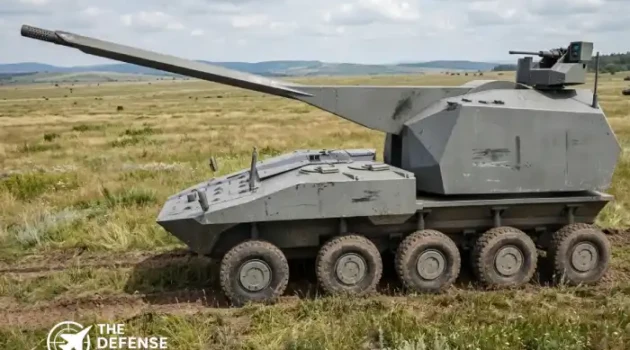
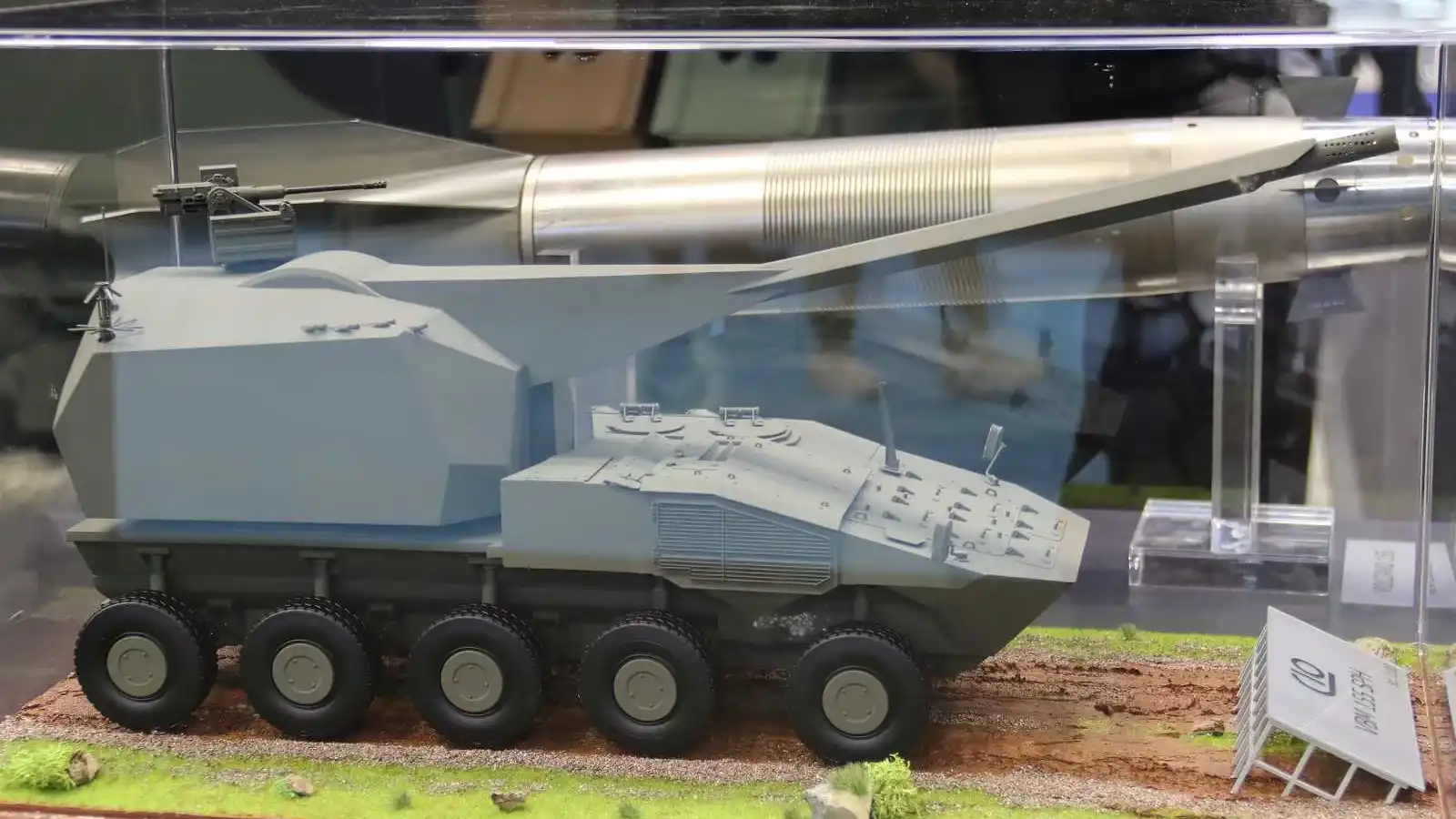
Italy’s defense industry unveiled the new VBM 155 self-propelled howitzer at Eurosatory 2026, marking its entry into the increasingly competitive market for highly automated long-range artillery systems. Developed by the Italian CIO consortium, the platform combines Leonardo’s HITFIRE 155 unmanned turret with a new 10×10 wheeled chassis and is designed to engage targets at ranges up to 70 kilometers while operating with a crew of only two soldiers.
Italy Introduces VBM 155 Self-Propelled Howitzer At Eurosatory 2026
The VBM 155 self-propelled howitzer made its public debut at Eurosatory 2026 in Paris, where the Italian CIO consortium, jointly owned by Leonardo and IDV (Iveco Defence Vehicles), showcased a new long-range artillery platform aimed at both domestic and export markets. The unveiling reflects growing European demand for highly mobile, survivable artillery systems capable of operating in contested environments shaped by drone surveillance and counterbattery threats.
The system combines Leonardo’s fully automated HITFIRE 155 turret with a newly developed 10×10 armored chassis from IDV. The design focuses on reducing crew requirements while maintaining high rates of fire, rapid deployment capability, and compatibility with NATO-standard 155mm ammunition.
- (adsbygoogle = window.adsbygoogle || []).push({});
Fully Automated Turret Reduces Crew To Two Soldiers
One of the VBM 155’s most notable features is its ability to operate with only two personnel.
The crew consists of a driver and a commander/gunner seated within a protected armored capsule integrated into the vehicle’s chassis. According to CIO, the extensive automation provided by the HITFIRE turret and computerized fire-control architecture allows artillery missions to be conducted without the larger crews typically required by conventional self-propelled guns.
The unmanned turret incorporates an automated loading system capable of handling 155mm projectiles and modular propellant charges. The system reportedly supports firing rates of up to 10 rounds per minute while carrying approximately 30 rounds onboard.
The first round can reportedly be fired within 10 seconds of the vehicle halting, while another 10 seconds are required to leave the firing position, enabling rapid shoot-and-scoot operations intended to reduce vulnerability to counterbattery fire.
(adsbygoogle = window.adsbygoogle || []).push({});Key Specifications
Specification VBM 155 Main Armament 155mm/52-caliber gun Turret Leonardo HITFIRE 155 automated unmanned turret Chassis IDV 10×10 wheeled platform Crew 2 Maximum Range Up to 70 km with extended-range ammunition Rate of Fire Up to 10 rounds per minute Combat Weight Approximately 37 tons Engine Power 720 hp Road Speed Over 100 km/h Fire Capability Rapid shoot-and-scoot operations Sources: CIO, Leonardo, Eurosatory 2026 reporting.
(adsbygoogle = window.adsbygoogle || []).push({});Designed For Long-Range Precision Fires
The VBM 155 leverages Leonardo’s existing expertise in artillery systems and precision-guided munitions.
A key element is compatibility with the Vulcano family of extended-range guided projectiles. Leonardo’s previous demonstrations have highlighted the ability of Vulcano ammunition to achieve engagement distances approaching 70 kilometers, significantly extending the reach of traditional 155mm artillery systems.
The platform also incorporates a NATO Generic Vehicle Architecture (NGVA)-compliant digital backbone, enabling integration with modern battlefield management systems, navigation equipment, tactical communications networks, and future sensor packages.
According to exhibition information, the vehicle can accommodate VHF, UHF, and SATCOM communications systems, supporting operations within NATO’s increasingly networked command-and-control environment.
Why The New 10×10 Configuration Matters
Unlike many existing wheeled self-propelled howitzers that utilize 8×8 truck or armored vehicle platforms, the VBM 155 is built on a dedicated 10×10 chassis.
The additional axle improves payload distribution and mobility across soft terrain while supporting the weight of the 13-ton automated turret. CIO states that the platform retains high mobility despite its increased size, benefiting from a 720-horsepower engine and advanced suspension design.
This approach mirrors a broader trend across NATO militaries toward heavier wheeled artillery systems that offer greater protection than truck-mounted guns while retaining much of the strategic mobility associated with wheeled vehicles.
Examples include Germany’s RCH 155, Israel’s Sigma 155, and emerging European 10×10 artillery concepts unveiled during 2026 defense exhibitions.
(adsbygoogle = window.adsbygoogle || []).push({});Strategic Analysis: Italy Enters A Competitive Long-Range Artillery Market
The VBM 155 arrives as Western militaries reassess artillery requirements following lessons learned from the war in Ukraine.
Recent combat operations have reinforced several key trends. Artillery units must fire rapidly, relocate immediately after engagements, operate with reduced manpower, and integrate seamlessly with digital targeting networks. Survivability now depends as much on speed and automation as on armor protection.
The Italian system appears designed specifically around these operational realities.
Its two-person crew reduces personnel exposure and training requirements. Automated ammunition handling minimizes physical workload during sustained operations. The short deployment and displacement times improve survivability against drones, loitering munitions, and counterbattery radar systems.
From a market perspective, the VBM 155 positions Italy alongside a growing group of European manufacturers seeking opportunities in ongoing artillery modernization programs. Nations across Europe are expanding indirect-fire capabilities while replacing legacy Cold War-era systems. Competition is intensifying among platforms such as the RCH 155, CAESAR, Archer, Sigma 155, and new long-range artillery concepts being presented at Eurosatory 2026.
For Italy, the VBM 155 also represents a significant step toward strengthening sovereign artillery manufacturing capabilities by combining domestic expertise in armored vehicles, automated turrets, fire-control systems, and precision-guided ammunition within a single platform.
Outlook
Prototype construction of the HITFIRE turret is already underway, with integration activities continuing through late 2026. While the VBM 155 is initially aimed at export customers, the system could also become a future candidate for Italian Army artillery modernization requirements if development progresses as planned.
Its success will ultimately depend on demonstrated reliability, firing performance, and the ability to compete against increasingly capable European and international artillery platforms entering service during the latter half of the decade.