


The Dassault Rafale and the Eurofighter Typhoon represent two of Europe’s most advanced multirole fighters, often compared for their technological sophistication, combat performance, and export success. Both aircraft emerged from Cold War-era requirements for next-generation fighters but diverged when France decided to pursue its own design instead of staying within the Eurofighter consortium.
For U.S. defense watchers, this comparison matters because NATO interoperability, European defense independence, and competition in the global arms market directly affect U.S. strategic interests. With conflicts in Ukraine and the Indo-Pacific highlighting the importance of advanced airpower, understanding the Rafale vs Eurofighter Typhoon debate provides valuable insights into allied capabilities and market competition against U.S. fighters like the F-35.
Rafale vs Eurofighter Typhoon: Specifications Table
| Feature | Dassault Rafale | Eurofighter Typhoon |
|---|---|---|
| Role | Multirole 4.5-gen fighter | Multirole 4.5-gen fighter |
| Crew | 1–2 (variants) | 1–2 (variants) |
| Length | 15.3 m | 15.96 m |
| Wingspan | 10.9 m | 10.95 m |
| Top Speed | Mach 1.8 | Mach 2.0 |
| Combat Radius | ~1,000 km | ~1,390 km |
| Ferry Range | 3,700+ km | 2,900+ km |
| Service Ceiling | 50,000 ft | 55,000 ft |
| Payload Capacity | 9,500 kg | 9,000 kg |
| Radar Cross Section (RCS est.) | 1 m² (reduced w/ shaping) | ~1.5–2 m² |
| Entry into Service | 2001 (French Air Force) | 2003 (RAF, Luftwaffe, others) |
| Unit Cost | $90–100 million | $110–125 million |
| Export Users | India, Egypt, Greece, UAE, Indonesia, Croatia, Qatar | UK, Germany, Italy, Spain, Austria, Saudi Arabia, Kuwait, Qatar |
Design & Technology
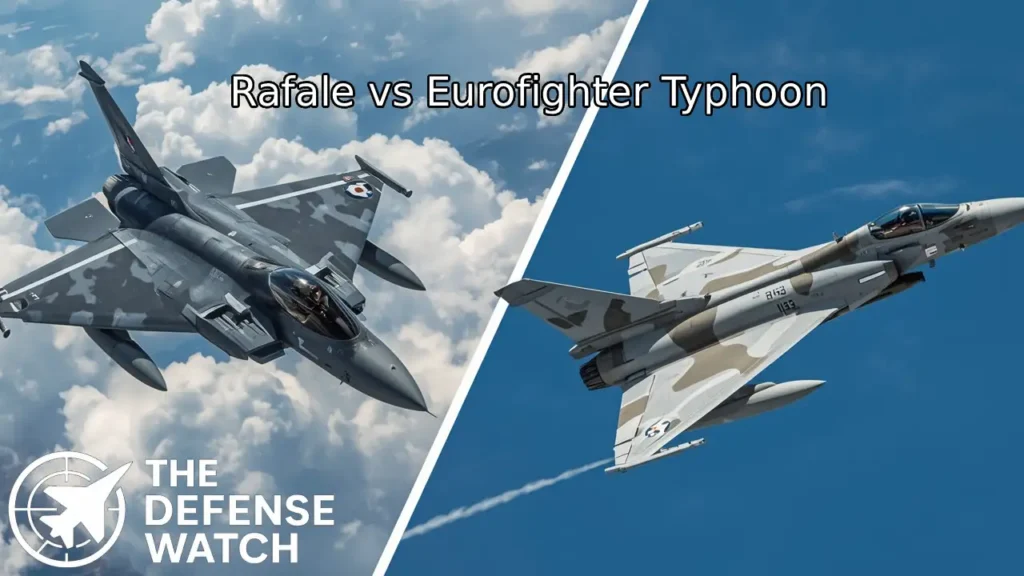
The Rafale was designed by Dassault with stealth shaping, smaller radar signature, and advanced SPECTRA electronic warfare suite, giving it strong survivability against modern air defenses. Its omnirole concept allows a single aircraft to perform air superiority, strike, reconnaissance, and nuclear deterrence missions.
The Eurofighter Typhoon, developed by a four-nation consortium (UK, Germany, Italy, Spain), emphasizes super-maneuverability, high thrust-to-weight ratio, and advanced Captor-E AESA radar (newer upgrades). While less stealthy than Rafale, Typhoon’s aerodynamics and powerful EJ200 engines make it a strong dogfighter.
Firepower & Performance
Both jets carry a mix of Western precision-guided munitions and air-to-air missiles.
- Rafale Loadout:
- Meteor, MICA IR/EM, SCALP-EG cruise missile, AM39 Exocet (anti-ship), Hammer/GBU series, ASMP-A nuclear missile.
- 30mm GIAT cannon.
- Typhoon Loadout:
- Meteor, AIM-120 AMRAAM, IRIS-T, Brimstone, Storm Shadow cruise missile, Paveway guided bombs.
- 27mm Mauser BK-27 cannon.
Rafale has stronger multirole versatility, including nuclear delivery, anti-ship, and carrier operations. Typhoon excels in air dominance, with unmatched high-altitude performance and dogfighting agility.
Operational Range & Mobility
The Rafale offers superior ferry range (3,700+ km) and carrier-based adaptability, making it attractive for nations with maritime operations. Its agility and lower RCS provide survivability against advanced SAM systems.
The Typhoon, while shorter ranged, has a larger combat radius (~1,390 km), enabling extended NATO air patrols. Its Mach 2 top speed and higher service ceiling give it the edge in high-speed interception.
Combat Effectiveness
The Rafale has extensive combat experience: Afghanistan, Libya, Syria, Iraq, Mali, and Ukraine (via export to allied operators). Its adaptability in precision strikes and long-range operations has been repeatedly validated.
The Eurofighter Typhoon has also seen action in Libya, Iraq, and Baltic NATO air policing missions. While its combat record is smaller, its presence across multiple NATO air forces ensures wide operational integration.
From a U.S. perspective, Rafale’s combat-proven record and nuclear strike capability make it strategically significant, while the Typhoon remains a vital NATO air superiority platform.
Cost & Export Value
- Rafale: More cost-effective, aggressively marketed by France. Major export wins in India (36 jets, with follow-on orders), UAE (80 jets), and Greece. Its adaptability to multiple environments (carrier ops, nuclear missions) boosts export appeal.
- Eurofighter Typhoon: More expensive, but backed by a larger industrial consortium. Exported to Saudi Arabia, Austria, Kuwait, and Qatar. Its long-term viability relies on Tranche 4/5 upgrades, extending service into the 2060s.
For U.S. defense contractors, Rafale and Typhoon compete in markets where the F-35 is politically sensitive or too expensive. This keeps them strategically relevant in global arms sales.
Analysis: Rafale vs Eurofighter Typhoon
- Strengths of Rafale: Superior multirole capability, stealthier design, carrier compatibility, nuclear role, proven combat record.
- Strengths of Typhoon: Faster, higher ceiling, superior dogfighting performance, strong NATO interoperability.
- Weaknesses: Rafale has slightly lower top-end performance; Typhoon has weaker strike/nuclear capability and higher cost.
From a U.S. defense perspective, both fighters complement NATO forces but remain 4.5-generation platforms compared to the 5th-generation F-35, which dominates future-oriented air combat planning.
Conclusion
The Rafale vs Eurofighter Typhoon debate reflects Europe’s diverging fighter design philosophies. Rafale excels as a versatile, combat-proven multirole fighter, while Typhoon shines as a high-performance air superiority jet with NATO-wide adoption.
In scenarios requiring multirole strike missions, the Rafale holds the edge. In pure air combat and NATO integration, the Typhoon may prove superior. For the U.S., both remain critical allies’ assets—but the F-35 still sets the benchmark for next-generation air dominance.
FAQ: Rafale vs Eurofighter Typhoon
The Typhoon offers higher speed and altitude, making it stronger in air-to-air combat, while Rafale balances air combat with superior multirole strike capability.
Yes. Rafale has extensive combat use in Afghanistan, Libya, Syria, Iraq, and Mali, whereas Typhoon’s combat record is more limited.
The Rafale is generally more cost-effective, priced around $90–100 million, compared to Typhoon’s $110–125 million per unit.
Both are advanced 4.5-generation jets, but neither fully matches the stealth and sensor fusion of the 5th-generation F-35.
The Rafale has recently outperformed the Typhoon in exports, securing major deals in India, UAE, and Indonesia.
🔗 Source: NATO Air Power

4 comments
[…] cross-border airstrikes into Pakistan. The ensuing aerial battles lasted several days and involved fighter jets, surface-to-air systems, and various support assets. Both sides traded claims about aircraft losses […]
[…] more versatile and cost-effective air platforms. The new aircraft will replace older training jets and handle missions that do not require full-size fighter […]
[…] Italy is pursuing aims to field an operational aircraft by 2035, replacing the country’s aging Eurofighter Typhoon fleet with a stealth-capable, network-centric warplane designed for 21st-century aerial […]
[…] agreement focuses on maintenance, sustainment, and pilot training for the Eurofighter Typhoon […]