

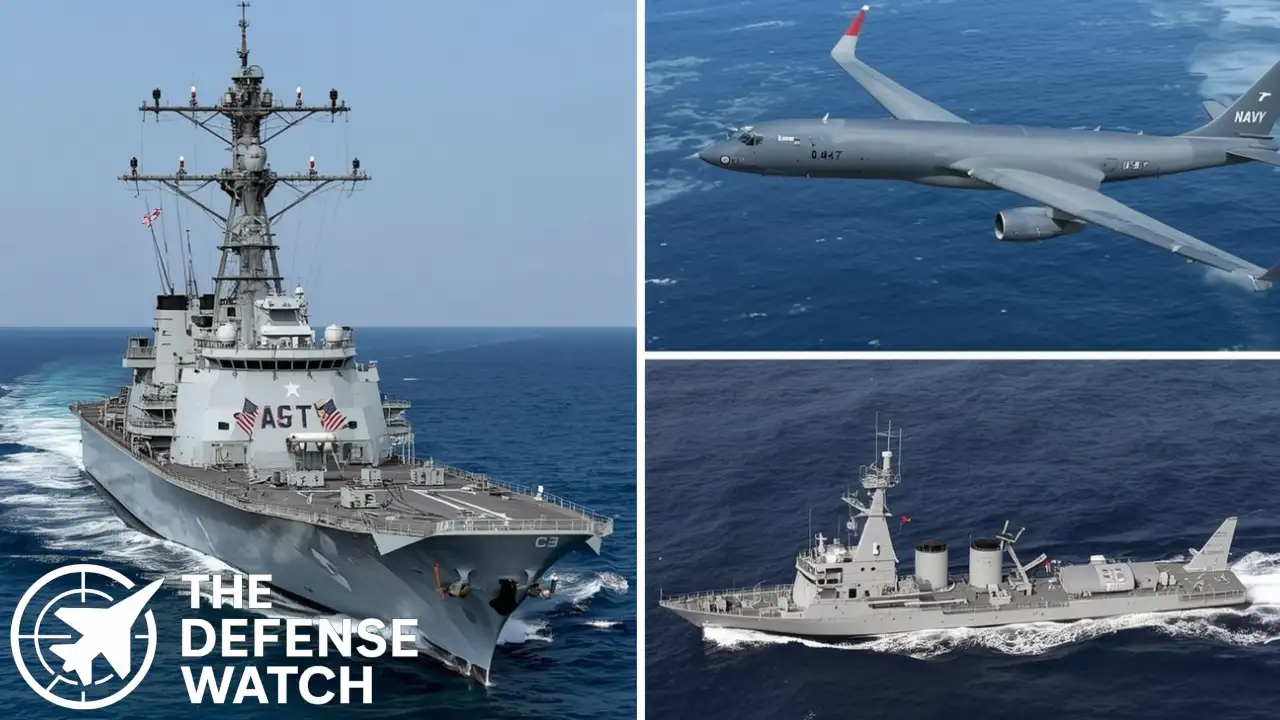
The U.S. Navy is intensifying its undersea warfare edge through a series of sonar technology advancements, ranging from AI-enhanced passive detection systems on Arleigh Burke destroyers to MAC-E active sonar trials aboard P-8A patrol aircraft, and SURTASS LFA platform expansions. These developments underscore a concerted push to elevate Anti-Submarine Warfare (ASW) capabilities amid rising global submarine threats.
AI-Enhanced Passive Sonar Extends Detection Range
A recently disclosed naval upgrade equips Arleigh Burke-class destroyers with next-generation passive sonar systems that leverage artificial intelligence. These systems reportedly deliver real-time acoustic signature analysis, dramatically reducing false-positive rates and doubling detection ranges—from approximately 80 km to 150 km. The modular architecture enables continuous software updates, allowing the Navy to adapt to evolving stealth technologies with minimal disruption.
Analysis Insight
This enhancement reflects a strategic shift: increasing reliance on passive detection not only conceals the host vessel’s presence but also enhances tracking stealth submarines—especially in contested waters. By integrating AI, the system promises a more discriminating, resilient ASW capability.
MAC-E Tested on P-8A Poseidon for Multi-Static Active ASW
The Multi-Static Active Coherent – Enhancements (MAC-E) system recently underwent operational testing aboard P-8A Poseidon aircraft at Joint Base Pearl Harbor–Hickam in July 2025, flying four sorties to evaluate its performance. Funded under a $12.8 million NAVAIR contract awarded in June, MAC-E builds upon earlier active sonar systems by incorporating advanced signal processing via coherent buoys, improving search rates, reducing clutter, and enhancing operator-machine interfaces.
Contextual Insight
MAC-E fortifies the P-8A’s status as an all-domain maritime patrol platform, dovetailing with its Increment 3 Block 2 upgrades. As anti-submarine demands escalate, MAC-E delivers sharper, more reliable active sonar functionality when passive methods fall short.
SURTASS LFA Expansion Prepares for Broader ASW Training
The Navy’s SURTASS LFA (Surveillance Towed Array Sensor System – Low Frequency Active) sonar program is advancing under a Draft Environmental Impact Statement covering operations from 2026 through 2033 in the western/central North Pacific and eastern Indian Ocean. The plan encompasses continued use of four T-AGOS-class surveillance ships and the deployment of one additional SURTASS LFA-equipped vessel per year. The updated SEIS/OEIS includes environmental and marine mammal impact analyses, reflecting mitigation efforts under NEPA and MMPA mandates.
Strategic Perspective
SURTASS LFA remains essential for long-range active ASW training. These vessels act as force multipliers, reinforcing the Navy’s capability to train across vast ocean expanses while balancing environmental responsibilities.
FAQs
Passive sonar listens for underwater acoustic emissions. AI significantly enhances its accuracy, reducing false positives and detecting stealthier targets more reliably.
MAC-E uses coherent, multi-static sonobuoy networks with improved signal processing, increasing search rate, clarity, and operational usability compared to legacy systems.
SURTASS LFA ships support active sonar training at long range, essential for maintaining ASW readiness and preparing sailors to detect advanced silent submarines.
Low-frequency active sonar can affect marine life. SEIS/OEIS documents help manage ecological compliance under laws like NEPA and the MMPA.
By integrating AI in passive systems, advancing active sonar platforms like MAC-E, and expanding towed-array training capabilities through SURTASS LFA program enhancements.
Note: The images are AI-generated.

33 comments
[…] featuring an elongated airframe, canard foreplanes, enhanced payload and fuel capacity, along with advanced sensors such as an AESA radar and IRST system. It is also projected to possess a high degree of indigenous content—above 60% with targets set […]
[…] current production standard, the M1A2 SEPv3 (System Enhancement Package Version 3), represents the most advanced Abrams variant in service. Key upgrades […]
[…] upgrades: Infrared countermeasures, advanced communications, and defensive systems enhance survivability in contested […]
[…] & lifecycle cost: A less capable but upgradeable aircraft might outperform a “flashier” model if it can evolve cost-effectively over 30 […]
[…] speeds above Mach 5, potentially bypassing U.S. missile defense systems. In 2021, China reportedly tested a fractional orbital bombardment system (FOBS) with a hypersonic glide vehicle, demonstrating a novel approach to space-enabled strike […]
[…] Navy. The trend underscores China’s ability to mass-produce naval platforms even if some lack advanced capability or […]
[…] some control losses, but agility—especially in yaw—could be constrained. The reliance on advanced flight control systems will be […]
[…] communication protocols between civilian and Navy personnel during testing or system […]
[…] stems from the need to replace its aging fleet of McDonnell Douglas CF‑18 Hornet fighters, enhance Arctic and continental-defence capability, and maintain interoperability with U.S. and NATO partners. The F-35A was selected in 2022 as the […]
[…] competition with nations such as China and Russia in hypersonics. Both have reported fielding or testing capabilities. Congress.gov Deploying more mobile hypersonic strike systems increases the perception of […]
[…] maturity: While the JL-3 upgrades improve range and MIRV capabilities, full operational integration and reliability remain subject to external […]
[…] near fishing zones or civilian maritime traffic demand robust deconfliction protocols. Even advanced navies are vulnerable to unexpected gear-snag […]
[…] adversaries are developing countermeasures: unmanned underwater vehicles (UUVs), advanced sonar nets, and acoustic sensor grids. The DCS, in turn, offers greater stealth, endurance, and inertial […]
[…] from the border requires logistical planning, air-defense suppression and possibly staging nodes or advanced navigation systems.For Russia, this incident underscores the challenge of defending deep-rear assets. If drone […]
[…] Journal of the Joint Airpower Competence Centre, Sanders highlighted the importance of balancing advanced capabilities with cost-effectiveness. He emphasized that the program must justify expenses while providing […]
[…] The JF-17 Thunder program is a collaborative effort between Pakistan and China to develop a lightweight, cost-effective, multirole fighter. The Block III variant represents a significant upgrade over earlier versions, featuring an active electronically scanned array (AESA) radar, enhanced avionics, improved maneuverability and extended mission range. Azerbaijan’s interest in modernizing its air-force has been well documented, as the country seeks to replace older Soviet-era platforms with more capable systems. […]
[…] The Rafale offers superior ferry range (3,700+ km) and carrier-based adaptability, making it attractive for nations with maritime operations. Its agility and lower RCS provide survivability against advanced SAM systems. […]
[…] has a modern dual-capable platform that can deliver both conventional and nuclear payloads. This capability enhances NATO’s deterrence posture, particularly in Europe and the Indo-Pacific […]
[…] The PL‑15’s guidance system is highly advanced: […]
[…] with a maneuverable hypersonic glide body. While publicly available details remain limited, the test suggested advanced capabilities for global-range, non-ballistic flight paths designed to bypass U.S. early-warning […]
[…] FDI frigates are being tailored for high-end missions, with advanced systems […]
[…] & Safety: Extensive testing will be required to certify such systems for regular operational use, especially considering safety, autonomy fail-safes, and emergent […]
[…] M1A2S variant is optimized for desert operations, featuring enhanced thermal sighting systems (second-generation FLIR), robust armor, and mission-management electronics suited to harsh […]
[…] D-3 variant — part of the “Form, Fit, Function Refresh” (F3R) upgrade — provides significant enhancements: a two-way data link enabling mid-course updates, inertial navigation augmented by encrypted GPS, […]
[…] navigation suite capable of autonomous route planning and obstacle avoidance. Its onboard radar and sonar systems allow for high-resolution seabed mapping and detection of underwater objects. With endurance […]
[…] development may accelerate US investment in counter underwater drone defenses, improved passive sonar networks, and new operational concepts for submarine protection in shallow […]
[…] convoy mission adds to a series of tests and evaluations that have advanced the MH-139 into operational use. Earlier Initial Operational Test and Evaluation flights focused on […]
[…] the agreement, Thales will develop enhanced functions for the TopOwl system, allowing crews to operate safely in degraded visual conditions. The helmet integrates […]
[…] US Navy as peer competitors expand submarine fleets and invest in quieter, more capable platforms. Passive sonar systems such as the Towed Body 34A provide a key layer of situational awareness without revealing ship […]
[…] at its San Diego shipyard. This includes hull, mechanical, and electrical repairs, as well as systems upgrades and preservation […]
[…] focused on long-term specifications and heavy industrial platforms. Stringer warned that defining capability requirements a decade in advance is increasingly unrealistic in a fast-changing tech and threat […]
[…] like Dynamic Manta allow participating navies to test sonar performance, coordinated tracking, and live tactical decision-making in complex underwater […]
[…] vessel integrates the Hull Mounted Sonar Abhay, an indigenous sonar system designed to enhance underwater detection in complex acoustic environments. It is also armed with lightweight torpedoes […]