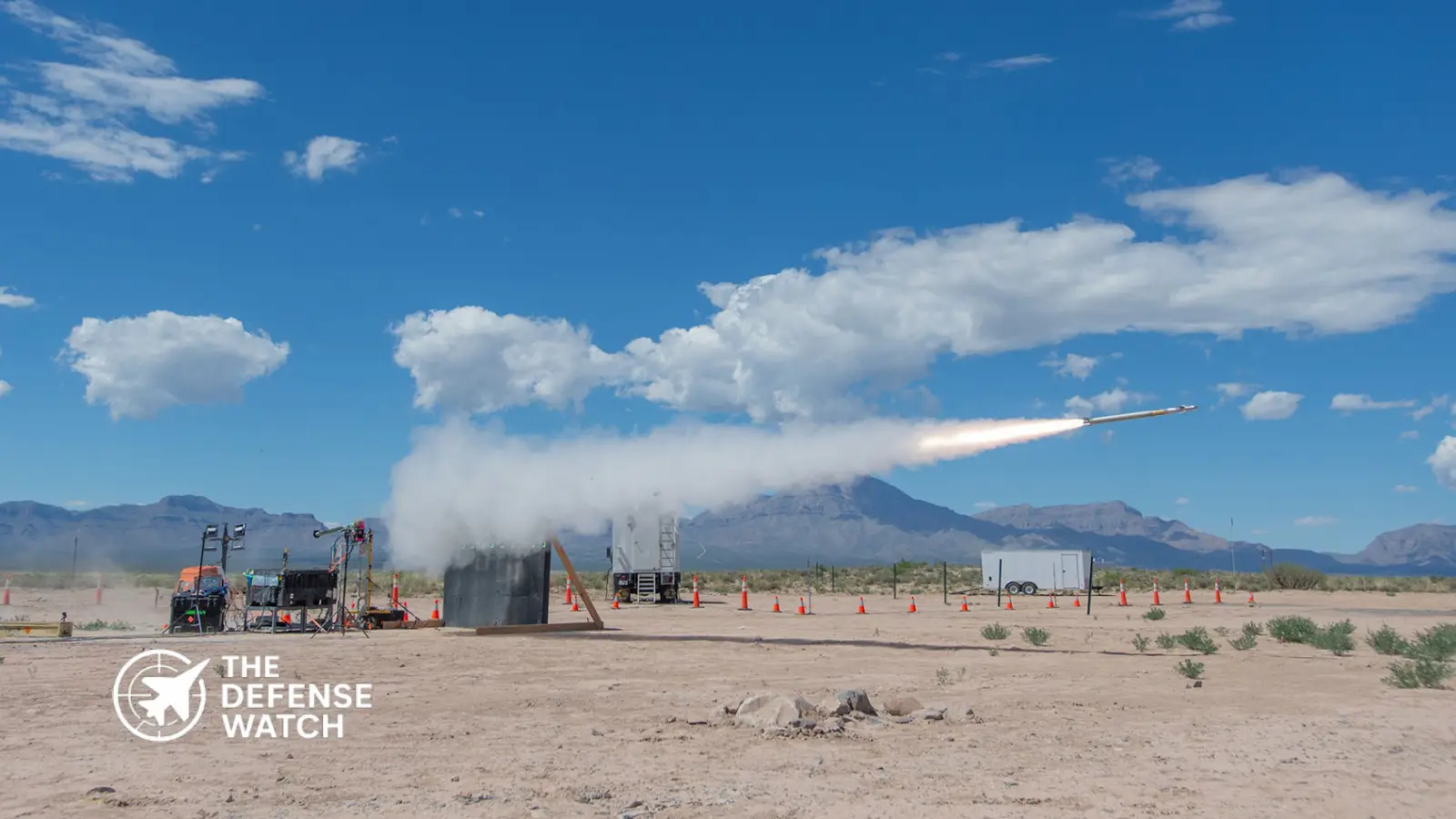
Executive Summary: Lockheed Martin successfully completed a critical seeker characterization flight test for its QuadStar™ missile — a leading contender in the U.S. Army’s Next-Generation Short-Range Interceptor (NGSRI) competition to replace the legacy Stinger. The test, conducted at White Sands Missile Range, New Mexico, achieved a 100% target acquisition rate and was completed just three months after first flight. The result positions Lockheed Martin as a strong frontrunner as the Army moves toward the next phase of the NGSRI program.
Lockheed Martin’s QuadStar Nails NGSRI Seeker Test — Here’s What It Means for U.S. Army Air Defense
The race to replace the U.S. Army’s aging Stinger missile just reached a pivotal turning point. Lockheed Martin’s QuadStar™ missile recently completed the Next-Generation Short-Range Interceptor (NGSRI) Seeker Characterization Flight Test (SCFT), a critical risk-reduction milestone for the program — and the results were decisive.
Conducted at White Sands Missile Range in New Mexico and announced on May 11, 2026, the test delivered a 100% seeker success rate against a designated target. For a program aimed at replacing one of the most iconic man-portable air defense weapons in U.S. military history, it is a significant step forward.
This milestone signals more than technical progress. It demonstrates that Lockheed Martin’s approach to seeker design, AI-driven signal processing, and open-systems architecture is maturing on schedule — and ahead of it in some respects — as the Army prepares to enter the next competitive phase of the NGSRI acquisition.
What the Test Actually Proved
The Seeker Characterization Flight Test had a clear and demanding mandate: confirm under operationally representative conditions that the missile’s guidance system could detect, acquire, and continuously track a target.
A QuadStar missile launched from a Command Launch Assembly (CLA) and flew a tactical trajectory, demonstrating seeker performance at a range exceeding the legacy system’s capability.
Three specific objectives were on the line: validate the seeker’s ability to capture imagery, process signals onboard in real time, and maintain unbroken target tracking throughout the engagement envelope.
The test confirmed CLA performance, critical system functionality, the innovative and affordable seeker technology, and QuadStar interceptor performance.
The “100% success” designation refers specifically to the seeker’s target-acquisition rate — a benchmark with direct operational consequence. In short-range air defense, engagement windows are measured in seconds. A guidance failure at that critical moment is not recoverable. Demonstrating flawless seeker performance at this stage substantially reduces technical risk ahead of full flight qualification.
Why the NGSRI Program Is Urgent
The Stinger has served the U.S. Army as its primary short-range interceptor since the 1980s. It remains in service today, but the threat environment it was designed to counter has fundamentally shifted.
Modern adversaries field faster and more maneuverable unmanned aerial systems, low-cost drone swarms, rotary-wing platforms, and fixed-wing aircraft capable of operating in radar-contested and GPS-degraded environments. These threats test the limits of legacy infrared seeker technology and single-mode guidance systems.
The NGSRI program is the Army’s formal response — a competition to field a next-generation interceptor capable of engaging the full spectrum of current and emerging air threats at greater ranges, with higher reliability, and at a unit cost that supports large-scale production and fielding.
Lockheed Martin is one of several competitors in the NGSRI acquisition. The Army has structured the program as a competitive downselect process, requiring vendors to demonstrate key technical capabilities before advancing. The test paves the way for continued testing as the U.S. Army moves into the next phase of the future replacement for the legacy Stinger missile.
Speed as a Strategic Differentiator
Perhaps the most striking aspect of this milestone is not what was tested — but how fast it was achieved.
This test follows a three-month sprint from first flight to the SCFT, underscoring Lockheed Martin’s dedication to partnering with the Army to rapidly address their mission needs.
Three months from first flight to a successful seeker characterization test is an aggressive pace by any modern defense acquisition standard. It reflects a deliberate program philosophy: compress risk-reduction timelines, demonstrate capability early, and maintain schedule flexibility for the customer.
In a defense acquisition environment increasingly focused on speed of delivery — particularly following lessons from the war in Ukraine about the rate at which modern air defense munitions are consumed — that tempo carries real programmatic weight.
The Technology Behind QuadStar
The QuadStar missile’s seeker is not a straightforward iteration of prior Lockheed Martin guidance systems. AI-driven signal processing and a modern open-systems architecture enable affordability, ensuring rapid updates and modular upgrades.
This architecture is significant for two reasons. First, it allows the seeker software to be updated in the field or at depot level as new threat signatures emerge — without requiring a hardware redesign. Second, it directly addresses a persistent criticism of legacy short-range interceptors: that their closed architectures make them slow and expensive to adapt as the threat evolves.
The SCFT validates this affordable, unique seeker design can reliably engage unmanned vehicles, rotary, and fixed-wing threats — confirming that the multi-threat engagement requirement at the heart of the NGSRI specification has been addressed at the seeker level, not just on paper.
The use of AI-driven onboard signal processing also implies a departure from purely passive infrared homing. While Lockheed Martin has not disclosed the full seeker modality, the emphasis on imagery capture and signal processing suggests a multi-mode or imaging-infrared approach capable of discriminating between decoys and actual targets — a capability gap that has historically limited short-range interceptor effectiveness.
What Program Officials Are Saying
Randy Crites, Vice President of Lockheed Martin Advanced Programs, stated: “Our team’s shared mission, innovative approach and agility were essential to achieving this milestone. The successful SCFT demonstrates we remain on course to deliver a next-generation interceptor that will defend our warfighters and allies well into the future.”
Chris Murphy, Business Development Lead for Lockheed Martin NGSRI, added: “Completing the seeker characterization in under six months highlights the speed, flexibility and drive the Lockheed Martin team brings to this customer. We remain committed to delivering highly capable, readily manufacturable and affordable solutions that meet the Army’s immediate and future needs.”
Murphy’s reference to “readily manufacturable” solutions is deliberate and notable. One of the standing concerns with next-generation interceptor programs is whether advanced seeker designs can be produced at the quantities the Army would require in a high-intensity conflict. Signaling manufacturability alongside technical performance directly addresses that operational and industrial concern.
Broader Context: Short-Range Air Defense in the Modern Battlespace
The NGSRI program does not exist in a vacuum. It is part of a wider U.S. Army effort to modernize its layered air defense architecture from the ground up.
Across multiple recent conflicts — most notably in Ukraine — short-range air defense systems have been consumed at rates far exceeding pre-conflict stockpile planning assumptions. Drone threats, in particular, have proven both numerically overwhelming and cost-asymmetric: fielding cheap UAS against expensive interceptors creates a sustainability problem that the Army is actively working to solve.
NGSRI addresses the guided interceptor tier of that challenge. The emphasis on affordability throughout Lockheed Martin’s NGSRI public communications — appearing in both the company’s technical description of the seeker and in executive statements — suggests the program team is acutely aware that unit cost will be as important a competitive factor as raw performance in the final downselect.
A successfully characterized, AI-enabled seeker with demonstrated multi-threat capability, achieved in three months and built on an open architecture — that is a compelling combination for an Army that needs large numbers of effective interceptors, quickly.
What Comes Next
With the SCFT complete, Lockheed Martin moves forward in the NGSRI competition having cleared a critical technical gate. This achievement demonstrates core sensor and guidance capabilities, ensuring testing stays on and ahead of schedule.
The next steps in the program will likely involve additional flight tests at expanded engagement envelopes, further validation against representative threat surrogates, and continued refinement of the Command Launch Assembly integration. The Army is expected to advance the NGSRI program toward a more definitive competitive phase, with a future downselect determining which vendor’s interceptor will proceed toward engineering and manufacturing development.
For Lockheed Martin, the QuadStar program now has demonstrated seeker performance, a rapid development timeline, AI-enabled guidance architecture, and explicit manufacturability commitments. The company has placed its markers down.
The Army — and its competitors — are watching.