Executive Summary:
Quantum Systems has announced it will supply autonomous Mercedes-Benz Zetros logistics trucks and Mandrill unmanned ground vehicles for operational testing in Ukraine. The initiative aims to evaluate autonomous resupply capabilities under real battlefield conditions, supporting efforts to improve military logistics while reducing risks to personnel.
Quantum Systems Expands Autonomous Battlefield Logistics Testing In Ukraine
German defense technology company Quantum Systems will supply autonomous Mercedes-Benz Zetros military trucks and Mandrill unmanned ground vehicles (UGVs) for operational testing in Ukraine, marking another step toward integrating autonomous logistics into active military operations.
- Quantum Systems Expands Autonomous Battlefield Logistics Testing In Ukraine
- Autonomous Logistics Becomes A Priority For Modern Militaries
- Autonomous Zetros Trucks Target Long-Range Military Transport
- Mandrill UGV Supports Tactical Frontline Operations
- Ukraine Continues To Shape Future Military Robotics
- Technical Challenges Remain Significant
- Why The Program Matters Beyond Ukraine
- Broader Defense Industry Trend
The announcement was made by the company as part of its broader effort to validate autonomous ground mobility technologies in real operational environments. Ukraine has become one of the world’s most important testing grounds for emerging military technologies, particularly autonomous systems designed to sustain frontline forces.
Unlike controlled demonstrations conducted at military proving grounds, the Ukrainian battlefield offers complex terrain, electronic warfare threats, damaged infrastructure, and constantly changing tactical conditions that provide valuable operational data for developers.
Autonomous Logistics Becomes A Priority For Modern Militaries
Military planners increasingly view logistics as one of the most vulnerable elements of modern warfare.
Supplying ammunition, fuel, food, and medical equipment often requires drivers and convoy personnel to travel through areas threatened by artillery, drones, loitering munitions, and anti-tank weapons. Autonomous ground vehicles are intended to reduce those risks by allowing supplies to move with limited or no onboard crew.
The Quantum Systems project focuses on two complementary platforms:
| Platform | Primary Role |
|---|---|
| Mercedes-Benz Zetros | Autonomous heavy logistics transport |
| Mandrill UGV | Unmanned tactical cargo and support missions |
Together, the systems are intended to demonstrate autonomous resupply operations across different payload classes and operational environments.
Autonomous Zetros Trucks Target Long-Range Military Transport
The Mercedes-Benz Zetros is already used by several armed forces as a highly mobile tactical logistics truck capable of operating over difficult terrain.
Under the new initiative, Quantum Systems will integrate autonomous driving technologies that allow the vehicle to navigate designated routes with minimal human intervention.
Potential military applications include:
- Ammunition resupply
- Fuel transportation
- Food and water delivery
- Engineering equipment movement
- Casualty evacuation support
- Humanitarian logistics
Autonomous operation does not eliminate the need for human oversight but can significantly reduce personnel exposure during dangerous transport missions.
Mandrill UGV Supports Tactical Frontline Operations
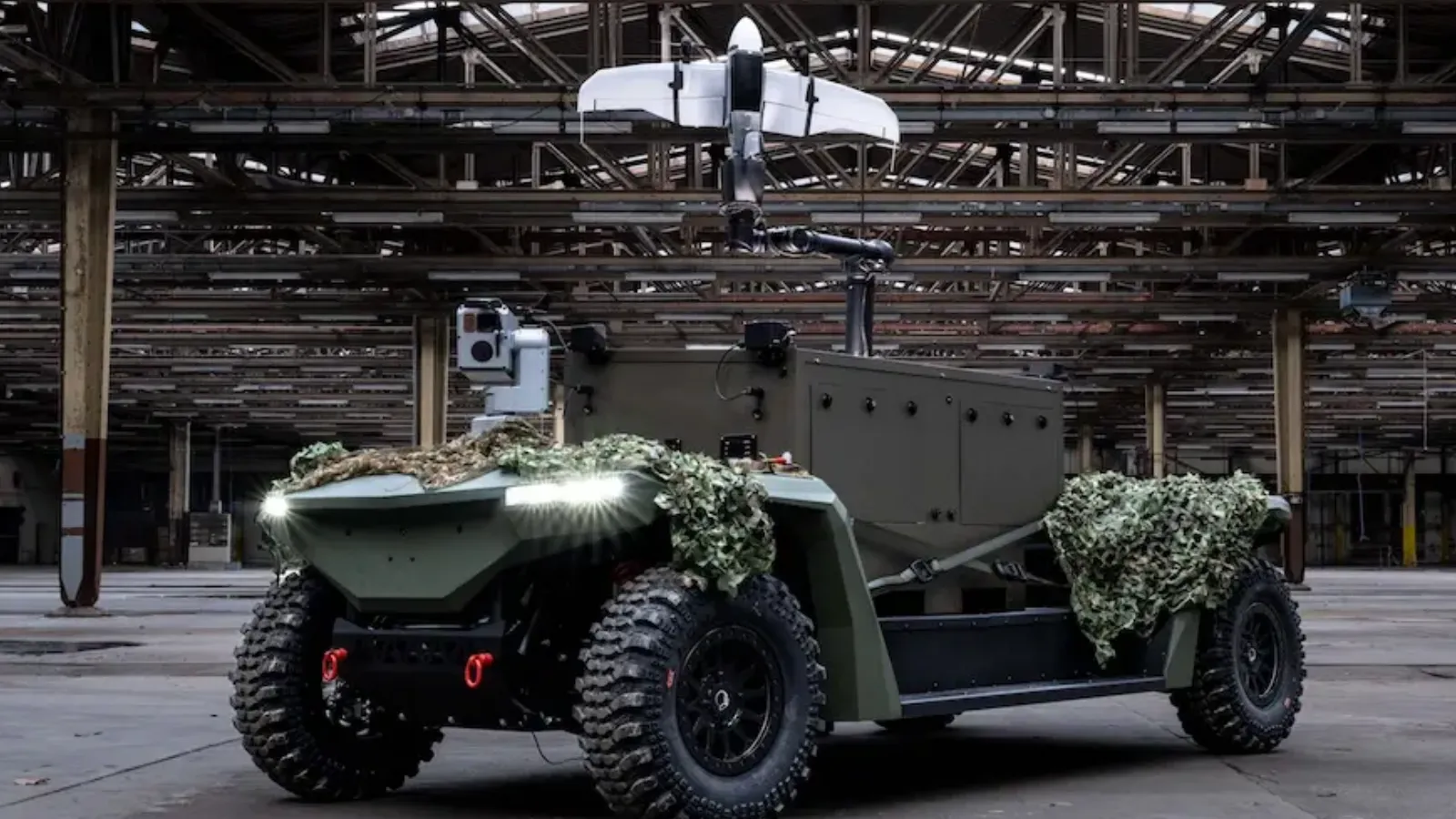
The Mandrill unmanned ground vehicle is designed for smaller tactical logistics missions closer to frontline units.
Compared with larger autonomous trucks, UGVs offer greater flexibility in confined terrain, urban environments, and forested areas where conventional vehicles may struggle.
Possible operational roles include:
- Delivering ammunition to infantry positions
- Transporting medical supplies
- Recovering wounded personnel
- Carrying communications equipment
- Supporting reconnaissance teams
Small autonomous ground vehicles have become increasingly important as drone surveillance makes conventional vehicle movement more hazardous.
Ukraine Continues To Shape Future Military Robotics
Ukraine has rapidly emerged as one of the world’s leading operational environments for autonomous military systems.
Since 2022, both Ukrainian forces and international industry partners have accelerated development of:
- First-person-view attack drones
- Long-range reconnaissance UAVs
- Autonomous surface vessels
- Electronic warfare systems
- AI-assisted target recognition
- Ground robotics
Testing systems under actual combat conditions allows developers to identify software limitations, navigation challenges, communications vulnerabilities, and maintenance requirements that cannot be fully replicated during peacetime trials.
The experience gained often influences future procurement decisions by NATO members and allied militaries.
Technical Challenges Remain Significant
Despite rapid advances, autonomous military logistics remains technically demanding.
Ground vehicles must safely navigate:
- Destroyed roads
- Mud and snow
- Rubble-filled urban areas
- GPS degradation
- Electronic warfare interference
- Dynamic obstacles including civilian traffic and military formations
Reliable autonomous operation requires a combination of onboard sensors, inertial navigation, computer vision, obstacle detection, artificial intelligence, and resilient communications links.
Military autonomy also demands high levels of cybersecurity to prevent interference or unauthorized control.
Why The Program Matters Beyond Ukraine
The significance of the Quantum Systems project extends well beyond the current conflict.
The U.S. Army, NATO allies, and Indo-Pacific partners are all investing heavily in autonomous logistics as part of broader modernization programs.
Future military operations are expected to involve highly dispersed formations operating over extended distances while facing persistent drone surveillance and precision fires. Autonomous supply vehicles could improve operational endurance by reducing reliance on manned convoy operations.
For NATO, operational data gathered in Ukraine may help inform future requirements for robotic logistics, autonomous convoy management, and human-machine teaming.
The program also reflects a broader shift in military modernization. While autonomous aircraft have received significant attention over the past decade, unmanned ground logistics systems are increasingly viewed as a critical capability for sustaining forces during high-intensity conflict.
Broader Defense Industry Trend
Quantum Systems joins a growing number of defense companies investing in autonomous ground mobility.
Major defense manufacturers across Europe and North America are developing robotic cargo vehicles, autonomous engineering platforms, and AI-enabled convoy systems intended to support future multidomain operations.
Rather than replacing human operators, these systems are expected to serve as force multipliers by handling repetitive, dangerous, or high-risk logistics tasks while allowing personnel to focus on tactical decision-making.
As autonomous technologies mature, battlefield logistics may become one of the earliest military missions where routine autonomous operations achieve widespread operational acceptance.