


What Happened
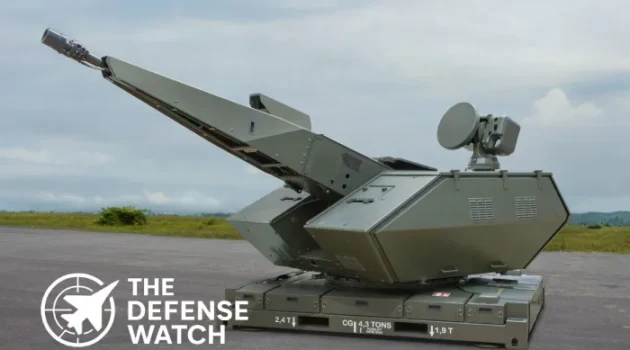
Germany has completed the delivery of four Rheinmetall Skynex short-range air defense systems to Ukraine, according to statements by Rheinmetall CEO Armin Papperger. The systems are now operational, particularly in western Ukraine, where they are deployed to protect power plants and critical grid infrastructure from Russian loitering munitions and cruise missile threats.
Background: Why Skynex Matters
The Skynex system is designed for very short-range air defense (VSHORAD), optimized to counter small, low-flying threats such as drones—including Shahed loitering munitions—as well as cruise missiles.
Germany first committed to supplying Skynex systems under a contract with Rheinmetall in late 2022. The modular architecture comprises a command node (Oerlikon Skymaster), radar (X-TAR3D), and up to four 35 mm Revolver Gun Mk 3 turrets per battery.
Each 35 mm turret uses AHEAD (Advanced Hit Efficiency And Destruction) programmable airburst ammunition, which deploys subprojectiles to form a dense tungsten cloud in front of the target—very effective against small drones and cruise missiles.
The range and performance
The Mk 3 cannon has an effective range up to ~4 km, can engage targets up to around 3,500 m in altitude, and can fire at a cyclic rate of up to 1,000 rounds per minute. The radar (X-TAR3D) enables 360-degree coverage out to roughly 50 km.
Deployment & Operational Role
According to the German Aid to Ukraine (GAU) monitoring project, the full four-system Skynex package (each with four guns) has been delivered and deployed.
In Ukrainian service, Skynex batteries are primarily assigned to Air Command West, tasked with defending key power plants and grid nodes from aerial threats.
In one reported August 2025 strike, Air Command West said it intercepted 42 Shahed drones and 11 cruise missiles in a single attack, with visual footage of a Skynex turret engaging multiple targets—firing a burst, quickly re-aiming, and engaging another target.
Industrial & Logistical Implications
A key strategic advantage of Skynex lies in its cost-efficiency. The 35 mm AHEAD rounds are far cheaper per engagement than guided missile interceptors, making it viable for high-volume, repeated use.
Ukraine already uses 35 mm ammunition in its Gepard self-propelled anti-aircraft guns, meaning existing supply chains can support sustained Skynex operations. Rheinmetall is reportedly expanding AHEAD production capacity, including in its facility in Várpalota, Hungary, to meet demand.
For Germany, the Skynex deliveries also support its broader European Sky Shield Initiative, strengthening integrated short-range air defense across Europe.
The fact that Rheinmetall has now fulfilled the entire pledged delivery (four systems) reflects not only industrial capacity but political will.
Expert & Policy Analysis
From a doctrinal standpoint, Skynex fills an important mid-layer role in Ukraine’s layered air-defense architecture:
- Missile systems (like Patriot, IRIS-T SLM, NASAMS) handle high-altitude, long-range, or high-speed threats.
- Skynex absorbs much of the threat from low-flying, saturating drones and cruise missiles in the terminal phase (within ~4 km).
- By doing so, Skynex frees up costly missile interceptors for more strategic threats, optimizing Ukraine’s limited stockpiles.
Industry observers say this could become a template for NATO-standard short-range air defense, especially with other European customers adopting Rheinmetall’s 35 mm gun + AHEAD ecosystem.
There’s also a political signal: Germany’s completion of its Skynex commitment underscores Berlin’s continued high-end support for Ukraine. As Germany has also delivered other systems, like IRIS-T and Patriot interceptors, this package reaffirms an integrated posture.
What to Watch Next
- Sustainment: Will Ukraine be able to maintain Skynex operations long term? Key will be continued supply of 35 mm AHEAD ammunition and spare parts.
- Further deliveries: Will Germany or other allies commit more Skynex or similar systems? Rheinmetall has already won orders in Europe.
- Integration: How will Skynex batteries mesh with Ukraine’s broader air-defense network (radars, command posts, higher-tier missile systems)?
- Operational performance: Continued open-source footage and Ukrainian statements may give insight into how effective Skynex is under real combat conditions, particularly against drone swarms or mixed missile attacks.
Conclusion
Germany’s completion of all four pledged Skynex air defense systems to Ukraine marks a significant reinforcement of Kyiv’s ability to defend critical infrastructure against Russian aerial threats. With its low-cost, high-rate-of-fire gun architecture, Skynex fills a vital gap in Ukraine’s air-defense shield—especially against saturating drone and cruise missile attacks. As Ukraine continues to build a layered and resilient air defense posture, Skynex could emerge as a cornerstone of efficient, high-volume terminal defense—and a model for other European nations as they modernize their short-range air defenses.

53 comments
[…] alone no longer guarantees victory in 2025’s contested airspace, where integrated air defense systems and hypersonic threats demand a holistic approach. The fastest fighter jets in the US military, […]
[…] multi‑mission radar (MMR) family underpins several integrated air defense systems, including national missile defense shields and counter‑rocket, artillery and mortar (C‑RAM) […]
[…] Ukrainian forces urgently need on the battlefield. The largest share of the 5 billion in planned deliveries will be air defense systems, ammunition and essential spare parts. According to Šekerinska, the bulk of air defense equipment […]
[…] radar systems. These radars are designed to track aerial targets and supply target data to air defense systems, enhancing early detection and tracking of unidentified drones. The systems will be deployed around […]
[…] the government and voters agreed to finance not only new fighter jets but also new ground-based air defense systems and upgraded surveillance capabilities. The 6 billion Swiss franc ceiling was set in a national […]
[…] are difficult to detect, fly at low altitudes, and can be launched in large numbers. Traditional air defense systems were not designed to counter such targets, leaving gaps in protection for ground […]
[…] configuration under the M-346F Block 20 standard. In addition to the jets, the package includes complete simulation systems, spare parts, ground equipment, and six years of maintenance support counted from the first […]
[…] was removed from the F-35 program in 2019 after it took delivery of the S-400 air defense systems from Russia. The United States argued that operating the S-400 alongside NATO aircraft posed […]
[…] ballistic missiles during the midcourse phase using hit to kill technology. Unlike lower tier air defense systems, Arrow 3 does not rely on a proximity warhead, instead neutralizing threats through direct kinetic […]
[…] lessons from Ukraine and the Middle East. Small UAVs have proven difficult to counter using legacy air defense systems, driving demand for layered and affordable […]
[…] indirect threats raise operational and political risks for host nations, particularly as regional air defense systems remain under strain from drones and […]
[…] have made similar warnings in response to expanded arms deliveries, including long range missiles, air defense systems, and advanced strike […]
[…] 6×6 unit to support combined training and to build indirect fire skills while awaiting the delivery of Latvia’s own systems. Officials said this arrangement aims to improve interoperability and give Latvian crews experience […]
[…] stressed that ballistic missiles, air defense systems and related technologies were major focus areas last year and will start moving into production or […]
[…] missions involves acting as realistic adversary or surrogate stealth targets. Modern US and allied air defense systems, fighter radars, and infrared sensors need real world exposure to low observable aircraft to […]
[…] Force Command. The attack pattern demonstrated sophisticated mission planning designed to overwhelm air defense systems through saturation […]
[…] The U-2 Dragon Lady intelligence aircraft continues serving as an irreplaceable asset for high-altitude reconnaissance missions, operating at altitudes exceeding 70,000 feet. This capability provides commanders with persistent surveillance options unavailable from satellite or lower-altitude platforms, particularly in denied or contested airspace where adversaries employ sophisticated air defense systems. […]
[…] The approach reflects lessons from recent conflicts and decades of US strike doctrine, prioritizing standoff precision weapons that can operate outside the reach of advanced air defense systems. […]
[…] United States has provided tens of billions of dollars in military assistance, including advanced air defense systems, armored vehicles, long range fires, and intelligence […]
[…] comments reflect growing recognition within the defense industry that traditional layered air defense systems, designed primarily to counter aircraft and anti-ship missiles, may struggle against coordinated […]
[…] attack capabilities are increasingly viewed as essential in countering modern air defense systems, particularly those built around networked sensors and digital fire […]
[…] has significantly enhanced its air surveillance capabilities since 2022, investing in integrated air defense systems and expanding radar coverage along its eastern […]
[…] acquisition also complements Poland’s recent investments in combat aircraft, air defense systems, and long range strike capabilities, creating a more integrated and resilient force […]
[…] For Russia, protecting airfields has become a growing challenge, requiring the redistribution of air defense systems that are also needed near active combat […]
[…] • Ground Master 200 Multi-Mission All-in-One (GM200 MM/A) medium-range radar. It provides air and surface surveillance out to roughly 350 kilometers and can support fire control for air defense systems. […]
[…] threats can saturate conventional air defense systems and deplete expensive surface-to-air missiles. As a result, militaries are experimenting with […]
[…] of a major non-NATO ally that contributes to regional stability. The agency stated that enhanced air defense systems will help Saudi Arabia address current and emerging threats while maintaining operational […]
[…] Authoritative defense sources note that radio frequency decoys are particularly effective against modern missiles that use active radar seekers, which are increasingly common in advanced integrated air defense systems. […]
[…] Electronic warfare aircraft are critical enablers in contested airspace. By disrupting radar and communications, they allow strike and stealth aircraft to operate with reduced risk. Defense officials have repeatedly emphasized that electronic attack is a core element of modern air campaigns, particularly against adversaries fielding dense and layered air defense systems. […]
[…] Laliberty, president of Land and Air Defense Systems for Raytheon, said the successful event reflects strong partnership with the Army as the program […]
[…] U.S. Navy officials have repeatedly described electronic warfare as a critical enabler for modern air operations, especially in regions protected by integrated air defense systems. […]
[…] plays a critical role in validating US Navy combat systems. It supports testing of• Ship based air defense systems• Surface to air missile interceptors• Fighter aircraft weapons and sensors• Integrated air […]
[…] the agreement, L3Harris will supply missiles, support equipment, manuals, and training packages. Deliveries are expected to be completed by the end of fiscal 2027. While the total contract value is public, specific production quantities […]
[…] for its Gripen fighter aircraft, GlobalEye airborne early warning system, and various ground-based air defense systems across multiple European nations implementing multi-year procurement […]
[…] and still does not have armed forces, though it maintains a Coast Guard, national police forces, an air defense system and a voluntary expeditionary peacekeeping […]
[…] AVIC indicated the J-35A’s primary mission focuses on achieving and maintaining air superiority, with secondary strike capabilities against land and maritime targets The platform is designed for engagement of hostile aircraft including fighters and bombers, cruise missile intercept, and neutralization of adversary air defense systems. […]
[…] Technology: Advanced radar-absorbing materials and airframe design minimize detection by enemy air defense systems, enabling operations in contested […]
[…] including fighter aircraft, transport planes, reconnaissance and attack drones, and ground-based air defense systems. This combination demonstrates France’s capacity to coordinate simultaneous effects across […]
[…] tactical value. The procurement organization also delivered counter-drone systems and ground-based air defense systems to French […]
[…] talks focused on accelerating delivery of air defense systems, increasing missile stocks, and expanding Ukraine combat aviation capacity through French made […]
[…] or maintain greater standoff distances. This adaptation may also increase reliance on ground-based air defense systems and electronic warfare rather than airborne […]
[…] Air Defense SupportCanada’s contribution comes as Western allies coordinate to provide Ukraine with air defense systems ranging from short-range to high-altitude engagements. The United States, European NATO members, […]
[…] redesigned datalink to MBDA and the Meteor programme’s International Joint Project Office. The system completed a Preliminary Design Review and met updated technical requirements, allowing development and […]
[…] class, Spain reinforces its contribution to NATO and allied maritime security. The frigates’ air defense systems, interoperability, and escort capabilities provide strategic flexibility across the Atlantic, […]
[…] The system debut includes the Multi Mission Radar (MMR), which enhances detection precision and tracking capabilities for diverse aerial targets. For low-altitude threats, Hanwha presented a counter-unmanned aerial vehicle suite featuring short-range AESA radars integrated with the Sky Light laser air defense system. […]
[…] companies, including CPMIEC and others, have been active in promoting air defense systems abroad, meeting demand where buyers seek alternatives to Western suppliers or complementary […]
[…] including a network of reopened Soviet era bases, modernized airfields, radar installations, and air defense systems stretching from the Kola Peninsula to the Chukchi […]
[…] have yet to be resolved. US military assets in the region, including carrier strike groups and air defense systems, remain positioned to support a range of operations if […]
[…] move reflects lessons drawn from ongoing combat operations, where low cost drones have been used to overwhelm traditional air defense systems through sheer […]
[…] in the Indo-Pacific and other theaters. Potential adversaries continue to expand integrated air defense systems, long-range missiles, and counter-air […]
[…] exposure time in contested airspace, a key consideration as NATO planners account for integrated air defense systems fielded by Russia and other potential adversaries. Recent conflicts in Ukraine have underscored the […]
[…] For U.S. allies in the Indo Pacific, this development underscores the need to invest in counter drone technologies and integrate them into existing air defense systems. […]
[…] shift highlights a growing recognition that future air defense systems must operate as integrated networks rather than isolated […]