B-21 Raider Production Expands With New Utah Manufacturing Facility
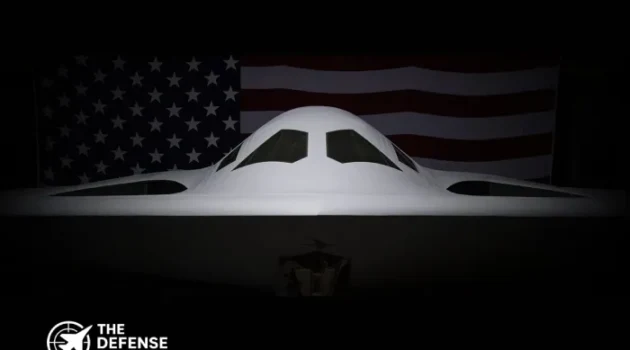
B-21 Raider production is expanding in Utah as Northrop Grumman opened its East Gate 3 manufacturing facility in Layton on September 9, adding capacity for key components of the U.S. Air Force’s next-generation stealth bomber.
- B-21 Raider Production Expands With New Utah Manufacturing Facility
- Takeaways
- East Gate 3 Expands Utah’s Role in B-21 Manufacturing
- Air Force and Northrop Grumman Accelerate Production
- B-21 Raider Program Status in 2026
- Why the Utah Expansion Matters to U.S. Long-Range Strike
- Manufacturing Scale Is a Strategic Requirement
- B-21 and the Future U.S. Bomber Force
- The China and Russia Context
- The 100-Aircraft Requirement and Future Growth
- From Development to Operational Capability
- Conclusion
Takeaways
Northrop Grumman’s new East Gate 3 facility expands the U.S. industrial base supporting B-21 Raider production as the Air Force accelerates the program toward operational fielding.
Northrop Grumman said the East Gate campus will encompass approximately 845,000 square feet and support up to 1,500 engineering and manufacturing positions by 2032. The expansion comes as the company and the Department of the Air Force accelerate the B-21 production program and prepare for the aircraft’s transition from flight testing into operational service.
The development is significant because the B-21 program is no longer focused only on demonstrating the aircraft’s design. Manufacturing capacity, supply-chain depth, sustainment infrastructure and production stability are increasingly important as the Air Force moves toward fielding the bomber at scale.
East Gate 3 Expands Utah’s Role in B-21 Manufacturing
East Gate 3 is part of Northrop Grumman’s broader manufacturing presence between Layton and nearby Clearfield, Utah.
The company said the combined manufacturing footprint in the area will exceed 2 million square feet. Northrop Grumman describes East Gate 3 as an expansion supporting next-generation aircraft manufacturing and the production scale-up of the B-21 Raider.
Company officials said key B-21 components will be manufactured in Utah, but they have not publicly disclosed the complete list of components or the detailed production processes assigned to the facility.
That distinction matters. East Gate 3 should be viewed as part of a distributed industrial network rather than as a standalone B-21 final-assembly plant.
Northrop Grumman’s B-21 work is spread across multiple locations and suppliers. The Air Force’s established B-21 industrial base includes companies such as Pratt & Whitney, Janicki Industries, Collins Aerospace, GKN Aerospace, BAE Systems and Spirit AeroSystems.
The Utah expansion therefore adds capacity to an existing production architecture rather than creating the program’s industrial base from scratch.
Air Force and Northrop Grumman Accelerate Production
The East Gate 3 opening follows a major B-21 production decision announced by the Department of the Air Force in February 2026.
The department and Northrop Grumman reached an agreement using $4.5 billion in previously authorized and appropriated funding to increase annual B-21 production capacity by 25 percent.
The Air Force said the decision was intended to compress delivery timelines while maintaining cost and performance discipline.
That production increase provides the strategic context for the Utah expansion. Building additional manufacturing space before the program reaches higher production rates allows Northrop Grumman to expand facilities, workforce and manufacturing processes ahead of demand rather than waiting for production pressure to expose industrial bottlenecks.
The company has also said it has invested more than $5 billion in digital engineering and manufacturing infrastructure associated with its advanced aircraft production efforts.
B-21 Raider Program Status in 2026
The B-21 remains in flight testing and low-rate initial production, with operational fielding approaching.
The Department of the Air Force said in February that B-21 aircraft were delivered on schedule in 2025 and that aircraft remain on track to be on the ramp at Ellsworth Air Force Base, South Dakota, in 2027.
Ellsworth was selected as the B-21’s first main operating base and formal training unit. The Air Force is simultaneously preparing facilities, personnel and security infrastructure to receive the aircraft.
The transition involves more than aircraft delivery.
Ellsworth has been accepting new B-21 infrastructure, including facilities designed to support the aircraft’s low-observable characteristics and maintenance requirements. In September 2026, the Air Force also activated a B-21 Integration Detachment at Ellsworth to coordinate the complex process of bringing the new bomber into the base’s operational structure.
The parallel investment in manufacturing and operational infrastructure illustrates the scale of the transition now underway.
B-21 Program Element Current Status Aircraft type Nuclear-capable penetrating stealth bomber Manufacturer Northrop Grumman Production status Low-rate initial production Flight testing Ongoing First main operating base Ellsworth AFB, South Dakota Planned first operational fielding 2027 Minimum planned inventory 100 aircraft East Gate campus Approximately 845,000 square feet Planned East Gate workforce Up to 1,500 by 2032 Production-capacity increase 25 percent Why the Utah Expansion Matters to U.S. Long-Range Strike
The B-21 is designed to provide the Air Force with a penetrating strike capability able to operate against advanced air defenses and other contested environments.
Unlike a conventional procurement program focused primarily on replacing individual aircraft, the B-21 is being developed as part of a wider family of systems. The Air Force describes the aircraft as a component of a broader long-range strike architecture involving intelligence, surveillance and reconnaissance, electronic attack, communications and other capabilities.
The bomber is also intended to carry both conventional and nuclear weapons.
That combination makes production capacity strategically important. A stealth bomber cannot provide its intended force-level effect if development succeeds but the industrial base cannot deliver aircraft at the required rate.
The 2026 production expansion therefore addresses a central acquisition problem: converting a successful development and flight-test program into a repeatable manufacturing process.
Manufacturing Scale Is a Strategic Requirement
The most important implication of East Gate 3 is not simply the size of the building.
The facility demonstrates that B-21 production is moving toward a larger industrial operation in which manufacturing capacity becomes an explicit program priority.
A stealth aircraft requires specialized materials, manufacturing processes, quality controls and low-observable treatments. Increasing production rates can therefore be more complicated than simply adding assembly workers or extending factory operating hours.
The industrial system must maintain consistency as output increases.
That makes additional floor space, skilled labor, supplier capacity and manufacturing engineering important elements of the B-21’s schedule.
Northrop Grumman’s expansion in Utah also provides geographic depth within the company’s wider aircraft manufacturing network. Nearby Clearfield already supports composite structures for several aerospace programs, including the B-21.
The proximity between manufacturing operations can potentially simplify movement of components and specialized work between facilities, although the company has not publicly quantified any specific schedule or cost benefit from the arrangement.
B-21 and the Future U.S. Bomber Force
The Air Force describes the B-21 as the future backbone of its bomber force alongside the B-52 Stratofortress.
The B-21 is intended to provide a penetrating platform for environments where older aircraft face increasing challenges from modern integrated air defense systems, long-range sensors and advanced weapons.
The aircraft also incorporates an open-systems architecture intended to make future upgrades easier to integrate.
That approach is particularly important for a strategic aircraft expected to remain in service for decades. The threat environment, communications systems, electronic warfare techniques and weapons available to potential adversaries will change over the B-21’s service life.
The ability to upgrade software, sensors, communications and weapons without redesigning the entire aircraft is therefore a major part of the program’s long-term value.
The China and Russia Context
The B-21’s development is taking place as the United States faces a more demanding strategic environment involving China and Russia.
China is expanding its nuclear arsenal, modernizing long-range strike capabilities and developing increasingly sophisticated air and missile defense systems. Russia continues to maintain a large strategic nuclear force while fielding advanced long-range air-defense and strike systems.
The B-21 is not simply intended to provide another bomber aircraft. Its purpose is to give U.S. commanders a survivable long-range option within a broader force that includes submarines, intercontinental ballistic missiles, conventional long-range weapons, fighters, tankers, intelligence systems and space-based capabilities.
The industrial base supporting the aircraft is consequently part of the deterrence equation.
A larger manufacturing capacity gives the Air Force greater flexibility to increase production, sustain the fleet and respond to future requirements, although the actual number of aircraft ultimately procured remains a policy and budget decision.
The 100-Aircraft Requirement and Future Growth
The Air Force’s official B-21 fact sheet continues to identify a minimum inventory of 100 aircraft.
The service also lists an Average Unit Procurement Cost of $692 million in fiscal year 2022 dollars. That figure is an average procurement measure covering aircraft flyaway costs, support equipment, training, spares and engineering change orders divided across a minimum fleet of 100 aircraft. It should not be interpreted as the simple flyaway price of an individual B-21.
The distinction is important when assessing future B-21 procurement.
A larger fleet could spread some program costs across more aircraft, while additional aircraft would also require additional procurement, maintenance, personnel, infrastructure and weapons spending.
For now, the confirmed policy baseline remains at least 100 aircraft.
From Development to Operational Capability
East Gate 3 arrives at a critical point in the B-21 program.
The aircraft is flying, production is underway, manufacturing capacity is expanding and Ellsworth is preparing for the first operational aircraft. These activities are progressing in parallel rather than sequentially.
That parallel approach can reduce the time between development and operational fielding, but it also places greater demands on the industrial base.
The Air Force’s February decision to increase production capacity by 25 percent shows that the service considers manufacturing throughput an important constraint on how quickly the B-21 can become an operational capability.
The new Utah facility is one part of that response.
Northrop Grumman’s East Gate 3 expansion does not itself change the B-21’s published specifications or operational role. Its significance is industrial: it provides additional manufacturing capacity at a time when the Air Force is preparing to move from flight-test production toward a larger operational fleet.
For the B-21 program, that transition may ultimately be as important as the aircraft’s performance in testing because strategic effect depends not only on designing a survivable bomber, but also on producing, sustaining and upgrading enough aircraft to support U.S. long-range strike requirements.
Conclusion
Northrop Grumman’s opening of East Gate 3 in Layton marks another step in the expansion of the U.S. industrial base behind the B-21 Raider.
The approximately 845,000-square-foot East Gate campus and planned workforce of up to 1,500 employees by 2032 add capacity as the Air Force accelerates B-21 production.
The development comes alongside the Air Force’s decision to increase annual production capacity by 25 percent and its continuing preparations for the first operational B-21 aircraft at Ellsworth Air Force Base in 2027.
The central issue now is no longer only whether the B-21 can complete development and flight testing. The program must demonstrate that the United States can manufacture the aircraft at the required rate, sustain its low-observable design, maintain a resilient supplier network and continue modernizing the platform throughout its service life.
East Gate 3 is therefore best understood as an industrial-base investment supporting that broader transition from an aircraft development program to a long-term U.S. strategic capability.