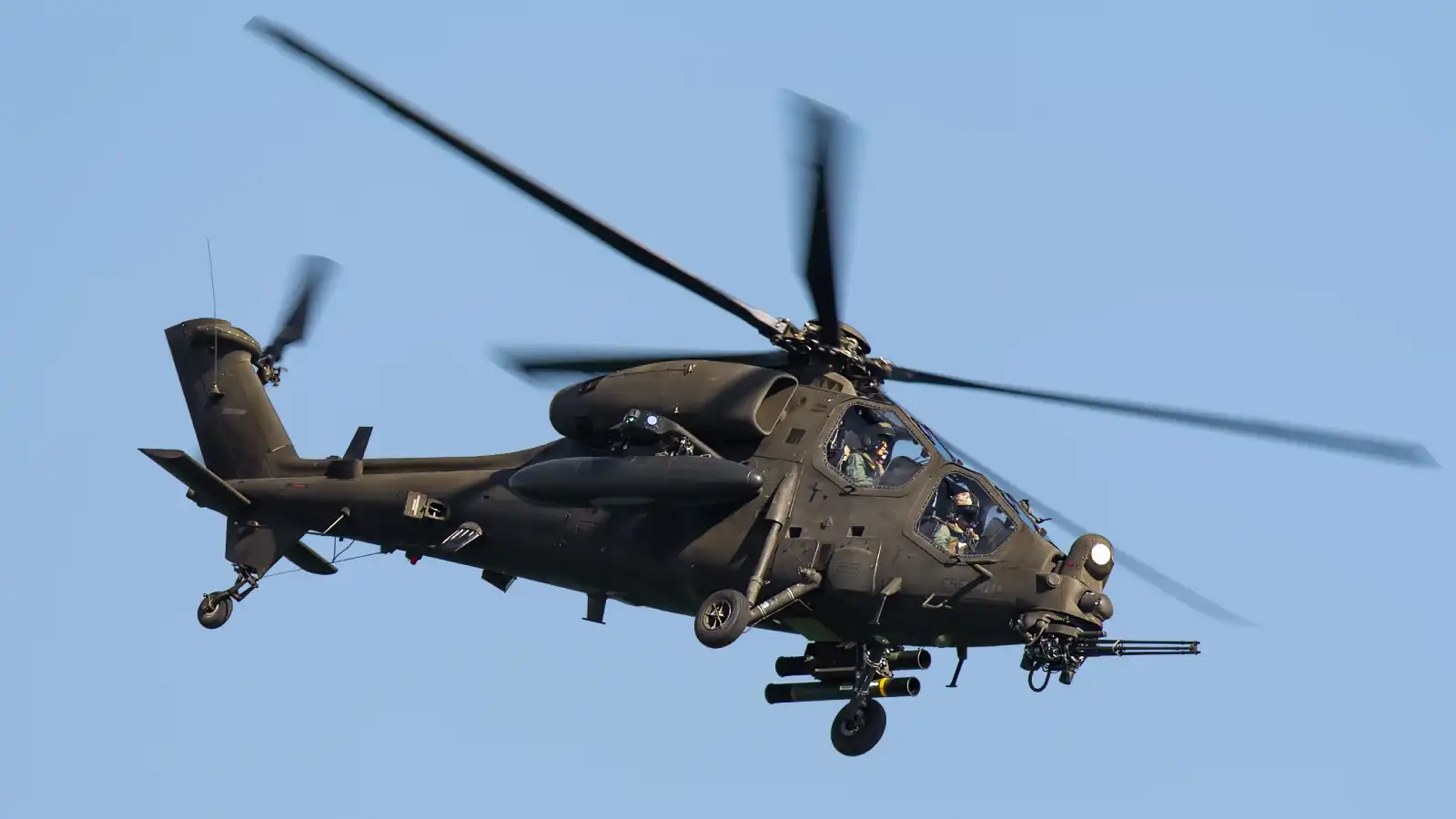
The T-129 ATAK’s performance at EFES 2026 highlighted Türkiye’s growing role in NATO attack aviation and regional defense operations.
Executive Summary:
Türkiye used the EFES 2026 military exercise to demonstrate the operational value of the T-129 ATAK attack helicopter in NATO-aligned combat scenarios. The exercise highlighted the platform’s close air support, reconnaissance, and battlefield coordination roles as Ankara continues expanding its indigenous defense capabilities.
T-129 ATAK Highlights Türkiye’s Expanding NATO Aviation Role
The T-129 ATAK attack helicopter played a central role during the EFES 2026 multinational military exercise in Türkiye, reinforcing Ankara’s effort to position its domestically developed aviation platforms as capable NATO operational assets.
Held near Izmir on Türkiye’s Aegean coast, EFES 2026 brought together allied and partner military forces for large-scale amphibious, air-ground, and joint combat operations. The T-129 ATAK participated in coordinated live-fire missions and battlefield support operations designed to simulate modern high-intensity warfare conditions.
The T-129 ATAK, developed by Turkish Aerospace Industries in cooperation with Italy’s Leonardo, has become one of Türkiye’s most visible indigenous military aviation programs. The twin-engine platform is optimized for attack and reconnaissance missions and is equipped with advanced targeting systems, guided munitions, and electronic warfare capabilities.
EFES 2026 Demonstrates Combined Arms Integration
EFES 2026 served as more than a routine military drill. The exercise reflected NATO members’ increasing focus on rapid deployment, interoperability, and multi-domain combat coordination across air, land, and maritime forces.
During the exercise, T-129 ATAK helicopters reportedly conducted close air support missions for ground assault forces while coordinating with armored units, artillery systems, and unmanned aerial platforms. This operational integration reflects broader NATO trends emphasizing networked battlefield operations rather than isolated platform performance.
The T-129 ATAK’s battlefield role is especially important for Türkiye because the country continues seeking greater strategic autonomy in defense production while remaining deeply integrated within NATO operational structures.
That balance has become increasingly significant as regional security concerns continue rising across the Eastern Mediterranean, Black Sea region, and Middle East.
Indigenous Defense Production Remains Strategic Priority
Türkiye has steadily invested in domestic aerospace and defense manufacturing over the last decade, aiming to reduce dependence on foreign suppliers and export restrictions. The T-129 ATAK program represents one of the country’s highest-profile successes in that strategy.
The helicopter incorporates Turkish-developed avionics, mission systems, and weapons integration technologies. Ankara has also pursued export opportunities for the platform, including agreements with countries such as the Philippines.
From a strategic perspective, EFES 2026 gave Türkiye an opportunity to demonstrate both operational readiness and defense industrial capability before international observers and allied militaries.
The visibility matters because the global market for attack helicopters is becoming increasingly competitive. Platforms such as the American AH-64 Apache, South Korea’s LAH program, and evolving unmanned combat systems are reshaping procurement priorities worldwide.
Rather than competing directly on scale, Türkiye appears focused on offering a cost-effective, combat-capable platform suited for regional operations, counterinsurgency missions, and expeditionary support roles.
NATO Operations Continue Evolving
The T-129 ATAK’s participation also reflects how NATO attack aviation doctrine is evolving in response to modern battlefield lessons emerging from conflicts in Ukraine and the Middle East.
Attack helicopters remain vulnerable to advanced air defense systems, portable surface-to-air missiles, and electronic warfare threats. However, they continue providing tactical advantages in terrain masking, rapid response firepower, and low-altitude strike coordination.
Military planners increasingly view rotary-wing aircraft as part of a larger ecosystem involving drones, precision-guided artillery, and real-time battlefield intelligence systems.
In this context, the T-129 ATAK’s demonstrated coordination with ground and aerial assets during EFES 2026 carries broader operational significance beyond the exercise itself.
Türkiye’s growing integration of unmanned systems alongside traditional aviation platforms may also shape future iterations of its combat doctrine.
Regional Security Implications
EFES 2026 occurred during a period of heightened geopolitical competition across several strategic theaters surrounding Türkiye.
The Eastern Mediterranean remains contested over maritime boundaries and energy exploration rights, while instability across parts of the Middle East continues driving regional military modernization efforts. At the same time, NATO members are reassessing force readiness and rapid reinforcement capabilities following continued tensions involving Russia and Black Sea security.
Within that environment, showcasing platforms such as the T-129 ATAK serves both operational and political purposes.
For Ankara, demonstrating indigenous military capability reinforces defense export ambitions while signaling continued relevance within NATO’s southern flank security architecture.
The exercise also highlighted Türkiye’s effort to maintain defense cooperation with allies even as it pursues a more independent procurement and industrial strategy.
Strategic Outlook For The T-129 ATAK
The long-term future of the T-129 ATAK will likely depend on export momentum, modernization upgrades, and integration with next-generation battlefield systems.
Türkiye is simultaneously advancing more ambitious aerospace projects, including the T929 heavy attack helicopter and fifth-generation fighter initiatives. Still, the T-129 remains an important operational bridge platform for both domestic military requirements and international customers seeking affordable attack helicopter capabilities.
Its performance during EFES 2026 demonstrated that the platform continues holding strategic relevance within modern combined-arms operations, particularly in regional conflict environments where mobility, close air support, and rapid strike coordination remain essential.