(adsbygoogle = window.adsbygoogle || []).push({});Executive Summary:
The U.S. Army’s transition from the AH-64D Apache attack helicopter to the AH-64E Apache Guardian standard represents far more than an engine swap — it is a shift from a platform-centric gunship to a networked strike node capable of directing unmanned systems and sharing targeting data across the joint force in real time. With Poland fielding the largest non-U.S. Apache fleet on NATO’s eastern flank and South Korea, the UK, and Israel all deepening their Echo-model commitments in 2026, the AH-64E has become the backbone of allied attack aviation even as the U.S. Army’s next-generation FARA program lies canceled.
The Apache’s Second Life as a Networked Strike Node
Attack aviation in 2026 is no longer judged solely by missile count or top speed. It is judged by how fast a crew can move from detection to engagement across a contested, sensor-saturated battlefield — and on that metric, the gap between the AH-64D Apache Longbow and the AH-64E Apache Guardian has become the defining storyline of Western rotary-wing modernization.
What began as an incremental Block III upgrade to the Delta-model airframe has matured into a wholesale redesign of how the Apache fights: a more powerful drivetrain, an open-systems mission computer, and — critically — the ability to receive, process, and act on live sensor feeds from unmanned aircraft without a human ever touching a joystick on the drone end.
The AH-64D Saraf variant introduced the Longbow fire control radar and improved night-fighting capability, but the Echo model added an open systems architecture that enables faster software updates and simpler integration of new sensors and weapons. That architectural leap is why NATO planners increasingly describe the AH-64E not as an upgraded helicopter, but as a different category of weapon system entirely.

From AH-64A to AH-64D: The Longbow Baseline
The AH-64D Apache Longbow entered service in the 1990s built around a single transformative addition: the mast-mounted AN/APG-78 Longbow millimeter-wave fire control radar, developed jointly by Lockheed Martin and Northrop Grumman under the Longbow LLC joint venture.
The radar allowed the Delta-model Apache to track up to 128 targets simultaneously and engage the sixteen highest-priority threats from behind terrain cover, cueing a new radar-guided version of the Hellfire missile. For its era, this was a genuine leap — it let the AH-64D Apache attack helicopter fight in adverse weather and heavy obscurant conditions where earlier A-model Apaches, reliant purely on electro-optical sensors, were effectively blind.
But the Delta-model airframe carried structural and propulsion limitations that became increasingly apparent as combat loads grew heavier and operating theaters expanded from temperate Europe to the “hot-and-high” conditions of Afghanistan and the Gulf. The Army’s own modernization assessment identified engine power, lift capacity, and digital interoperability as the specific shortfalls driving the next-generation requirement — the gaps that would define the AH-64D-to-AH-64E transition.
The AH-64D to AH-64E Transition: What Actually Changed
The AH-64E Apache Guardian was formally redesignated from “AH-64D Block III” in 2012, but the rebrand reflected a genuine platform discontinuity rather than a marketing exercise. Three subsystems account for nearly all of the operational separation between the two variants.
Drivetrain and Powerplant
The AH-64E integrates the Joint Tactical Information Distribution System for enhanced digital connectivity, and is powered by twin General Electric T700-GE-701D engines paired with an upgraded transmission that increases available power and payload capacity, while composite rotor blades improve cruise speed and climb performance.
Those composite blades trace their lineage to the canceled RAH-66 Comanche program — a rare instance of a scrapped Army aviation effort still paying dividends two decades later. The resulting airframe achieves speeds up to 293 km/h (158 knots) and can operate at altitudes exceeding 6,000 meters, materially closing the hot-and-high performance gap that limited the Delta model in Afghanistan-type environments.
South Korea’s ongoing fleet upgrade illustrates how central the powerplant remains to modernization economics: a 2024 U.S. approval for Seoul covered up to 36 additional AH-64Es alongside 76 T700-GE-701D engines, 14 AN/APG-78 radars, and hundreds of Hellfire and Joint Air-to-Ground Missiles — a package that treats the engine as inseparable from the sensor and weapons upgrade rather than a standalone line item.

Sensor Fusion: Longbow Radar and Modernized TADS/PNVS
The AN/APG-78 radar itself did not stand still between the Delta and Echo models. The updated Longbow radar fitted to the AH-64E gained overwater capability, enabling naval and littoral strike missions that the original Delta-model radar could not perform.
This is paired with the Modernized Target Acquisition and Designation Sight/Pilot Night Vision Sensor, which delivers high-resolution thermal imaging, day optics, and laser designation, supplemented by the AGM-179 Joint Air-to-Ground Missile’s dual-mode millimeter-wave radar and semi-active laser guidance — a combination that materially improves effectiveness against moving, concealed, or low-signature aerial targets such as small UAVs, a threat category that barely existed when the Delta model was designed.
(adsbygoogle = window.adsbygoogle || []).push({});Network Architecture and Open-Systems Avionics
This is the least visually obvious but most operationally significant change. The Delta-model Apache was fundamentally a self-contained sensor-shooter platform; the Echo model is a network participant. The AH-64E’s enhanced mission computer, advanced data links, and improved cockpit displays provide greater situational awareness and reduce crew workload during complex strike missions involving multiple targets and friendly forces.
South Korea’s Link 16 integration illustrates the practical effect: the KOR-24A Small Tactical Terminal brings Link 16 data exchange and secure voice to the aircraft, allowing a crew to receive target data from a ground command post, another aircraft, or a drone, update friendly-force awareness, and pass a target location to artillery or combat aircraft — reducing the time between detection, decision, and engagement.
Manned-Unmanned Teaming: The Real Dividing Line
If a single capability separates the AH-64D Apache attack helicopter from its successor, it is manned-unmanned teaming (MUM-T). The Echo model’s kill chain runs through detection by a drone, satellite, or the Longbow radar; automated classification of the contact; network-level prioritization of the threat; assignment of the best-positioned shooter — whether that is the Apache itself, ground artillery, or a fixed-wing aircraft; and execution before the target is aware it has been observed. Unlike earlier Apache variants, which relied on limited or bolted-on solutions to work with unmanned aircraft, the Guardian is designed natively to receive, process, and exploit real-time sensor feeds from unmanned aerial systems.
atOptions = { ‘key’ : ‘3d48d603f906e3fe9f205be3c4433835’, ‘format’ : ‘iframe’, ‘height’ : 250, ‘width’ : 300, ‘params’ : {} };U.S. Army aviation is now pushing that concept further with experimental “launched effects” — small, disposable unmanned systems such as Anduril’s Altius-700 — that scout ahead of the crewed aircraft, relay communications, and can disrupt or strike before the Apache itself enters the most heavily defended airspace. This shifts survivability calculus by extending sensor and strike reach while reducing crew exposure, a change NATO planners view as decisive for future high-intensity operations in Europe.
AH-64D vs. AH-64E: Head-to-Head
System AH-64D Apache Longbow AH-64E Apache Guardian Engines Earlier T700 variants Twin T700-GE-701D turboshafts, upgraded transmission Rotor system Standard four-blade rotor Composite rotor derived from RAH-66 Comanche program Fire control radar AN/APG-78 Longbow (original) AN/APG-78 Longbow (updated, overwater-capable) Sensor suite Original TADS/PNVS Modernized TADS/PNVS, higher resolution Primary anti-armor weapon AGM-114 Hellfire AGM-114R Hellfire and AGM-179 JAGM (dual-mode) Networking Limited/legacy data links Link 16, open-systems mission computer Unmanned integration Minimal, externally bolted-on Native MUM-T, “MUM-TX” drone control Chain gun M230, ~600–650 rounds/min M230E1, same rate, IHADSS-slaved Max speed Comparable airframe limits Up to 293 km/h (158 knots) Service ceiling Lower hot-and-high performance Above 6,000 meters NATO’s Eastern Flank: The Apache Attack Helicopter as Alliance Backbone
Poland’s 96-Aircraft Program
No single procurement decision illustrates the AH-64E’s centrality to European deterrence better than Poland’s. Boeing was awarded a Foreign Military Sales contract worth nearly $4.7 billion in November 2025 to build AH-64E Apache attack helicopters for Poland, marking the largest Apache order ever placed by a country outside the United States.
The Polish Apaches will carry the standard U.S.-export sensor and weapons suite — the mast-mounted Longbow radar, advanced electro-optical systems, and AGM-114 Hellfire or AGM-179 JAGM precision missiles — designed to integrate with Poland’s new M1A2 Abrams and K2 Black Panther tanks, HIMARS and K239 Chunmoo rocket artillery, and Patriot and Narew air-defense systems into a layered, mobile deterrent along the eastern flank. When deliveries begin in 2028, Poland is set to operate the largest Apache fleet outside the United States, replacing a legacy Mi-24 Hind fleet increasingly unsuited to modern combat environments.
(adsbygoogle = window.adsbygoogle || []).push({});The interoperability groundwork is already being laid. In May 2026, U.S. Army AH-64E crews from the 12th Combat Aviation Brigade conducted live-fire training with Polish and British forces near Toruń, Poland, demonstrating the kind of rapid target-sharing and multinational coordination that NATO views as central to deterring a high-intensity conflict along its eastern defense line.
UK Joint Helicopter Command and Allied Interoperability
Britain’s Army Air Corps, operating under the Joint Helicopter Command framework, made its own Delta-to-Echo transition years ahead of Poland. The United Kingdom has operated the AH-64E variant since 2022, transitioning from the legacy WAH-64D model as part of a broader Army Air Corps modernization effort, while the Netherlands has separately been upgrading its own AH-64D fleet to the Echo standard with deliveries expected to complete in 2026.
That shared baseline — Britain, the Netherlands, and soon Poland all operating the same Echo-model architecture — is precisely what makes exercises like the Toruń live-fire tables operationally meaningful rather than symbolic: a British and a Polish Apache attack helicopter crew can now, in principle, receive and act on the same targeting picture as a U.S. Army crew flying the identical airframe.
The FARA/FLRAA Context: Why the Apache Still Carries the Fight
Any account of Apache modernization in 2026 has to reckon with what didn’t happen. The Army’s Future Attack Reconnaissance Aircraft — intended to replace the retired OH-58 Kiowa Warrior in the armed scout role — was canceled in the FY2025 budget request after roughly $2 billion in development spending.
Army leadership framed the cancellation as a reflection of how aerial reconnaissance has changed, citing lessons from Ukraine that sensors and weapons mounted on unmanned systems and in space are more ubiquitous, longer-reaching, and cheaper than a dedicated scout helicopter.
Part of that rebalancing redirected the General Electric T901 engine program away from FARA and toward integration on existing AH-64 Apache and UH-60 Black Hawk fleets instead — meaning the Echo-model Apache is now a direct beneficiary of a canceled program’s engineering investment.
The Future Long-Range Assault Aircraft, by contrast, continues on track. The Army’s Bell-built FLRAA, designated the MV-75, is intended to cruise at up to 280 knots and fly up to 1,700 nautical miles with twelve passengers, with a first prototype flight planned for 2026 and initial fielding targeted for 2030.
FLRAA is a troop-transport and assault-lift replacement for the Black Hawk, not an attack platform — which means the AH-64E Apache Guardian remains, by default, the U.S. Army’s primary crewed attack helicopter for at least the next decade, with no FARA-class successor in the acquisition pipeline.
The Kill-Chain Parallel: Why the Sim-and-Strategy Crowd Should Be Paying Attention
For readers who spend as much time in RTS lobbies and tactical shooters as they do tracking defense procurement, the AH-64E’s MUM-T architecture will feel familiar in structure if not in stakes. The detect-classify-prioritize-assign-execute sequence that now governs Apache targeting is, functionally, the same resource-allocation problem competitive strategy games have modeled for two decades: limited high-value units, a contested information space, and a premium on compressing the decision loop faster than the opponent.
The difference is that the Echo model’s “map” is a real battlefield, its “fog of war” is genuine sensor denial, and its “APM” advantage — the speed at which the network converts a drone contact into a fired JAGM — is measured in human lives rather than a scoreboard.
Strategic Takeaway
The AH-64D-to-AH-64E transition closes out a design lineage that began with the Longbow radar in the 1990s and now terminates in a platform built explicitly to fight as one node among many. With Poland’s 96-aircraft program, South Korea’s $1.2 billion sensor and networking upgrade, and continued British and Dutch fleet modernization all converging on the same Echo-model baseline, the AH-64E Apache Guardian has effectively become NATO’s common attack helicopter standard by default — not because a formal alliance-wide program mandated it, but because FARA’s cancellation left no near-term successor and the Apache’s open-systems architecture proved cheap enough to keep upgrading instead of replacing.
The next inflection point will not be a new airframe; it will be how deeply launched-effects drones and AI-assisted target prioritization get pushed into the existing AH-64E mission computer before FLRAA’s armed variants — if they materialize — arrive at the end of the decade.
- The US Army recently tested the APEX counter-UAS round at Yuma Proving Ground in Arizona.
- The 30mm Aviation Proximity Explosive round is designed for the AH-64 Apache’s M230 chain gun.
- The munition detonates near a drone, creating a fragmentation pattern to destroy small UAS.
- About 1,200 rounds were fired during testing against aerial and ground targets.
- The next milestone is an airworthiness release enabling operational firing from Apache helicopters.
US Army Tests APEX Counter-UAS Round To Strengthen Drone Defense
The APEX counter-UAS round is undergoing testing by the US Army at Yuma Proving Ground in Arizona as part of efforts to improve the military’s ability to defeat drones on the modern battlefield. The new 30mm Aviation Proximity Explosive munition is designed for use with the AH-64 Apache helicopter’s M230 chain gun and is intended to destroy unmanned aerial systems by detonating near the target rather than requiring a direct hit.
Army testers recently conducted live-fire evaluations at the Yuma Test Center, where crews fired approximately 1,200 rounds during a series of trials comparing the new munition with legacy ammunition and assessing its effectiveness against aerial targets.
The Big Picture
The US military’s rapid push for counter-drone technologies reflects a fundamental shift in modern warfare. Small and inexpensive unmanned aerial systems have become widely used for reconnaissance, targeting, and attack missions.
Recent conflicts have demonstrated the scale of this challenge. In the war between Russia and Ukraine, both sides rely heavily on small drones for surveillance and strike operations, forcing militaries to develop new tools to detect and destroy these systems.
Army leadership has increasingly prioritized counter-UAS capabilities across multiple domains. The service has expanded research and testing programs focused on sensors, electronic warfare, and kinetic solutions designed to counter both individual drones and coordinated drone swarms.
The APEX counter-UAS round represents a relatively low-cost kinetic option that could expand the Apache helicopter’s ability to engage aerial threats.
What’s Happening
Testing took place at the Yuma Test Center at US Army Yuma Proving Ground, one of the military’s largest testing facilities. The site includes nearly 2,000 square miles of restricted airspace, allowing safe aerial weapons testing from helicopters.
The APEX round closely resembles existing 30mm ammunition used by the Apache, including the M788 training round and the M789 high-explosive dual-purpose round. However, the new munition introduces a key feature.
Instead of detonating on impact, the round uses a proximity effect that allows it to explode just in front of a target drone. The resulting fragmentation pattern spreads outward to disable or destroy the unmanned aircraft.
During testing, crews conducted two main subtests:
- A comparison between the APEX round and legacy M789 ammunition
- Engagement trials against unmanned aerial systems
Apache crews also fired at ground targets and tested the round at both short and longer ranges.
To capture detailed performance data, testers used a range of instrumentation. Support assets included overhead scoring aircraft, telemetry systems, tracking mounts, high-speed video cameras, and multiple ground-based sensors.
Why It Matters
Counter-drone defense presents a difficult problem for traditional military weapons. Small drones are often fast, agile, and inexpensive, which makes it inefficient to use costly missiles against them.
Attack helicopters such as the Apache already carry a powerful 30mm cannon that can fire hundreds of rounds per minute. However, hitting a small drone directly with conventional ammunition can be challenging.
The APEX counter-UAS round addresses this issue by using proximity detonation and fragmentation. This increases the probability of destroying a drone even when the round does not score a direct hit.
If fielded, the munition could significantly expand the Apache’s defensive and offensive capabilities against small aerial threats.
Strategic Implications
Integrating counter-drone ammunition into existing weapons platforms could offer several operational advantages.
First, it allows helicopters already deployed in combat zones to engage drones without requiring specialized interceptors or additional systems.
Second, it improves layered air defense. Apache helicopters operating near forward units could provide mobile counter-UAS coverage against surveillance drones or loitering munitions.
Third, it supports the broader US military approach to distributed air defense, where multiple platforms contribute to detecting and defeating unmanned threats.
This concept is increasingly important as drones become more numerous and are used in swarms or coordinated attacks.
Competitor View
Strategic competitors are closely watching Western progress in counter-drone technology.
Russia has relied heavily on reconnaissance and loitering drones in Ukraine, while China has invested heavily in drone swarms and autonomous systems. Both nations have also developed their own counter-UAS technologies.
A weapon like the APEX counter-UAS round highlights a Western approach focused on adapting existing platforms to defeat drone threats quickly and cost effectively.
Rather than relying only on high-end missile interceptors, militaries are increasingly combining electronic warfare, directed energy weapons, and proximity-fused ammunition to create layered defenses.
What To Watch Next
The next major milestone for the program is an airworthiness release.
This certification would allow soldiers to safely fire the APEX round from Apache helicopters in operational settings once the munition becomes available. The release represents a critical step toward full materiel release and eventual fielding to Army units.
Additional testing may examine reliability, lethality against different drone types, and compatibility with Apache fire control systems.
Future evaluations could also explore how the round performs against drone swarms or fast-moving aerial targets.
Capability Gap
Modern militaries face a growing gap between the cost of defending against drones and the cost of deploying them.
A small commercial drone can cost a few thousand dollars or less, while intercepting it with a missile can cost hundreds of thousands of dollars.
The APEX counter-UAS round aims to close this gap by providing a low-cost engagement option using a weapon system already carried by Apache helicopters.
However, the munition also has limitations. It relies on the helicopter’s sensors and targeting systems to detect and track drones, which can be difficult against small or low-flying targets. It also remains a line-of-sight weapon with limited engagement range compared with missile systems.
The Bottom Line
The APEX counter-UAS round represents a practical step toward giving Apache helicopters an effective and cost-efficient weapon against the growing threat of battlefield drones.
The U.S. Army awarded Boeing a $2.7 billion contract for Apache helicopter support services, marking a major sustainment award for the AH-64 attack helicopter fleet, the Pentagon said.
Contract Details and Scope
The Pentagon announced that the U.S. Army selected Boeing to provide post-production support services for Apache helicopters under a firm-fixed-price agreement valued at roughly $2,728,234,918. The contract was awarded after a competitive internet-based bidding process and is managed by the Army Contracting Command at Redstone Arsenal in Alabama. Work will primarily be carried out from Boeing’s facility in Mesa, Arizona, and is expected to run through December 31, 2030.
Under the agreement, Boeing will deliver logistics support and sustainment services designed to maintain the operational readiness of the AH-64 attack helicopter fleet. Specific task orders and funding details will be set at the order level throughout the life of the contract.
Importance for Army Aviation
The Apache helicopter remains a cornerstone of U.S. Army attack aviation. The AH-64 platform has been in continuous service for decades, providing close air support, anti-armor capability, and reconnaissance to Army units. Sustainment contracts like this ensure the Army can keep a high rate of availability across its fleet while managing readiness costs over the long term.
This award follows a separate, larger Boeing build contract announced last month, in which the Army awarded Boeing about $4.7 billion for new Apache AH-64E attack helicopters and Longbow crew trainers.
Industrial and Strategic Impact
Sustainment contracts of this size reflect the ongoing need to support legacy platforms even as modernization programs progress. Boeing’s sustainment work for the Army helps preserve an industrial base of specialized rotorcraft support capability in the United States while the Apache fleet continues to play a central role in U.S. Army aviation operations.
The Apache Helicopter as a Modern Battlefield Icon
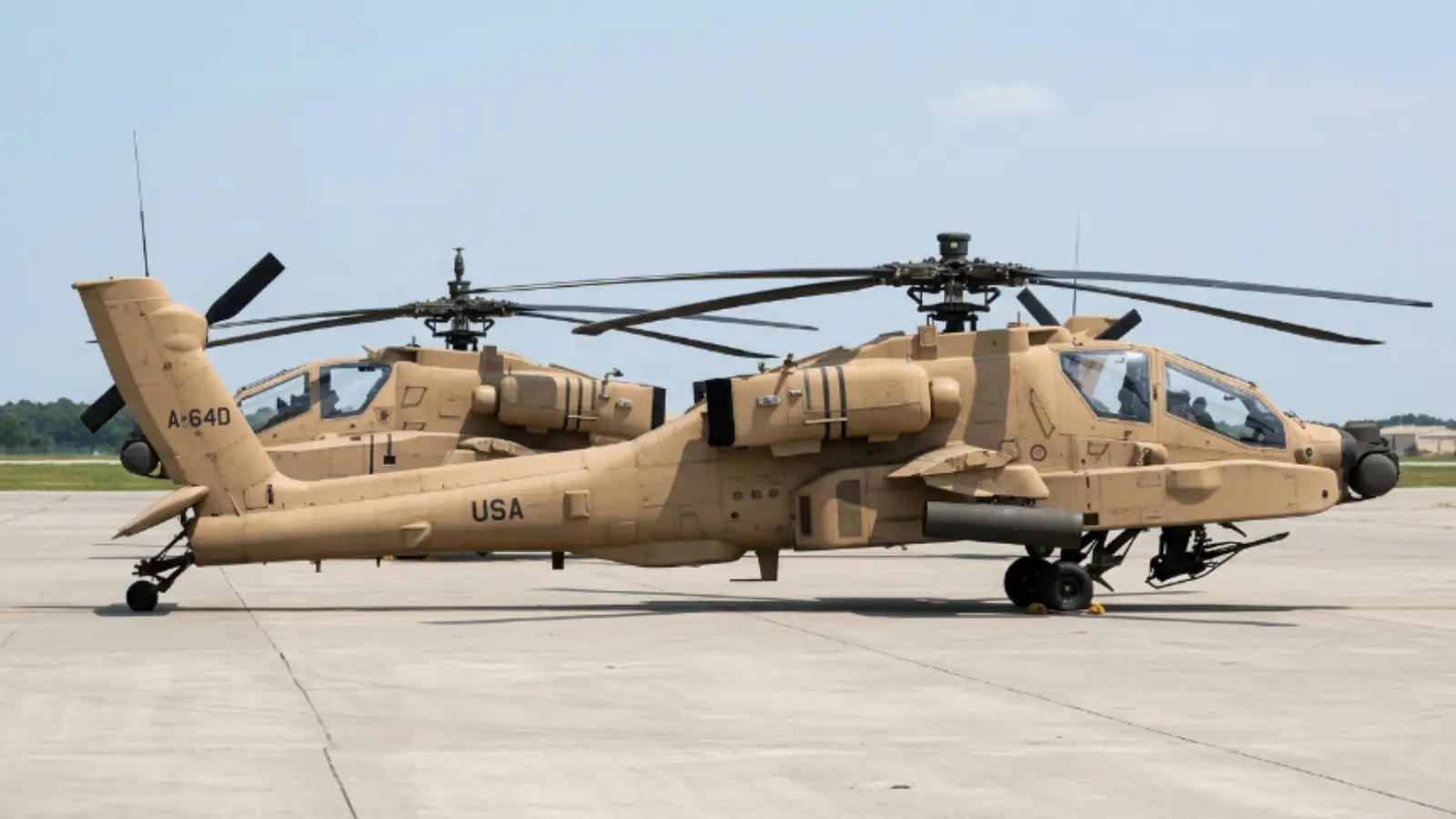
The Apache helicopter has become one of the most recognizable and feared combat aircraft in modern warfare. Designed during the Cold War and continuously upgraded for 21st-century conflicts, the Apache attack helicopter remains a core element of U.S. Army airpower and a benchmark for attack rotorcraft worldwide. From high-intensity armored warfare to counter-insurgency and precision strike missions, the Apache’s combat record spans more than four decades of global operations.
(adsbygoogle = window.adsbygoogle || []).push({});Today, platforms such as the AH-64D Apache helicopter and the latest AH-64E Guardian represent not just flying gunships, but fully networked battlefield systems capable of finding, fixing, and destroying targets day or night, in all weather conditions. With its distinctive mast-mounted radar, heavy weapons load, and survivability features, the Apache fighter helicopter continues to define the attack helicopter category.
The Origins of the Apache Attack Helicopter
The Apache’s roots trace back to the U.S. Army’s search in the 1970s for an advanced anti-armor helicopter capable of countering large Soviet tank formations in Europe. This requirement led to the Advanced Attack Helicopter (AAH) program, eventually won by Hughes Helicopters—later acquired by McDonnell Douglas and now part of Boeing Defense.

The resulting AH-64 entered U.S. Army service in the mid-1980s, introducing a new generation of survivability, firepower, and sensor integration. Unlike earlier gunships, the Apache was designed from the ground up to fight in heavily defended environments, incorporating armor protection, redundant systems, and the ability to operate at extremely low altitudes.
(adsbygoogle = window.adsbygoogle || []).push({});AH-64D Apache Helicopter: A Major Leap in Capability
The AH-64D Apache helicopter, introduced in the late 1990s, marked a transformational upgrade over earlier models. Its most visible feature is the AN/APG-78 Longbow radar, mounted above the rotor mast. This radar allows the Apache to detect, classify, and prioritize multiple targets while remaining concealed behind terrain.
Key Enhancements of the AH-64D
- Longbow fire-control radar enabling “fire-and-forget” missile engagements
- Fully digital glass cockpit
- Improved datalinks for sharing targeting data with other aircraft and ground forces
- Enhanced electronic warfare and self-protection systems
In combat, these improvements allowed Apache crews to engage armored vehicles and high-value targets with unprecedented speed and coordination, especially when operating in hunter-killer teams.
Apache Fighter Helicopter: Weapons and Firepower
At the heart of the Apache’s reputation is its lethal weapons suite. The Apache attack helicopter is designed to deliver precision firepower across a wide range of mission profiles.
Primary Armament
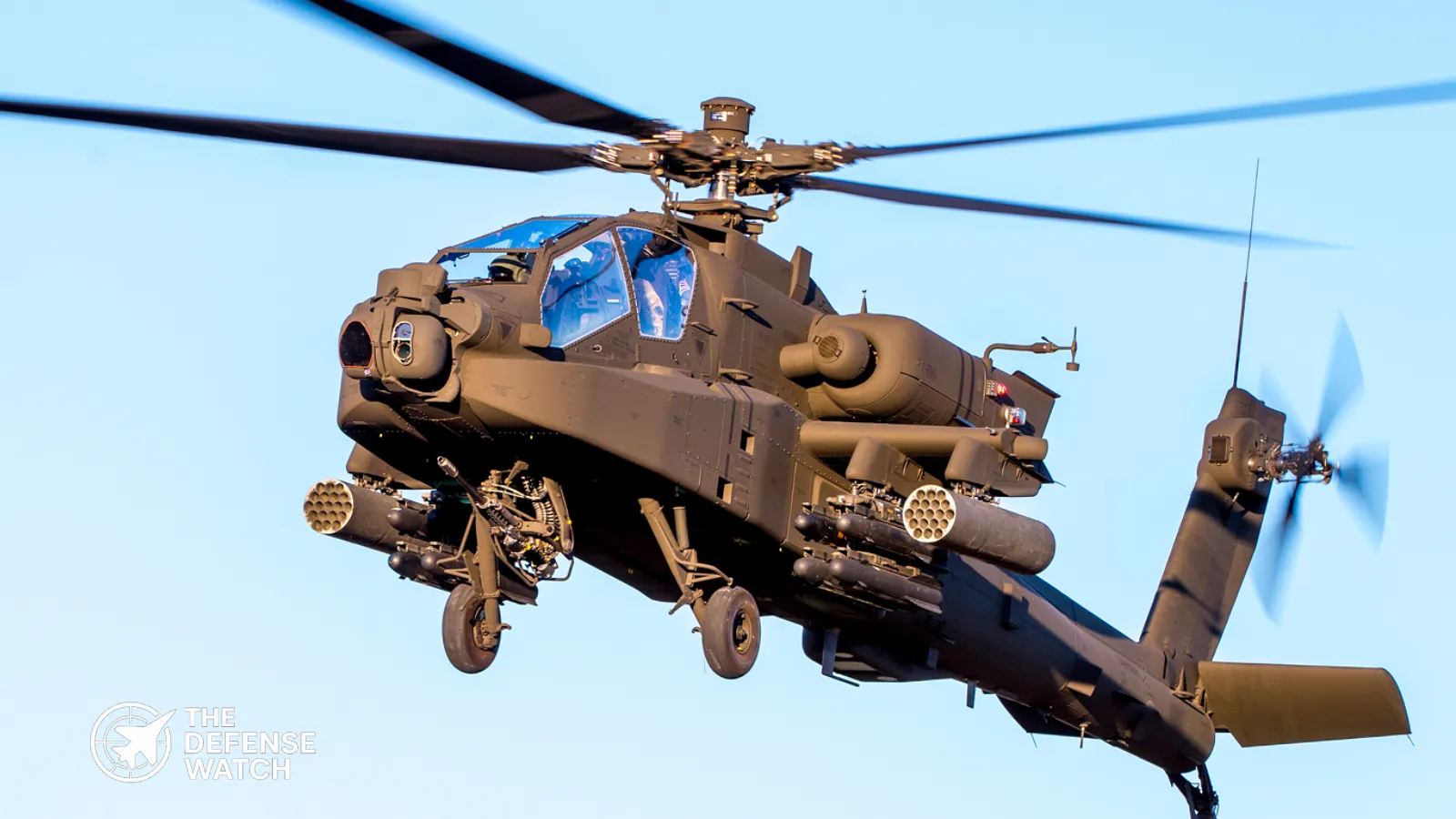
- 30mm M230 Chain Gun: Mounted under the fuselage, capable of engaging infantry, vehicles, and fortified positions.
- AGM-114 Hellfire Missiles: The Apache’s primary anti-armor weapon, used extensively in Iraq, Afghanistan, and other theaters.
- Hydra 70 Rocket Pods: Unguided and guided variants for area suppression and precision strike.
- Air-to-Air Missiles: Such as Stinger, for self-defense against aerial threats.
This combination allows the Apache fighter helicopter to conduct close air support, deep attack missions, armed reconnaissance, and escort operations.

Combat Experience: From Desert Storm to Today
The Apache helicopter’s combat debut during Operation Desert Storm in 1991 cemented its reputation. Apache helicopters were among the first aircraft to strike Iraqi targets, neutralizing radar sites and opening corridors for coalition airpower.
Since then, Apaches have seen extensive combat use in:
- Iraq and Afghanistan
- Syria and counter-ISIS operations
- Peacekeeping and deterrence missions worldwide
U.S. Army operational assessments consistently highlight the Apache’s ability to operate in high-threat environments while maintaining a high mission-capable rate. According to publicly available U.S. Army aviation briefings (external source: U.S. Army Aviation Center), Apache units remain central to ground maneuver operations.
Apache Helicopter Price and Global Market
The apache helicopter price varies significantly depending on configuration, support packages, and modernization level. While exact figures depend on contracts, defense analysts estimate that a new-build Apache can exceed $35–40 million per unit, with lifetime costs rising considerably once training, spares, and sustainment are included.
International Operators
Beyond the United States, the Apache attack helicopter has been exported to numerous allied nations, including:
- United Kingdom
- India
- Japan
- South Korea
- Saudi Arabia
- Netherlands
For many countries, the Apache represents a high-end capability aimed at deterring armored threats and enhancing joint operations with U.S. and NATO forces.
(adsbygoogle = window.adsbygoogle || []).push({});AH-64E Guardian: The Latest Evolution
While the AH-64D remains influential, the U.S. Army has largely transitioned to the AH-64E Guardian, an upgraded variant featuring:
- More powerful engines
- Improved composite rotor blades
- Enhanced networking with drones and ground forces
- Better maritime strike capability
The AH-64E reflects the shift toward multi-domain operations, where attack helicopters act as sensor and shooter nodes within a broader combat network.
Survivability and Battlefield Integration
One reason the Apache helicopter remains relevant is its emphasis on survivability. The aircraft incorporates:
- Armored crew compartments
- Redundant flight and weapons systems
- Infrared suppression and countermeasures
- Advanced electronic warfare suites
In modern conflicts, Apache crews increasingly operate alongside unmanned aerial systems (UAS), using drones to scout ahead and relay targeting data. This manned-unmanned teaming concept is a key pillar of U.S. Army aviation modernization.
Strategic Analysis: Why the Apache Still Matters
Despite the rise of drones and precision missiles, the Apache attack helicopter continues to offer unique advantages. Its ability to loiter, adapt to changing battlefield conditions, and directly support ground forces gives it a flexibility that fixed-wing aircraft and unmanned systems often lack.
From a strategic perspective, the Apache’s continued upgrades signal that the U.S. Army views attack helicopters as essential in both conventional warfare and hybrid conflicts. For allies, acquiring Apache helicopters also strengthens interoperability with U.S. forces, reinforcing coalition operations.
(adsbygoogle = window.adsbygoogle || []).push({});Future Outlook: Modernization Beyond 2030
The U.S. Army plans to keep the Apache in service well into the 2040s, even as it explores next-generation platforms under the Future Vertical Lift (FVL) program. Rather than replacing the Apache outright, current plans emphasize incremental upgrades, ensuring the aircraft remains lethal and survivable against evolving threats.
FAQs
What is the main role of the Apache helicopter?The Apache helicopter is designed for attack missions, including anti-armor warfare, close air support, and armed reconnaissance.
How much does an Apache helicopter cost?The apache helicopter price typically ranges above $35 million per unit, depending on configuration and support packages.
What is the difference between AH-64D and AH-64E?The AH-64E features stronger engines, better networking, and improved performance compared to the AH-64D.
Which countries operate the Apache attack helicopter?The U.S., UK, India, Japan, South Korea, and several NATO allies operate Apache helicopters.
Is the Apache still relevant in modern warfare?Yes. Continuous upgrades keep the Apache effective against modern threats and integrated into network-centric warfare.