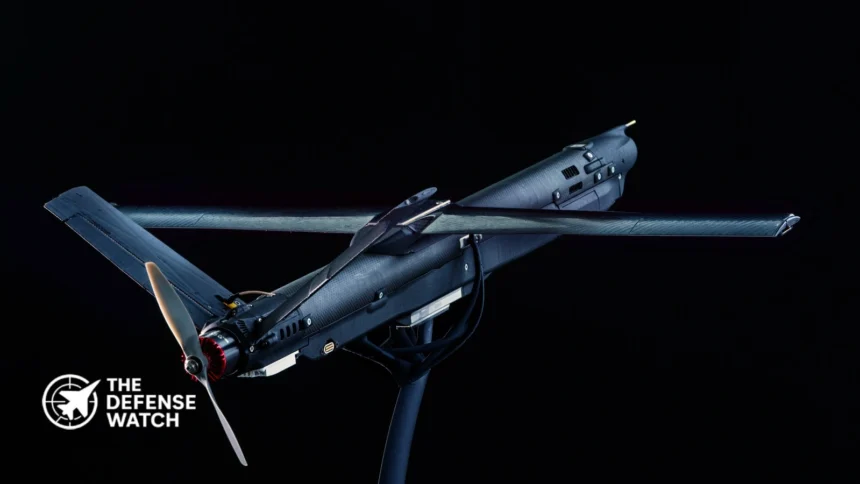
Swedish defense technology company Nordic Air Defence is preparing to send its K200 drone interceptor to Ukraine for trials, adding another European-developed system to Kyiv’s efforts to counter Russia’s expanding use of unmanned attack aircraft.
The reported move comes as Ukraine seeks affordable ways to intercept increasingly capable Russian drones, particularly jet-powered variants that challenge conventional low-cost interceptor systems.
FlightGlobal reported the planned Ukrainian trials in November 2026. The report places the K200 among the latest European counter-unmanned aircraft systems being considered for evaluation in a conflict where battlefield experience is increasingly influencing drone development.
The company has not publicly disclosed a detailed Ukrainian testing schedule, the number of systems involved, or the conditions under which the K200 will be evaluated.
K200 Was Developed Around the Russian Drone Threat
Nordic Air Defence says it developed the K200 in 70 days in response to a customer requirement covering Russian Geran and Shahed-type threats, including the Geran-4.
The company describes the K200 as part of its Kreuger interceptor platform, which combines interceptor aircraft, launch systems, onboard software and sensing technologies.
Its development approach relies on adapting an existing technological foundation rather than designing an entirely new system for every operational requirement.
That approach could be relevant to Ukraine, where the characteristics of incoming drones continue to change and defensive systems must be adapted without lengthy development cycles.
However, the company’s published information does not establish the K200’s independently verified interception performance against Geran-4 or other jet-powered targets. Nordic Air Defence also states that engagement performance must be established through testing and validation.
Why Ukraine Needs Faster Interceptors
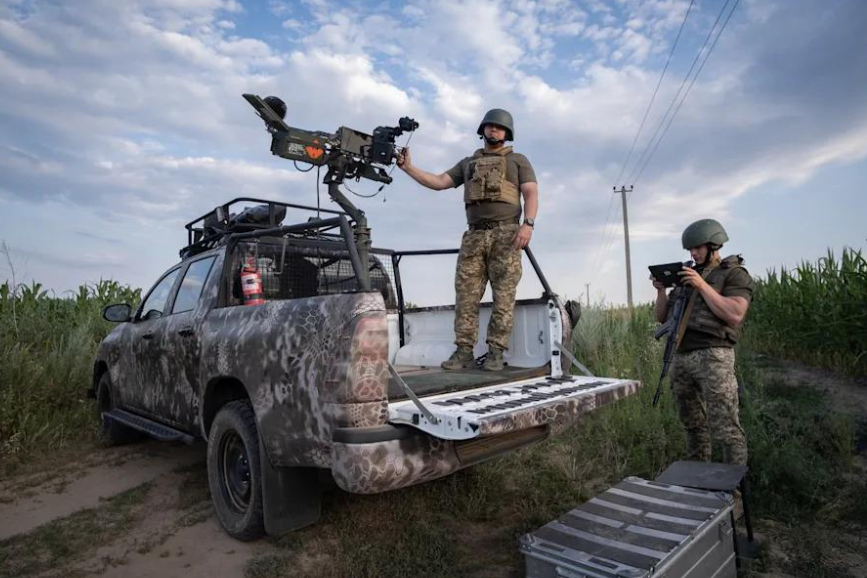
Ukraine’s demand for new interceptor systems is closely linked to Russia’s expanding use of faster attack drones.
In a September 2026 investigation, Reuters reported that Russian launches of jet-powered drones travelling between 240 and 500 kilometers per hour increased from approximately 450 in June to 2,850 in August, based on Ukrainian military data reviewed by the news agency.
Ukraine’s earlier counter-drone approach relied heavily on relatively inexpensive interceptor aircraft, which proved effective against slower propeller-driven Shahed-type drones.
Reuters reported that these systems had achieved interception rates of around 90% against earlier threats. However, their effectiveness has been challenged by faster jet-powered aircraft.
The problem is not simply speed. Some newer Russian drones can change altitude and flight paths under operator control, while certain models reportedly use onboard systems to detect approaching objects and accelerate.
These changes reduce the time available for Ukrainian air-defense crews to detect, identify and engage incoming targets.
Ukraine therefore needs interceptor systems that combine sufficient speed, reliable guidance and affordable production.
Nordic Air Defence’s Kreuger Platform
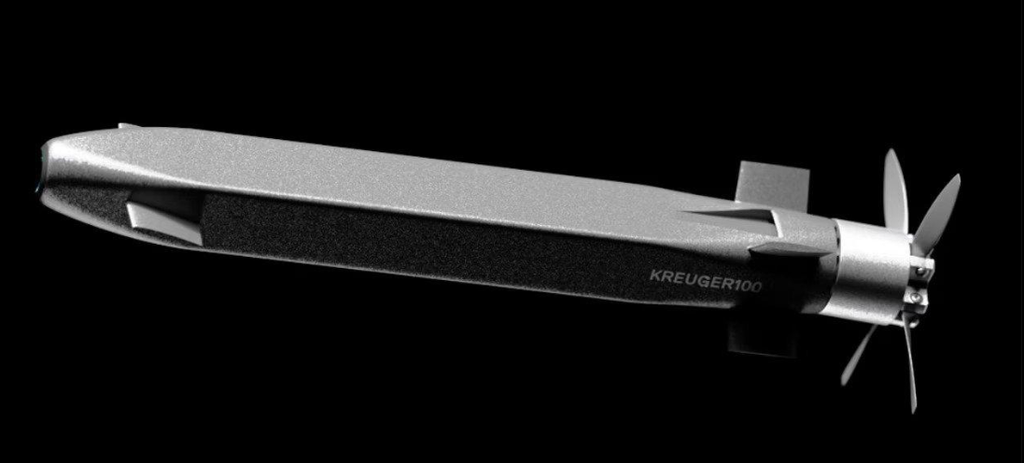
The K200 belongs to Nordic Air Defence’s broader Kreuger family of interceptor systems.
The company describes its platform as a modular architecture covering several elements:
- Interceptors: The K100 and K200 are identified as lightweight electric interceptor systems.
- Launch equipment: Modular launchers are intended for mobile platforms and fixed defensive positions.
- Autonomy: Shared onboard software supports perception, flight control and guidance.
- Mission control: An operator and integration layer is intended to connect interceptors with existing sensors and command systems.
- Seeker technology: Nordic Air Defence is developing its own semi-active laser seeker for the Kreuger platform.
The company’s product information also identifies the Striker launcher as a shared system for K100, K200 and K300 interceptors.
This modular design could allow the company to adapt different interceptor configurations to different operational requirements without rebuilding the entire system.
However, the presence of these technologies within the wider Kreuger platform should not be interpreted as confirmation that every component is installed on the K200 configuration being prepared for Ukrainian trials.
Testing Will Determine Its Operational Value
The Ukrainian evaluation could provide important evidence about whether the K200 can operate effectively against the threats it was designed to address.
Several factors will determine its potential usefulness.
Interception performance: The system will need to demonstrate that it can detect, pursue and engage relevant aerial targets under realistic operating conditions.
Guidance and control: Reliable flight control is essential when intercepting faster drones, particularly when engagement opportunities are limited.
Electronic warfare resistance: Operations in Ukraine require counter-drone systems to function in an environment where electronic warfare can disrupt navigation, communications and control links.
Deployment and logistics: A useful interceptor must be practical to transport, launch, maintain and operate near threatened locations.
Cost and production: Ukraine needs systems that can be manufactured and supplied in sufficient quantities without placing excessive pressure on limited air-defense budgets.
Public information does not yet establish how the K200 performs against these requirements.
A Competitive Market for European Counter-Drone Systems
Nordic Air Defence is entering a growing European market for affordable interceptor technology.
The war in Ukraine has demonstrated the economic challenge of using expensive surface-to-air missiles against large numbers of relatively inexpensive unmanned aircraft.
European manufacturers are increasingly exploring smaller interceptors, guided weapons and integrated counter-UAS architectures to address this problem.
The International Institute for Strategic Studies previously identified Nordic Air Defence’s K100 alongside other emerging European interceptor projects, including Estonia’s Tytan Technologies interceptor and Frankenburg Technologies’ Mk 1 missile.
These systems reflect different approaches to reducing the cost of defeating unmanned aerial threats.
The K200’s development for a customer requirement involving Geran and Shahed threats gives it a more specific development context. Its eventual value, however, will depend on demonstrated performance rather than the intended target list.
Production Capacity and Future Deliveries
Beyond technical performance, production will be an important consideration if the K200 progresses through Ukrainian trials.
Nordic Air Defence says its manufacturing operations are based in Sweden, with engineering and final assembly conducted close together.
The company has also published an internal production target of 1,000 interceptors per month by March 2027. This is a company target, not evidence that this production rate has already been achieved or that the output will consist entirely of K200 systems.
The distinction matters because Ukraine’s air-defense requirements extend beyond developing a capable prototype. The country needs systems that can be manufactured consistently, delivered in meaningful quantities and supported by trained operators.
A successful evaluation would provide a basis for further decisions, but it would not automatically establish a procurement commitment or operational deployment.
For Nordic Air Defence, Ukrainian trials could provide valuable feedback on a system developed around the changing characteristics of Russian attack drones. For Ukraine, the immediate priority remains finding affordable interceptors capable of dealing with both conventional and faster jet-powered threats.
The K200’s operational contribution will become clearer only when its testing results and deployment arrangements are publicly established.
Enjoying our coverage?
Make The Defense Watch a preferred source on Google to see more of our geopolitical and defense insights when relevant to you.