
- Home
- Defense Systems
- Bombers & Strategic Aircraft
- F-104 Starfighter
F-104 Starfighter
Defense Systems Full Specifications
1. General Information
| Name | F-104 Starfighter |
| Manufacturer | Lockheed Corporation |
| Country of Origin | United States |
| Introduction / In Service Since | 1958 |
| Status | Retired from military service |
| Category | Supersonic interceptor / fighter-bomber |
| Crew | 1 (2 in trainer variants) |
| Unit Cost | Historical prices varied by variant and contract; no single comparable price |
2. Dimensions & Structure
| Length | 54 ft 8 in (16.66 m) |
| Wingspan | 21 ft 9 in (6.63 m) |
| Height | 13 ft 6 in (4.11 m) |
| Wing Area | 196.1 sq ft (18.22 m²) |
| Empty Weight | 14,000 lb (6,350 kg) |
| Maximum Takeoff Weight (MTOW) | 29,027 lb (13,170 kg) |
3. Performance
| Maximum Speed | Approximately Mach 2.0 to 2.2 |
| Range | 1,630 miles (ferry range) |
| Combat Radius | Approximately 420 miles |
| Service Ceiling | Approximately 50,000 ft |
| Rate of Climb | Approximately 48,000 ft/min |
4. Powerplant
| Engine Type | 1 × General Electric J79-GE-11A |
| Thrust (per engine) | Approximately 15,600 lbf with afterburner |
| Total Thrust | Approximately 15,600 lbf with afterburner |
5. Payload & Armament
| Internal Payload Capacity | No dedicated internal weapons payload |
| Weapons Bay | None |
| Compatible Weapons | AIM-9 Sidewinder, M61 Vulcan cannon, conventional bombs, rockets, nuclear weapons (variant and mission dependent) |
| Hardpoints | 7 external stations on F-104G |
6. Avionics & Systems
| Radar System | NASARR radar (F-104G configuration) |
| Navigation | Conventional radio navigation and onboard navigation instruments |
| Electronic Warfare (EW) | Variant-dependent radar warning and defensive equipment |
| Stealth Features | None |
7. Operational History
| Primary Operator | NASARR radar (F-104G configuration) |
| Conflict Usage | Conventional radio navigation and onboard navigation instruments |
| Notable Missions | Variant-dependent radar warning and defensive equipment |
8. Additional Information
| Variants | United States Air Force |
| Successor / Future Replacement | Germany, Italy, Canada, Japan, Belgium, Netherlands, Turkey, Pakistan and others |
| Notable Features | Vietnam War, Indo-Pakistani conflicts, regional air operations |
| Estimated Operational Life | USAF operations in Vietnam, NATO air defense, high-altitude interception and fighter-bomber missions |
PROS
- Mach 2 supersonic performance for rapid interception.
- High rate of climb and strong high-altitude performance.
- Compact airframe with a relatively low-drag design.
- M61 Vulcan cannon and Sidewinder missile compatibility.
- Adaptable platform with interceptor, fighter-bomber, and reconnaissance-related applications across variants.
CONS
- Limited internal fuel capacity and endurance.
- Short wings provide limited low-speed handling margins.
- High landing speeds and demanding flight characteristics.
- Limited payload compared with larger multirole fighters.
- Historically associated with significant accident rates in several operator air forces.
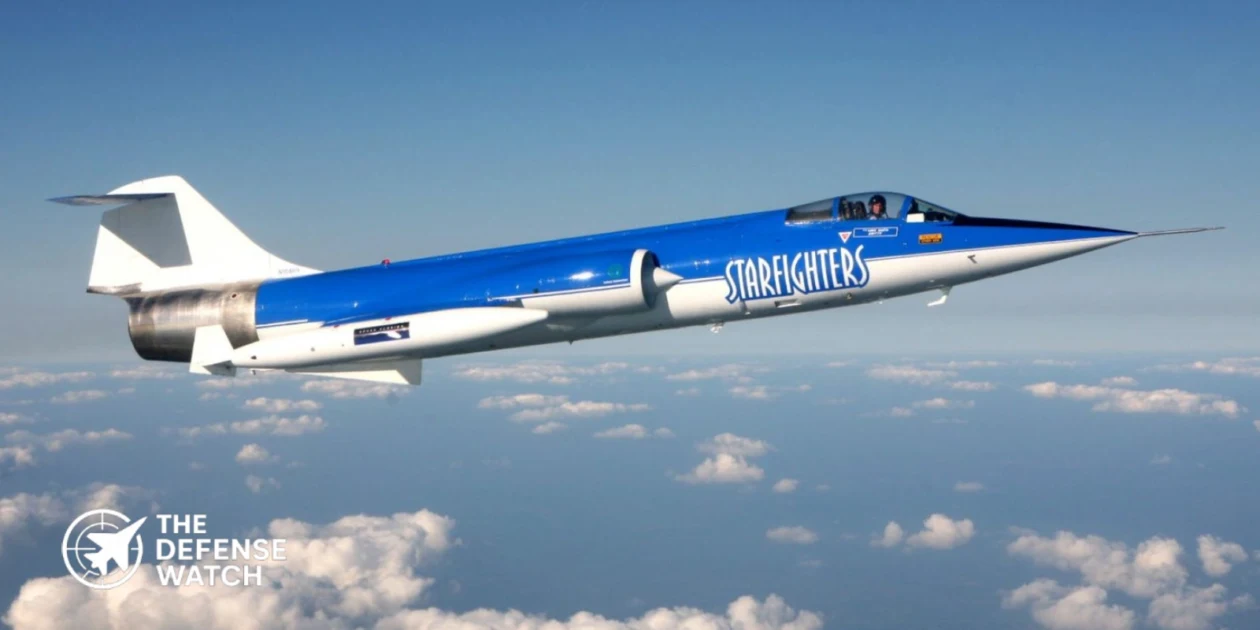
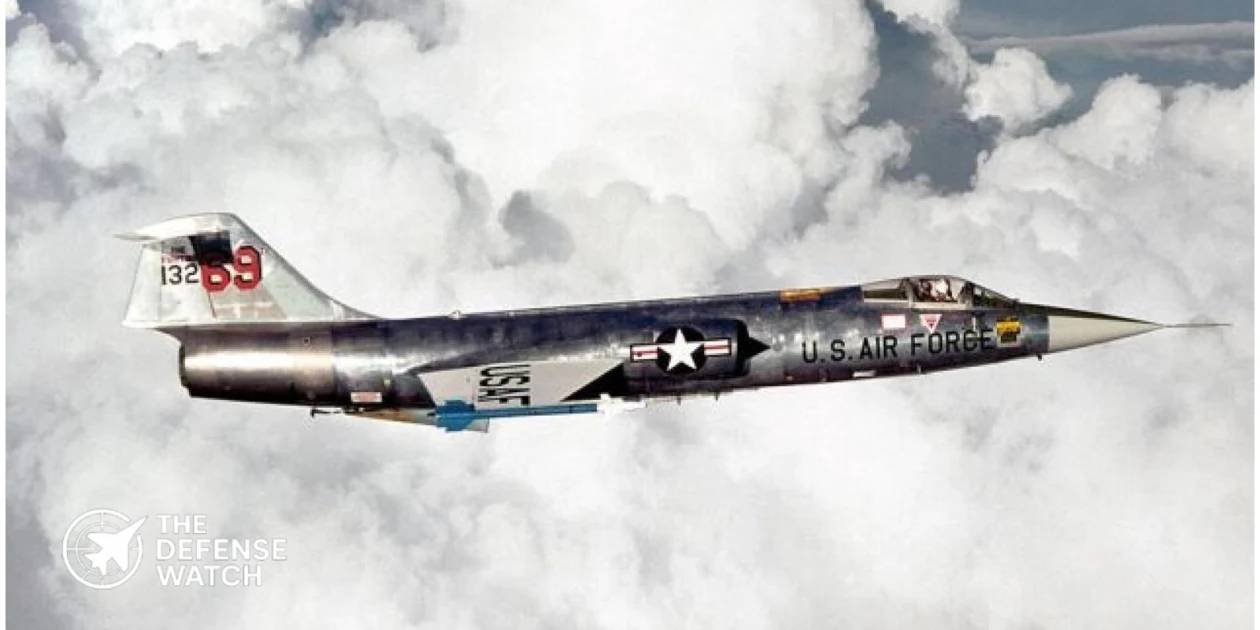
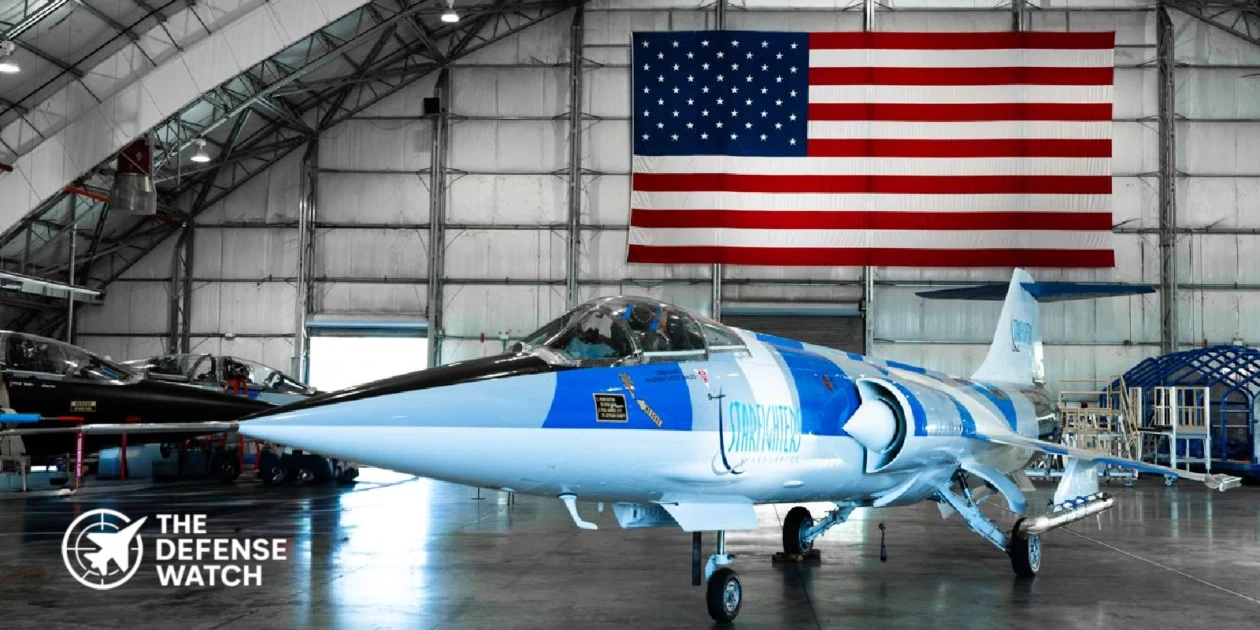
The F-104 Starfighter was a supersonic interceptor developed during the Cold War to provide high-speed air defense against enemy bombers. Known as the Missile with a Man in It, the aircraft featured an exceptionally slim fuselage, short razor-thin wings, and a powerful turbojet engine. Its aerodynamic design prioritized speed and climb performance over maneuverability and extended range.
The Starfighter could exceed Mach 2, making it one of the fastest operational fighters of its generation. Depending on the variant, it carried an internal 20mm M61 Vulcan cannon, air-to-air missiles, and external fuel tanks or other stores. It served with several NATO air forces and other international operators.
Manufacturer
The F-104 was developed by Lockheed Corporation in the United States under the leadership of aircraft designer Clarence L. Johnson. Its first flight took place on March 4, 1954, and the U.S. Air Force introduced it into service in 1958. The aircraft was originally designed as a lightweight, high-performance interceptor. Later variants, including the F-104G, were adapted for ground attack and multirole missions.
Speed and Range
Powered by a General Electric J79 afterburning turbojet, the F-104 achieved a maximum speed of approximately 1,320 knots (Mach 2.0). Its operational range varied considerably with mission profile, external fuel tanks, and aircraft configuration. The F-104 was optimized for high-speed interception rather than long-duration patrols. Its service ceiling was approximately 50,000 feet.
Cost / Price
The F-104 does not have a single standardized acquisition price because production costs varied by variant, country, production period, and licensing arrangements. Historical unit prices are not directly comparable with modern fighter procurement costs. Today, surviving aircraft are primarily museum exhibits, privately maintained historic aircraft, or research and demonstration platforms rather than operational military fighters.
Disclaimer Note
The information provided on TheDefenseWatch.com is for general informational purposes only. While we strive to ensure the accuracy, completeness, and timeliness of our content regarding defense and aerospace products, technologies, and specifications, we cannot guarantee that all information is 100% accurate or up-to-date due to the evolving nature of military technology and classified data.TheDefenseWatch.com does not warrant the reliability, suitability, or availability of the information for any specific purpose. Users are advised to consult official sources, such as manufacturers, government publications, or defense agencies, for precise and verified data before making decisions based on our content.We are not affiliated with any defense manufacturers, governments, or military organizations mentioned. Opinions, reviews, and ratings reflect expert analysis but are subjective and should not be considered endorsements. TheDefenseWatch.com is not responsible for any errors, omissions, or consequences arising from the use of this website’s content.External links are provided for convenience and do not imply endorsement. TheDefenseWatch.com reserves the right to update or modify content without prior notice. By using this website, you agree to our Privacy & Cookies Policy.
More Defense Systems from US Defense Prime Contractor


New Arrivals











Popular Comparisons
-
 J-10C vs JF-17 Thunder: Which Fighter Is More Capable?
View Comparison →
-
Tejas vs Gripen: Key Differences and Capabilities
View Comparison →
-
Tejas vs MiG-21 Bison: How India Replaced Its Iconic Supersonic Fighter
View Comparison →
-
F-35 vs F-16: Stealth, Sensors and Combat Roles
View Comparison →
-
Tejas Fighter Jet vs F-16 Fighting Falcon: Capability Compared
View Comparison →
-
Rafale Fighter Jet vs F-16 Fighting Falcon : Which Fighter Has the Edge?
View Comparison →
-
Su-57 Fighter Jet vs J-20 Fighter Jet: Stealth and Air Combat Compared
View Comparison →
-
Mirage 2000 vs Tejas Mk1A: Legacy Combat Power vs Indigenous Modernization
View Comparison →
-
Rafale Fighter Jet vs F-22 Raptor: Which Air Dominance Fighter Has the Edge?
View Comparison →
-
Tejas Fighter Jet vs. Rafale Fighter Jet: India’s Indigenous Fighter Meets France’s Proven Multirole Combat Aircraft
View Comparison →


- Starfighters Aerospace Repurposes F-104 Starfighters for High-Speed Flight Research

- New York Air Guard Deploys Five Ski-Equipped LC-130s for Antarctic Operation Deep Freeze
- Pentagon Reports Audit Progress as 2028 Clean Financial Audit Deadline Approaches
- 1th Airborne Division Tests 3,000-Mile Pacific Deployment From Alaska to Hawaii
- Australia Receives New MH-60R Seahawk Helicopters as Naval Fleet Modernization Continues
- Italy Plans More Than €6 Billion for Hybrid Threat Defense
- Boeing B-1B LAM Pylon Clears Design Review, Advancing Hypersonic Weapons Integration
- Pakistan, Türkiye Explore Deeper Air Force Cooperation in Drones and Electronic Warfare
- Meta Muse AI Agent Faces Privacy Concerns After Reports of Unauthorized Data Access
- Trump Nominates Christopher LaNeve for Permanent U.S. Army Chief of Staff





Fighter Jets
-
 F-15J Eagle Fighter Jet
-
F-15EX Eagle Fighter Jet
-
F-47A Fighter Jet
-
F-100 Super Sabre
-
North American F-86 Sabre
-
Northrop YF-23 Fighter
-
Rafale F5 Fighter
-
SU-57 Felon Stealth Fighter
-
Boeing F/A-XX Fighter
-
JF-17 Thunder Fighter Jet
-
F-47 Fighter Jet
-
MIG-31 Fighter Jet
-
J-10CE Fighter Jet
-
Chengdu J-10 Fighter Jet
-
Chengdu J-10C Fighter Jet
-
Gripen E Fighter Jet
-
Tejas Mk1A Fighter Jet
-
Tejas Mk‑2 Fighter Jet
-
F-16V Viper Block 70 Fighter Jet
-
F-15EX Eagle II Fighter
-
F-15E Strike Eagle Fighter
-
F/A-18E/F Super Hornet Fighter Jet
-
Saab Gripen F Fighter Jet
-
JAS 39E/F Gripen Fighter Jet












Recent Compares
-
J-10C vs JF-17 Thunder: Which Fighter Is More Capable?
View Comparison →
-
Tejas vs Gripen: Key Differences and Capabilities
View Comparison →
-
Tejas vs MiG-21 Bison: How India Replaced Its Iconic Supersonic Fighter
View Comparison →
-
F-35 vs F-16: Stealth, Sensors and Combat Roles
View Comparison →
-
Tejas Fighter Jet vs F-16 Fighting Falcon: Capability Compared
View Comparison →
Latest Defense Systems
10 Compares Defense Systems
-
J-10C vs JF-17 Thunder: Which Fighter Is More Capable?
View Comparison →
-
Tejas vs Gripen: Key Differences and Capabilities
View Comparison →
-
Tejas vs MiG-21 Bison: How India Replaced Its Iconic Supersonic Fighter
View Comparison →
-
F-35 vs F-16: Stealth, Sensors and Combat Roles
View Comparison →
-
Tejas Fighter Jet vs F-16 Fighting Falcon: Capability Compared
View Comparison →
-
Rafale Fighter Jet vs F-16 Fighting Falcon : Which Fighter Has the Edge?
View Comparison →
-
Su-57 Fighter Jet vs J-20 Fighter Jet: Stealth and Air Combat Compared
View Comparison →
-
Mirage 2000 vs Tejas Mk1A: Legacy Combat Power vs Indigenous Modernization
View Comparison →
-
Rafale Fighter Jet vs F-22 Raptor: Which Air Dominance Fighter Has the Edge?
View Comparison →
-
Tejas Fighter Jet vs. Rafale Fighter Jet: India’s Indigenous Fighter Meets France’s Proven Multirole Combat Aircraft
View Comparison →
- Starfighters Aerospace Repurposes F-104 Starfighters for High-Speed Flight Research
- New York Air Guard Deploys Five Ski-Equipped LC-130s for Antarctic Operation Deep Freeze
- Pentagon Reports Audit Progress as 2028 Clean Financial Audit Deadline Approaches
- 1th Airborne Division Tests 3,000-Mile Pacific Deployment From Alaska to Hawaii
- Australia Receives New MH-60R Seahawk Helicopters as Naval Fleet Modernization Continues