Swedish defense company Saab has signed a licensing agreement with Polish ammunition manufacturer Dezamet to establish domestic production and sales of MAPAM mortar ammunition in Poland. The agreement transfers manufacturing technology to a Polish defense company and fulfills the first industrial cooperation commitment associated with Poland’s ORKA submarine procurement program.
Announced on November 20, 2026, the agreement brings Saab Bofors Dynamics Switzerland’s mortar ammunition technology into Poland’s domestic defense manufacturing sector. Dezamet is part of Polska Grupa Zbrojeniowa (PGZ), Poland’s state-owned defense industrial group.
The agreement also moves an earlier industrial partnership between Saab and Dezamet beyond the preliminary cooperation stage and into licensed production.
Claudio Penna, Managing Director of Saab Switzerland, said the companies now need to secure orders to advance the program to its next stage.
MAPAM Ammunition Production Moves to Poland
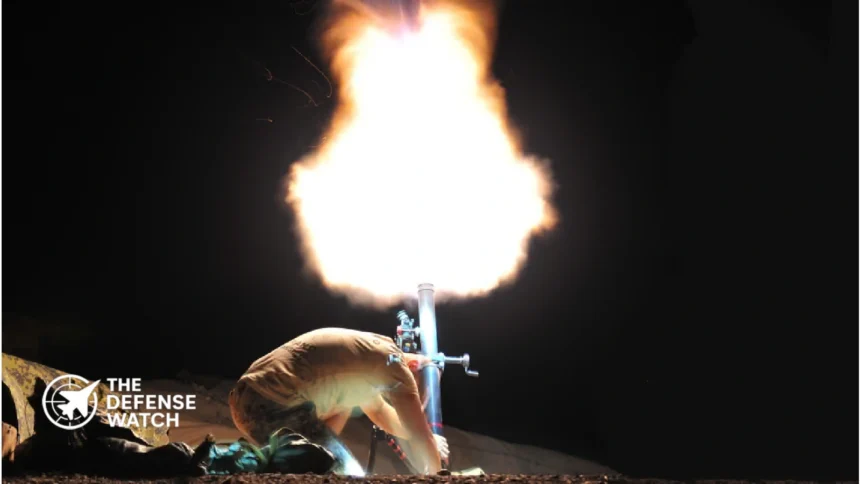
MAPAM, short for Mortar Anti-Personnel Anti-Material, is a family of mortar ammunition developed by Saab Bofors Dynamics Switzerland.
Saab’s published product information identifies two MAPAM variants, 60 mm and 81 mm. The ammunition is designed to provide fragmentation effects against personnel and material targets.
The manufacturer describes MAPAM as offering improved effectiveness compared with conventional mortar ammunition. Saab also highlights its prefragmented warhead technology and insensitive munition characteristics, which are intended to improve handling and storage safety.
According to Saab, the 60 mm variant is intended for close-range infantry support, while the 81 mm version provides a wider engagement zone.
However, the November licensing announcement does not identify which MAPAM calibres Dezamet will initially manufacture. It also does not disclose production volumes, manufacturing capacity, investment requirements, or the expected start of deliveries.
These details will be important in determining how quickly the agreement can translate into a practical increase in Poland’s domestic ammunition supply. Saab
Why the Agreement Matters to Poland’s ORKA Program
The licensing arrangement is linked to Poland’s decision to select Saab for its ORKA submarine program.
On June 29, 2026, Saab signed a contract with Poland’s State Treasury Armaments Agency for the production and delivery of three A26 submarines. The order, valued at approximately SEK 47 billion, also includes a weapons package and training and support arrangements. Final submarine deliveries are scheduled through 2038.
The submarine procurement extends beyond the acquisition of naval platforms. Poland has also sought industrial participation, technology transfers and domestic capabilities that can support its armed forces over the long term.
The MAPAM licensing agreement is the first delivered industrial cooperation and technology transfer commitment identified by Saab under the associated package.
This distinction is important. The mortar ammunition agreement is not part of the submarines’ onboard weapons configuration. Instead, it is a separate defense-industrial arrangement connected to the broader industrial commitments accompanying the ORKA procurement.
For Poland, this approach offers an opportunity to obtain manufacturing knowledge in an additional ammunition category while building a wider industrial relationship with Swedish defense companies.
Dezamet’s Role in Expanding Domestic Ammunition Manufacturing
Dezamet is an established Polish ammunition manufacturer operating within the PGZ Group. Its participation gives Saab an existing industrial partner rather than requiring the creation of an entirely new manufacturing organization.
The company already produces mortar ammunition for the Polish armed forces. In December 2025, Dezamet signed a contract with Poland’s Armament Agency to supply several tens of thousands of 60 mm mortar rounds. The contract demonstrates its existing role in the country’s domestic mortar ammunition supply chain.
Licensed MAPAM production would add a different technology and product family to this industrial base.
The arrangement could provide several benefits:
- Domestic manufacturing: Production in Poland could strengthen local access to another category of mortar ammunition.
- Technology transfer: Dezamet gains access to Saab’s ammunition manufacturing expertise under the licensing arrangement.
- Industrial development: The cooperation could support additional technical skills and manufacturing capabilities within the PGZ Group.
- Supply-chain resilience: Local production could give Polish defense planners another source of ammunition supply, subject to production capacity and procurement orders.
However, a licensing agreement does not automatically establish large-scale production. Actual output will depend on subsequent orders, manufacturing preparations, technology transfer arrangements and the availability of production inputs.
Saab’s Wider Industrial Partnership With Poland
The MAPAM agreement follows several steps in the expansion of Saab’s industrial relationship with Poland.
In October 2025, Saab and Dezamet signed an initial memorandum of understanding covering potential cooperation in the production and sale of selected Saab Bofors Dynamics Switzerland products in Poland, including mortar ammunition. The November 2026 licensing agreement advances that relationship into a more concrete production framework.
Saab also signed additional cooperation agreements with PGZ in March 2026, covering potential Polish capabilities for submarine maintenance, repair and overhaul under ORKA.
In May 2026, Saab and PGZ established a broader strategic naval cooperation framework. Areas included submarine and surface-vessel support, Polish industrial participation in Saab’s supply chain, and potential cooperation on underwater technologies.
These agreements form part of a wider Swedish-Polish defense industrial relationship.
For Saab, working with Polish manufacturers creates opportunities to establish local industrial support and strengthen cooperation with a NATO member on the Baltic Sea. For PGZ, partnerships with foreign defense companies can provide access to technologies and manufacturing expertise that complement existing national capabilities.
Production Orders Remain the Next Milestone
Despite the signing of the licensing agreement, several important details remain undisclosed.
Saab has not announced a confirmed production order for MAPAM ammunition under the arrangement. The companies have also not published a manufacturing schedule, expected annual output, investment value or delivery commitments.
Penna’s comments indicate that securing orders is the next requirement before the program can progress further.
The distinction between technology transfer and operational production will therefore be important. The agreement establishes a framework for licensed manufacturing, but the scale of its contribution to Poland’s ammunition supply will depend on the commercial and procurement decisions that follow.
For Poland, the immediate significance lies in expanding the range of ammunition technologies that can potentially be manufactured domestically. The longer-term industrial value will depend on whether the Saab-Dezamet partnership develops into sustained production and additional cooperation.
Enjoying our coverage?
Make The Defense Watch a preferred source on Google to see more of our geopolitical and defense insights when relevant to you.