




























@2026 – All Right Reserved. TheDefenseWatch.com
- Home
- Defense Systems
- Bombs & Aerial Munitions
- GBU-72 Bunker Buster Bomb
GBU-72 Bunker Buster Bomb


Defense Systems Full Specifications
1. General Information
| Name / Designation | GBU-72 Advanced 5K Penetrator |
| Type | Precision Guided Penetrator Bomb |
| Manufacturer | Northrop Grumman |
| Country of Origin | United States |
| Year Introduced | Late 2010s |
| Operational Status | Operational / Limited Deployment |
2. Physical Characteristics
| Weight | Approximately 5,000 lb class |
| Length | Estimated over 4 m |
| Diameter | Approx. 16 to 18 inches |
| Casing Type | Hardened steel penetrator casing |
3. Performance
| Yield | Conventional high explosive |
| Guidance | GPS aided INS |
| Accuracy (CEP) | High precision, exact figures classified |
| Delivery Platforms | F-15E, F-35, strategic aircraft |
| Penetration Capability | Deep hardened structure penetration |
4. Warhead / Explosive Details
| Warhead Type | High Explosive Penetrator |
| Fuzing Options | Delayed impact fuze |
| Explosive Composition | Classified |
5. Operational Use
| Primary Mission | Destruction of underground and fortified targets |
| Operators | United States Air Force |
| Notable Deployments / History | Developed for modern bunker defeat missions |
6. Variants
| Variants | GBU-72 integrated with BLU-137 warhead |
PROS
- High penetration capability against hardened underground targets
- Precision guidance improves strike accuracy
- Compatible with modern stealth aircraft
- Effective in all weather operational conditions
- Designed for strategic deep strike missions
CONS
- High production and procurement cost
- Limited public operational combat history
- Requires advanced aircraft integration
- Heavy weight limits aircraft loadout flexibility
- Primarily optimized for hardened targets only
GBU-72 Advanced Penetrator Bomb
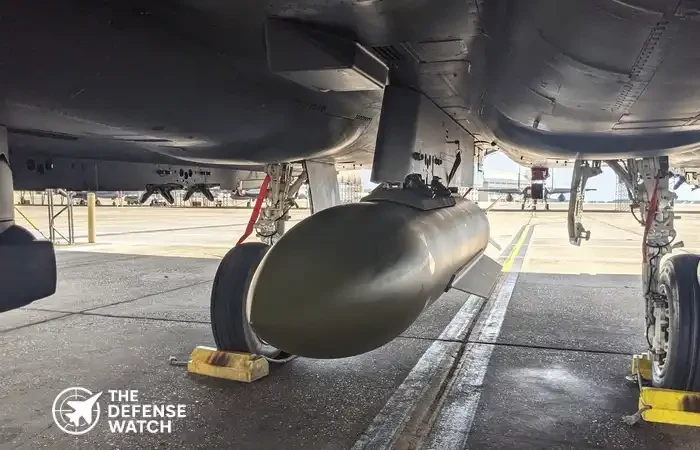
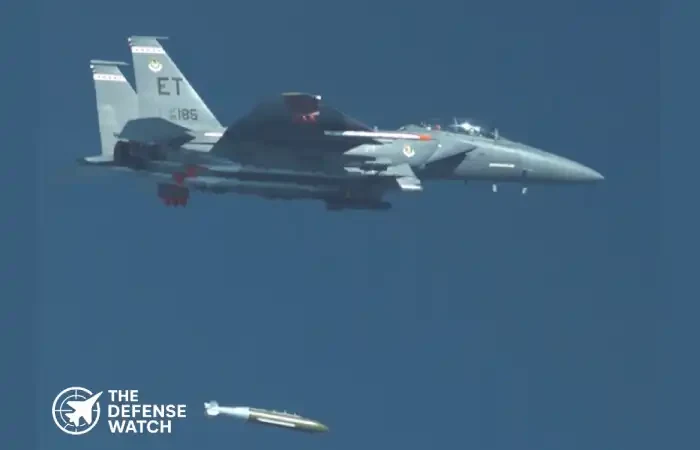
The GBU-72 Advanced 5K Penetrator is a next generation U.S. precision guided bunker buster bomb developed to destroy hardened and deeply buried targets. Designed for modern high intensity warfare, the weapon provides improved penetration capability over older systems such as the GBU-28. The bomb is intended for use against fortified underground facilities, command bunkers, weapon storage sites, and protected infrastructure.
The GBU-72 combines a heavy penetrating warhead with precision guidance technology, allowing U.S. and allied air forces to strike hardened targets with greater accuracy and survivability. The weapon is compatible with several advanced combat aircraft, including stealth platforms capable of penetrating contested airspace.
Manufacturer
The GBU-72 was developed primarily by Northrop Grumman for the United States Air Force. The bomb integrates a BLU-137 penetrating warhead and advanced guidance systems designed to improve accuracy during high speed delivery missions.
The United States accelerated development of the bomb to address evolving underground threats and heavily fortified military infrastructure. Testing has included deployment from aircraft such as the F-15E Strike Eagle and evaluations for compatibility with the F-35 Lightning II.
Speed and Range
The GBU-72 itself is an air dropped gravity bomb and does not possess independent propulsion. Its operational range depends on the launch altitude, speed, and delivery platform. When released from high altitude fighter aircraft, the weapon can travel significant stand off distances using guidance fins and glide characteristics.
The bomb uses a GPS aided inertial navigation guidance system, enabling accurate strikes in all weather conditions. Its penetrating warhead is engineered to defeat reinforced concrete and underground facilities before detonation.
Cost/Price
Exact unit pricing for the GBU-72 remains classified. However, defense analysts estimate the cost of each bomb and associated guidance kit to be several hundred thousand U.S. dollars depending on configuration, procurement volume, and integration requirements. Development and testing programs have involved multi million dollar contracts awarded by the U.S. Department of Defense.
FAQs
What is the GBU-72 bomb used for?
The GBU-72 is designed to destroy hardened underground bunkers, fortified military sites, and deeply buried infrastructure.
Is the GBU-72 nuclear capable?
No. The GBU-72 is a conventional precision guided penetrator bomb.
Which aircraft can carry the GBU-72?
Known compatible aircraft include the F-15E Strike Eagle, with testing and integration efforts involving the F-35 Lightning II.
How accurate is the GBU-72?
The bomb uses GPS aided inertial navigation guidance for highly accurate strikes in various weather conditions.
How does the GBU-72 compare to the GBU-28?
The GBU-72 offers improved penetration capability, updated guidance systems, and compatibility with newer stealth aircraft platforms.
Disclaimer Note
The information provided on TheDefenseWatch.com is for general informational purposes only. While we strive to ensure the accuracy, completeness, and timeliness of our content regarding defense and aerospace products, technologies, and specifications, we cannot guarantee that all information is 100% accurate or up-to-date due to the evolving nature of military technology and classified data.TheDefenseWatch.com does not warrant the reliability, suitability, or availability of the information for any specific purpose. Users are advised to consult official sources, such as manufacturers, government publications, or defense agencies, for precise and verified data before making decisions based on our content.We are not affiliated with any defense manufacturers, governments, or military organizations mentioned. Opinions, reviews, and ratings reflect expert analysis but are subjective and should not be considered endorsements. TheDefenseWatch.com is not responsible for any errors, omissions, or consequences arising from the use of this website’s content.External links are provided for convenience and do not imply endorsement. TheDefenseWatch.com reserves the right to update or modify content without prior notice. By using this website, you agree to our Privacy & Cookies Policy.
New Arrivals
Popular Comparisons
-
 Tejas Fighter Jet vs F-16 Fighting Falcon: Capability Compared
View Comparison →
Tejas Fighter Jet vs F-16 Fighting Falcon: Capability Compared
View Comparison → -
Rafale Fighter Jet vs F-16 Fighting Falcon : Which Fighter Has the Edge?
View Comparison →
-
Su-57 Fighter Jet vs J-20 Fighter Jet: Stealth and Air Combat Compared
View Comparison →
-
Mirage 2000 vs Tejas Mk1A: Legacy Combat Power vs Indigenous Modernization
View Comparison →
-
Rafale Fighter Jet vs F-22 Raptor: Which Air Dominance Fighter Has the Edge?
View Comparison →
-
Tejas Fighter Jet vs. Rafale Fighter Jet: India’s Indigenous Fighter Meets France’s Proven Multirole Combat Aircraft
View Comparison →
-
F-22 Raptor vs. F-35 Joint Strike Fighter: Which Fifth Generation Fighter Has the Edge?
View Comparison →
-
F-35A vs. F-22 Raptor: Which U.S. Stealth Fighter Dominates Modern Air Combat?
View Comparison →
-
AGM-114 Hellfire vs. AGM-179 JAGM: Which U.S. Precision Missile Is Better?
View Comparison →
-
Patriot (PAC-3) vs. THAAD: Complete Missile Defense System Comparison, Capabilities, Range, and Strategic Roles
View Comparison →
- Greek-Operated Patriot Intercepts Ballistic Missile and Drone Over Saudi Arabia

- Raytheon Wins $50.1 Million Navy Order for EA-18G Next Generation Jammer Repairs
- Stark Aerospace Wins $114 Million MK 41 VLS Canister Contract
- Northrop Grumman Wins $123.8M F-35 APG-85 Lot 7 Radar Contract
- Leonardo, Fincantieri Win €3.7B Contract for Two Italian Navy DDX Destroyers
- Finnish President Urges Musk to Expand Starlink Access for Ukraine to Target Russian Missile Launchers
- MV-22B Osprey Completes First Navy Sonobuoy Acceptance Test
- Saab expands Swedish space role through new partnerships with SSC Space, OHB Sweden and Ericsson
- Russian Mi-8 Briefly Enters Polish Airspace, Prompting Fighter Scramble
- Last A-10 Warthog Departs Nellis, Closing a 49-Year Close Air Support Era